Bilingual Website Design

Free. No call. Usually ready in 48 hours.
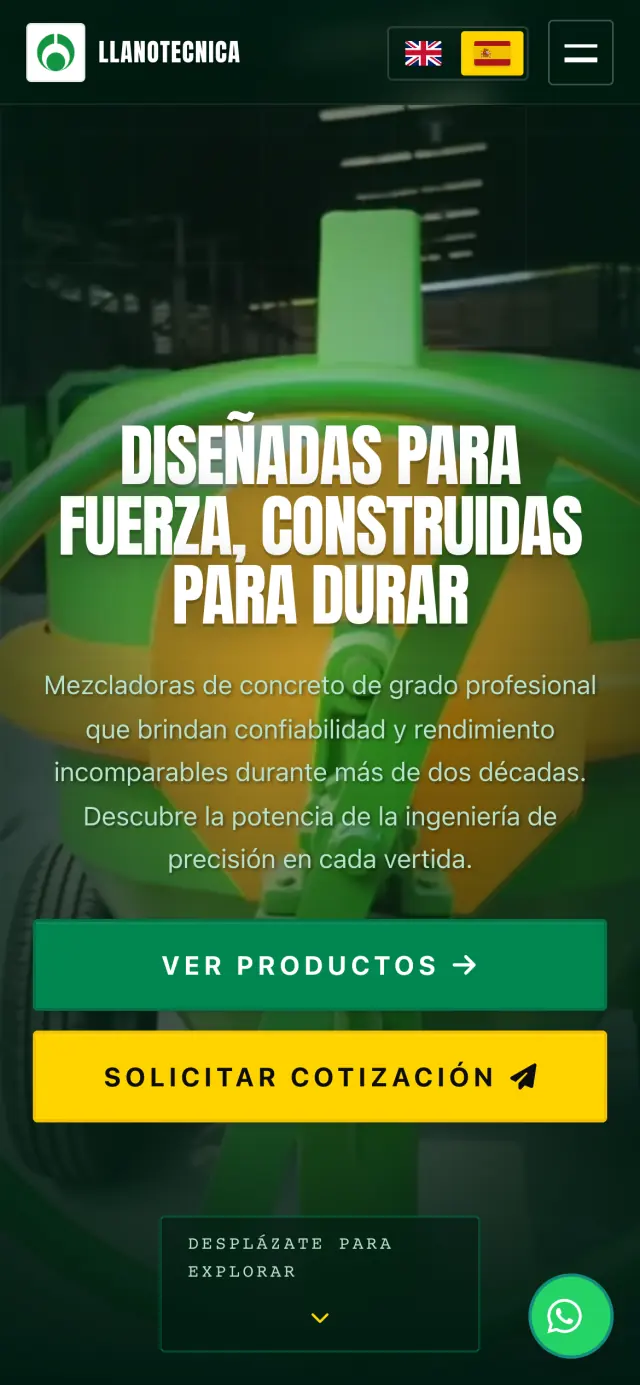
A bilingual build for Llanotecnica, a concrete mixer maker, with English on the laptop and Spanish on the phonea concrete mixer maker, in English and Spanish. See the project
- Price
- Quoted in writing
- Before the mockup, so you know the number first
- Languages
- English and Spanish
- Each page on its own URL
- Ownership
- You own everything
- Site, domain, code, accounts
Rasmussen Results, in Tampa, Florida, builds bilingual websites for contractors and local service businesses whose customers search in Spanish as often as in English. Every service and town page gets a real Spanish version on its own address, written by a person and paired with its English twin, so each language has a fair shot at being found.
Try the switch above. It opens the Spanish page instantly, and that page is a separate address Google can read on its own. That is the whole idea, and the demo below shows it on a sample homepage.
Tampa, Florida · Remote builds in any US state
The demo
What a bilingual homepage feels like to a customer.
Plumbing, your town and nearby
Water heaters, drains and leaks, fixed by a licensed plumber.
Tell us what is going on and get a written estimate before any work starts.
Request a free estimate →- Water heater replacementTank and tankless, removal of the old unit included.
- Drain cleaningKitchen, bathroom and main line clogs.
- Leak repairUnder sinks, behind walls and in the slab.
License number and reviews shown on every page
Showing the English homepage
This is a sample plumber's homepage for a made-up company. Press ES and the words change in place: the menu, the call button, the headline, the services and the estimate button. Nothing reloads.
Watch the address bar too. On a real bilingual site the Spanish homepage has its own address, here /es/, and so does every Spanish service page. That separate address is what lets Google index the Spanish and show it to someone searching in Spanish. The switch is for the visitor; the separate pages are for search. Two of mine are in Spanish already: the diseño de páginas web page and the calculadora de costo de sitio web.
Who it is for
Who needs a website in English and Spanish?
The test is simple. If customers call and switch to Spanish when they hear you can follow, part of your market is searching in Spanish and finding whoever has a Spanish page.
- Contractors in Florida and Texas
- Roofers, remodelers, pool builders and concrete crews in places like Miami, Orlando, Houston and San Antonio, where many homeowners would rather read the details in Spanish.
- Local services with Spanish-speaking customers anywhere
- Plumbers, cleaners, auto shops and landscapers in Charlotte, Atlanta, Phoenix or a farm town in Georgia. If callers already ask questions in Spanish, they search in Spanish too.
- Owners who run the business in Spanish
- Plenty of crews talk shop in Spanish and quote in English. A Spanish version lets you text a customer a link in the language you just explained the job in.
- Not a fit: a site for another country
- This is for businesses serving customers in the United States. A Spanish site aimed at Mexico or Latin America is a different project.
The widget trap
Why a translate button is not a bilingual website.
The cheapest way to "go bilingual" is a plugin that adds a little flag or a dropdown and runs the page through automatic translation. It looks finished. For search, and for a customer deciding whether to trust you with their roof, it mostly is not.
- Google never sees the Spanish
- A translate widget swaps the words in the visitor's browser after the page loads. The page Google crawls is still English, so there is nothing in Spanish to index. Google's guidance on multilingual sites asks for a separate URL per language for this reason.
- Trade words come out wrong
- Machine translation handles "hello" fine and trips on "flashing", "drip edge", "French drain" or "rough-in". A homeowner who sees a word that makes no sense in a roofing estimate stops trusting the rest of the page.
- Buttons and forms stay in English
- Widgets often miss form labels, error messages and image text. The visitor reads half a page in Spanish, then hits a form asking for "Zip code" and "Describe your project".
Both languages
How to rank a website in English and Spanish.
Eight pieces, all in the build.
The same signals that make an English page findable, done again in Spanish and tied together so search engines know the two versions belong to each other.
- One URL per language
The English homepage sits at the root of the domain and the Spanish one at /es/, with every service and town page paired the same way. Each version is rendered on the server, so search engines read the Spanish directly.
- hreflang on every page
Each page lists its twin with hreflang tags: en-US for English, es-US for Spanish, and an x-default for everyone else. Google then treats the pair as one page for two audiences, not as duplicates.
- Translation by a person who knows the trade
The Spanish is written by a person, checked against the words customers use for the work, and reviewed by you during the rounds of changes.
- Spanish service and town pages
A Spanish homepage alone will not rank for a specific job in a specific city. Service and town pages get Spanish versions too, each with its own title.
- Spanish keywords people actually type
Spanish searchers in the US mix languages and drop accent marks. Titles are written from real searches checked in Google Keyword Planner, not translated from the English title.
- Reviews in both languages
Ask customers to review in whatever language they spoke with you. Reviews in both languages tell a Spanish-speaking homeowner someone will understand them.
- The Business Profile and schema
Your Google Business Profile description can say you serve customers in Spanish, and posts can link to the Spanish pages. On the site, structured data marks each page with inLanguage, en-US or es-US.
- One sitemap with both versions
One sitemap lists every English and Spanish URL and goes to Google Search Console and Bing Webmaster Tools on launch day, so you can see which Spanish pages are indexed.
Here is what step five looks like on paper. Each row is a Spanish search, the Spanish page that answers it, and what goes on that page. Your list comes from your own services and towns.
- plomero en orlando/es/plomero-orlando
The Orlando service area page in Spanish, with the neighborhoods you work in and reviews from Orlando customers.
- cambio de calentador de agua/es/calentador-de-agua
Tank and tankless replacement explained the way a homeowner asks, with photos of your installs.
- reparación de techos cerca de mí/es/reparacion-de-techos
Leak repair, shingles and storm damage, with the insurance questions answered plainly.
- estimado gratis/es/estimado
A short Spanish form whose labels, error messages and thank-you note are all in Spanish.
Translation
How to translate a website to Spanish the right way.
If you already have an English site and want Spanish website translation, the order of work matters more than the tool. These five rules hold whether you hire someone or do it with a bilingual family member over a few weekends.
- Start from the pages that bring calls
- Skip the old blog posts. Start with the homepage, each service you sell, the towns you drive to, and the contact page.
- Write it, do not run it through a tool
- A translation tool is fine for your own first draft. The published page is written by a person, in the plain Spanish people use in the US, addressing the reader as usted.
- Keep the trade terms consistent
- Pick one word for each service and use it everywhere: menu, title, form and Business Profile.
- Translate the parts people forget
- Alt text, page titles, meta descriptions, button labels, form errors and the confirmation email.
- Give each translated page its own address
- This makes the work count in search: its own URL, hreflang to the English twin, and a line in the sitemap.
I do not sell translation on its own. When you hire me for a bilingual build, the Spanish pages are part of the site, built and paired from the start, so there is no second project to coordinate.
Spanish SEO
Spanish SEO basics for a local business.
Spanish SEO is not a separate science. Google ranks a Spanish page for a Spanish search on the same things it uses in English: whether the page answers the search, whether it loads quickly on a phone, whether the business looks real and local, and whether other sites and reviews back that up.
What changes is the research. Spanish searches for local work are smaller and messier than English ones, so each title targets one real Spanish phrase well instead of six badly.
It also helps to look at who you are up against. Search your main service in Spanish with your town name and count the local businesses that come back with a real Spanish page. In many towns that list is short, which is an opening for a business that does it properly. That is not a promise of a position; nobody can honestly make one.
If you want ongoing Spanish SEO services after launch, they are part of the SEO service: a flat monthly fee, quoted in writing, month to month, with the accounts in your name. You can also skip it and simply own the site.
Proof
A live bilingual site: Llanotecnica.
Llanotecnica builds professional concrete mixers and sells across English and Spanish-speaking markets in Latin America. They needed a site that works natively in both languages rather than an English site with a translation added later.
Each language has its own URL paths, so the Spanish product page lives at /es/productos and the English one at /en/products. Every string was written in each language, with no Google Translate. Hreflang tags and a sitemap for each language let each version stand on its own in search, and the site is server-rendered so the text can be read without JavaScript.
It is a manufacturer, not a local contractor, but the setup underneath is what a bilingual plumber or roofer needs. Screenshots of both languages are on the portfolio page, and the site is live at llanotecnica.com.
The price
What does a bilingual website cost?
The standard build is $2,000 one time with no required monthly fee. A bilingual site is quoted in writing before the mockup, because the price depends on how many pages need a Spanish version, so you know the number before any design work starts.
The short version
Last updated:
- Price
- $2,000one time
- Monthly fee
- None required by me. Hosting usually costs $0 within Google's free allowance; a busy site might pay Google a few dollars a month. Maintenance is optional.
- Timeline
- 2 to 3 weeks from kickoff to a live site
- First step
- A free homepage mockup, so you see the design before you decide anything
See what you own and everything included
- You own
- The domainat your own registrar, renewing to you
- The codea GitHub repository in your name
- The hostinga Firebase project in your Google account, usually $0, with any charge billed by Google to you
- Google Analytics and Search Consoleproperties under your Google account
- Your Google Business Profileyou are the owner, and I am a manager you can remove
- Every form submissiondelivered to the inbox you choose
All of it in your name from day one. I am added as a collaborator for the build and removed by you at handover, and I never hold the only copy of any login.
- What's included
- English and Spanish versions of each page, each on its own URL
- hreflang tags pairing every English page with its Spanish twin
- Spanish written by a person, reviewed by you before launch
- Spanish form labels, buttons and confirmation messages
- One sitemap with both languages, sent to Search Console on launch day
- A language switch in the header of every page
- Search Console and Google Analytics set up in your name
- Set up on Bing too: Webmaster Tools, which reports how your pages show up in Microsoft Copilot, and Bing Places
Q&A
Questions about bilingual websites and Spanish SEO.
Is a translate widget good enough for a bilingual website?
Not for search. A widget translates the page in the visitor's browser, so the version Google crawls is still English and the Spanish never gets indexed. Widgets also mangle trade terms and often skip forms and buttons. A bilingual site gives each language its own server-rendered page, linked with hreflang.
How do I translate my website to Spanish?
Start with the homepage, your service pages, your town pages and the contact page. Have a person write the Spanish using the words your customers use, keep the trade terms consistent, translate titles, alt text and form messages, and put each Spanish page on its own URL linked to the English one with hreflang. Here the Spanish pages are part of the bilingual build, not a separate translation service.
How much does a bilingual website cost?
The standard build here is $2,000 one time with no required monthly fee. A bilingual site is quoted in writing before the mockup, because the number depends on how many pages need a Spanish version. You see the price before any design work starts.
Will a Spanish version hurt my English rankings?
Not when it is set up correctly. With hreflang, Google understands that the English and Spanish pages are the same content for two audiences, so it does not treat them as duplicates. Each one competes in its own language.
What is Spanish SEO?
Spanish SEO is the work of getting Spanish pages found by people searching in Spanish: Spanish URLs and titles written from real searches, hreflang, Spanish service and town pages, reviews in Spanish, and a Business Profile that tells people you serve customers in Spanish. It follows the same rules as English SEO, with its own keyword research.
Can you guarantee my site will rank in Spanish?
No. Nobody honest can promise a position in Google. What the build guarantees is that the Spanish pages exist, are readable by search engines, are paired correctly with the English ones, and are submitted to Search Console, which are the conditions for ranking at all.
Taking Bilingual Projects
See your homepage in both languages first.
Tell me your business name and town, and in the note, roughly how many of your customers speak Spanish. I will send a written quote for the bilingual build and then a free homepage mockup. Or call (813) 531-8442 or email chris@rasmussenresults.com.