HVAC Website Design

Free. No call. Usually ready in 48 hours.
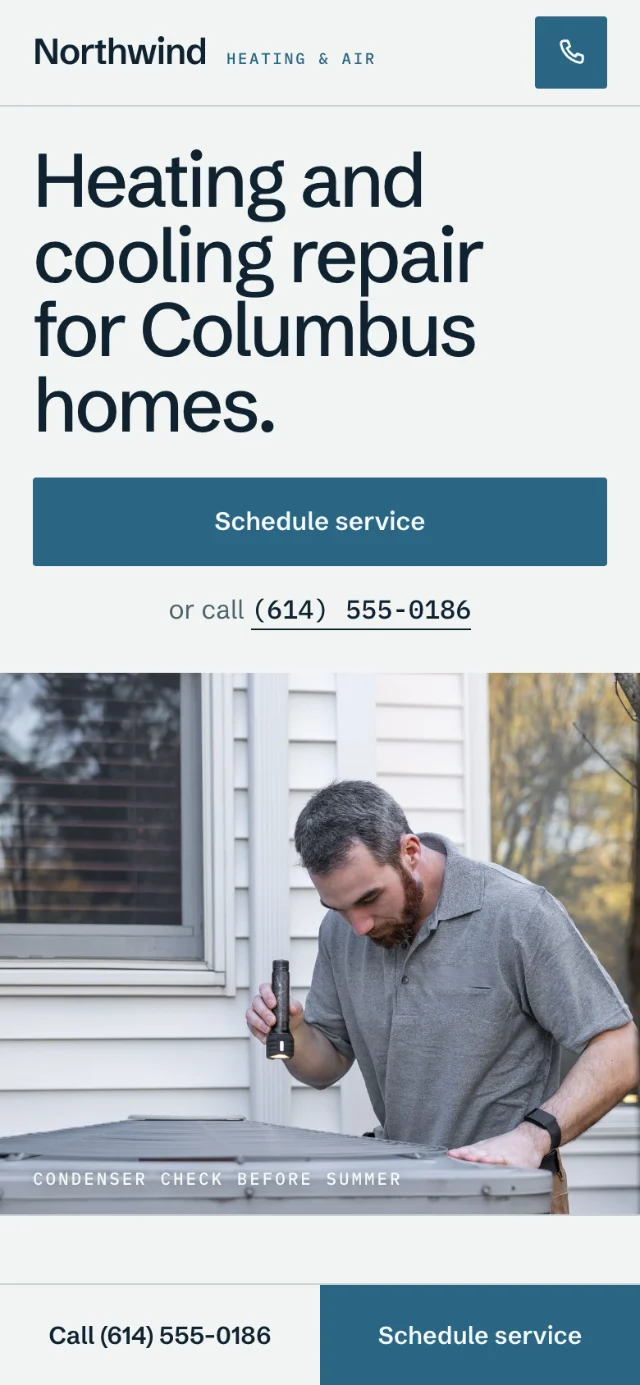
The phone number and the main button sit at the top of every page.
Example concept: Northwind Heating & Air is a made-up heating and air company, and the requests and numbers shown are made up too. Your site is built from your own photos, services and reviews, so it comes out stronger. See real builds
- Three Visitors
- Breakdown, replacement, membership
- Each gets its own path from the homepage
- The Deadline
- Live before the first heat wave
- Or before the first cold snap
- The Field
- 30.8% of local trade listings
- have no website, across 17 trades we checked
Rasmussen Results, in Tampa, Florida, designs and builds websites for heating and cooling contractors across the United States. With every account in your name and a site you can edit from your phone, you get a page for each repair and install you sell, a maintenance agreement sign-up page and a page for every town you serve.
Tampa, Florida · Remote builds in any US state
The first screen
What should someone see when their AC quits in July?
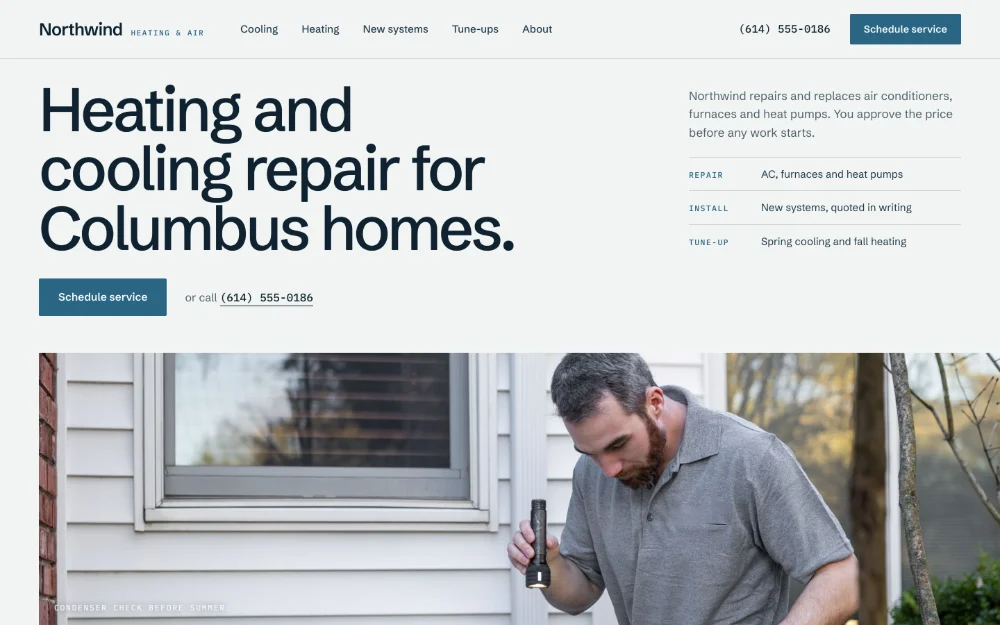
Roundups of the best HVAC websites praise clean layouts. The first screen has a narrower job: turn a stressed homeowner into a booked call. The example concept above shows one way to lay it out, and a finished build follows these four rules; the concept gallery has the other trades. Ten real companies that do this first screen well are on best HVAC websites.
- Tap to call, in the header, on every page
- The person reading is hot, cold or worried about a parent. One thumb, one tap, and your dispatcher picks up. A number buried in the footer loses that call to the next result.
- A line that says whether you can come today
- Same-day service, after-hours calls, the towns you cover. Plain words, near the top, kept current. If you charge a diagnostic or trip fee, say so here and avoid the argument at the door.
- Two buttons: fix it, or replace it
- Repair calls go to a short service request form. People shopping for a new system go to the replacement page, where the questions about tonnage, SEER2 and financing get answered before the estimate.
- Your own trucks and your own installs
- A clean condenser pad, a tidy air handler closet, a mini-split head on a bedroom wall. Real photos beat a stock thermometer every time, and they tell a buyer the crew finishes neatly.
Built to those four rules, the standard build also gives every repair and install you sell, the maintenance agreement sign-up and each town its own page, for $2,000. If you need more, the written quote comes before the mockup, so the cost is clear before any work.
Three visitors
A broken unit, a 15-year-old system and a tune-up reminder bring three different people to your site.
The breakdown
It is 94 degrees and the house is warm, or it is January and the furnace is blowing cold air. She types "ac repair near me" or "furnace not working" and calls the first company that looks like it can come today. She will not read three paragraphs. She needs your number, your hours and a sign you cover her street.
The replacement
His system is 15 years old and the last repair quote made him think. A new system can run $8,000 to $20,000, so he collects two or three quotes and reads at night. He wants to know how you size the equipment, which brands and SEER2 ratings you install, whether you offer financing and what rebates might apply.
The member and the manager
The third visitor wants two tune-ups a year and priority scheduling, or runs a building with rooftop units and needs a contractor on call. Maintenance agreements are the steady revenue that carries a shop through spring and fall, and commercial accounts fill the schedule. Both need a page of their own.
Most heating and cooling website design hands all three the same "Contact us" button. Here each one gets a door from the homepage: request service, get a replacement estimate, join the maintenance agreement.
The field
How many HVAC companies run without a website? We checked 2,147 listings.
Between September 8, 2026 and October 10, 2026, we checked 2,147 public Google Maps listings for heating and cooling companies in 30 towns across 30 states, and noted whether each one linked to a website. No business is named.
23.1% link to no website at all, 0.9% link to a Facebook page instead, and 0.6% point to a builder subdomain or a link page. Across all 17 trades, the no-website share is 30.8%. Among businesses with 1 to 9 reviews it is 44.4%; among those with 100 or more, 4.4%.
The tables by trade and by state are in the full 17-trade study.
The pages
The pages an HVAC company website should have, one per search.
Fourteen rows, fourteen pages. The left column is the search, the middle is the page we build for it, the right is its content. A homeowner typing "heat pump installation" should land on a heat pump page, not on one line of a long services list.
- "ac repair near me", "ac not cooling"AC repair
Common no-cool causes (frozen coil, failed capacitor, low refrigerant, a tripped float switch), what a tech checks first, and the button to book a visit.
- "ac replacement", "new ac unit cost"AC installation and replacement
How you size a system with a load calculation (Manual J) instead of copying the old tonnage, the SEER2 ratings you install, brands, and what the install day looks like.
- "furnace not working", "heater repair [town]"Heating and furnace repair
No heat, short cycling, a pilot or igniter fault, a smell of gas (with the step to leave the house and call the gas company first), and your winter hours.
- "furnace replacement", "gas furnace installation"Furnace installation
Gas, electric and dual-fuel setups, efficiency ratings, venting, and why an old furnace often gets replaced together with the AC.
- "heat pump installation", "heat pump repair"Heat pumps
How a heat pump heats and cools with one outdoor unit, cold-climate models where they fit, and the backup heat question for your region.
- "ductless mini split installation"Ductless mini-splits
Additions, garages, bonus rooms and older homes without ducts, single and multi-zone systems, and photos of indoor heads you mounted.
- "duct cleaning", "ductwork replacement"Ductwork and duct cleaning
Leaky or undersized ducts, rooms that never get comfortable, sealing and replacement, and what cleaning does and does not fix.
- "indoor air quality", "whole house dehumidifier"Indoor air quality
Filtration upgrades, humidifiers and dehumidifiers, UV lights, and fresh-air ventilation, sold as add-ons with honest expectations.
- "smart thermostat installation"Thermostats
Smart and programmable models you install, wiring checks, and zoning for two-story homes with one hot floor.
- "hvac maintenance plan", "ac tune up"Maintenance agreement
Two visits a year (cooling tune-up in spring, heating in fall), what each visit covers, member perks you actually offer, and a sign-up form.
- "24 hour hvac", "emergency ac repair"Emergency service
Your after-hours policy, the fee if there is one, what to do while the tech drives over, and the number in large type.
- "commercial hvac [town]", "rooftop unit repair"Commercial HVAC
Rooftop units, preventive maintenance contracts for property managers and restaurants, response times, and a certificate of insurance on request.
- "hvac financing", "hvac rebates [state]"Financing, rebates and credits
The financing partner and terms you offer, the utility programs and federal credits that may apply, and a note that you confirm current amounts at quote time.
- "hvac company [town]"A page per town
The neighborhoods you work in, the housing stock (slab homes, older homes with attic ducts), and jobs you finished there.
Every page carries tap-to-call in the header and the same short service request form, with a text button for sending a photo of the unit's data plate or the thermostat error. Getting these pages ranked after launch is the work of SEO for HVAC companies, and paid calls in the peak weeks are covered on the Google Ads for HVAC page.
The money questions
Price ranges, financing, rebates and agreements: what goes on the site and how to say it.
- Replacement prices
- Publish a range or explain how you price, but do not leave the buyer guessing. Name what moves the number: tonnage from the load calculation, efficiency, a new air handler or coil, duct changes, access to the attic or the roof. A buyer who understands the range before the visit is easier to close at the kitchen table.
- Financing
- Name the lender you work with and link to its terms. "Financing available" with no detail reads like a trap; a monthly example from the lender's own calculator, with its fine print, reads like a plan.
- Rebates and credits
- Utility rebates and federal tax credits change, sometimes mid-year. The page lists the programs that may apply in your area and says you confirm current amounts and eligibility when you write the quote. No dollar figures that go stale.
- Maintenance agreements
- A page that lists both yearly visits, the checklist for each (coil cleaning, refrigerant pressures, burner and heat exchanger inspection, filter, drain line), member perks you actually honor, the price and a sign-up form. Link it from every repair page, because the best time to sell a membership is right after a repair.
- Certifications and licenses
- Your state contractor license number, EPA refrigerant certification and NATE-certified techs if you have them, written in text near the top and in the footer, with a plain insurance line. Only what is true, and only what you can show on request.
The instant quote tool
Can an HVAC website price a new system for a homeowner on the spot?
Yes. I build an instant quote tool that sits on your own website. A homeowner types an address, the tool looks up that home in public property records, and it shows installed prices, worked out from your own price guide for that home, before anyone picks up the phone. It is an add-on to the $2,000 site, quoted in writing before the mockup.
Typing an address, confirming the home, picking the equipment and seeing three prices.
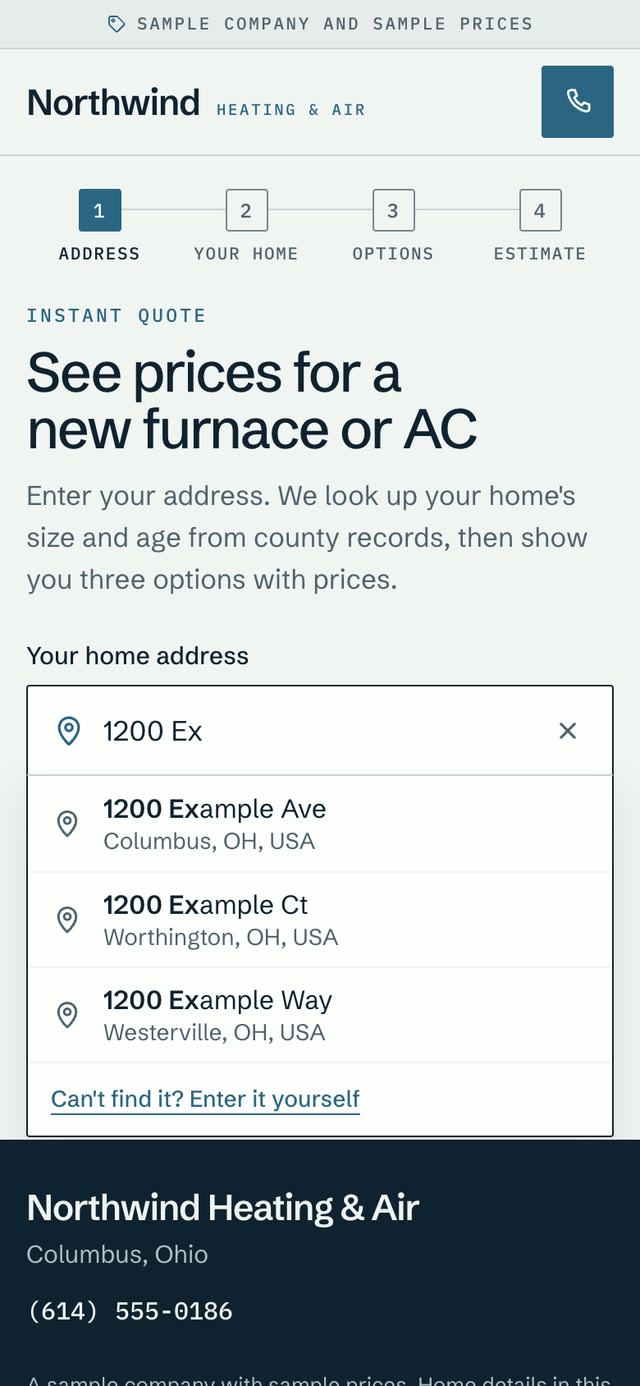
Address suggestions as they type
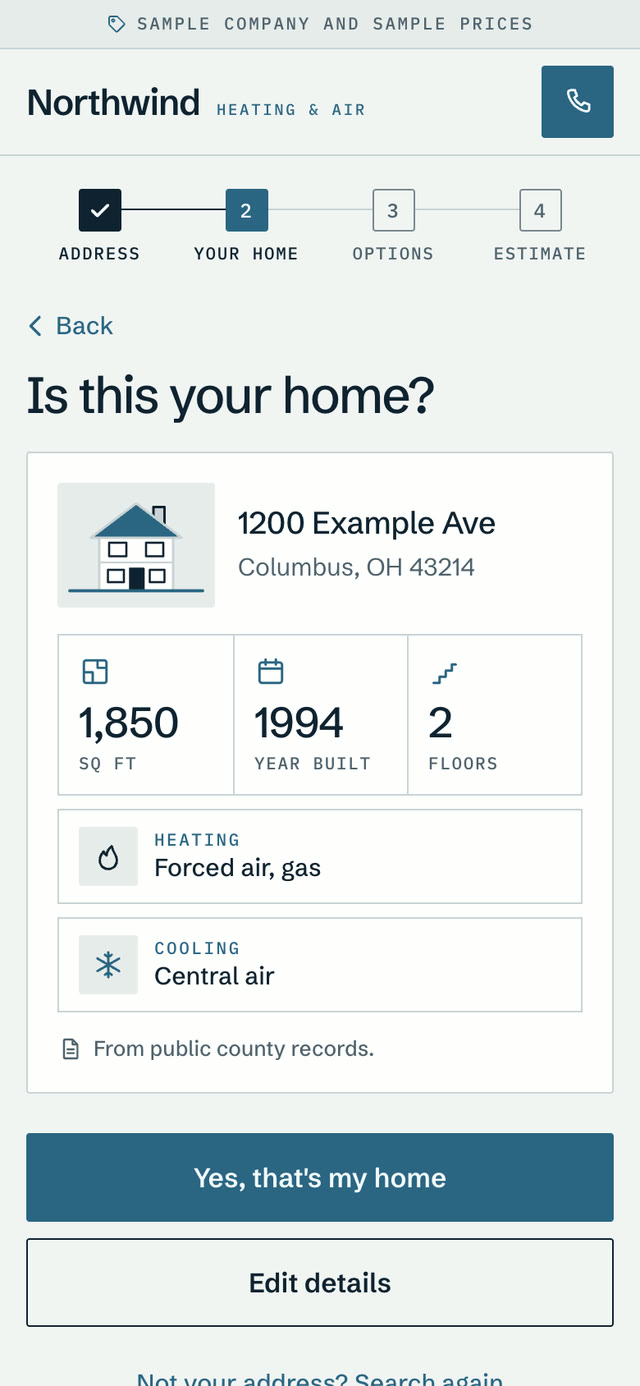
The home, filled in from records
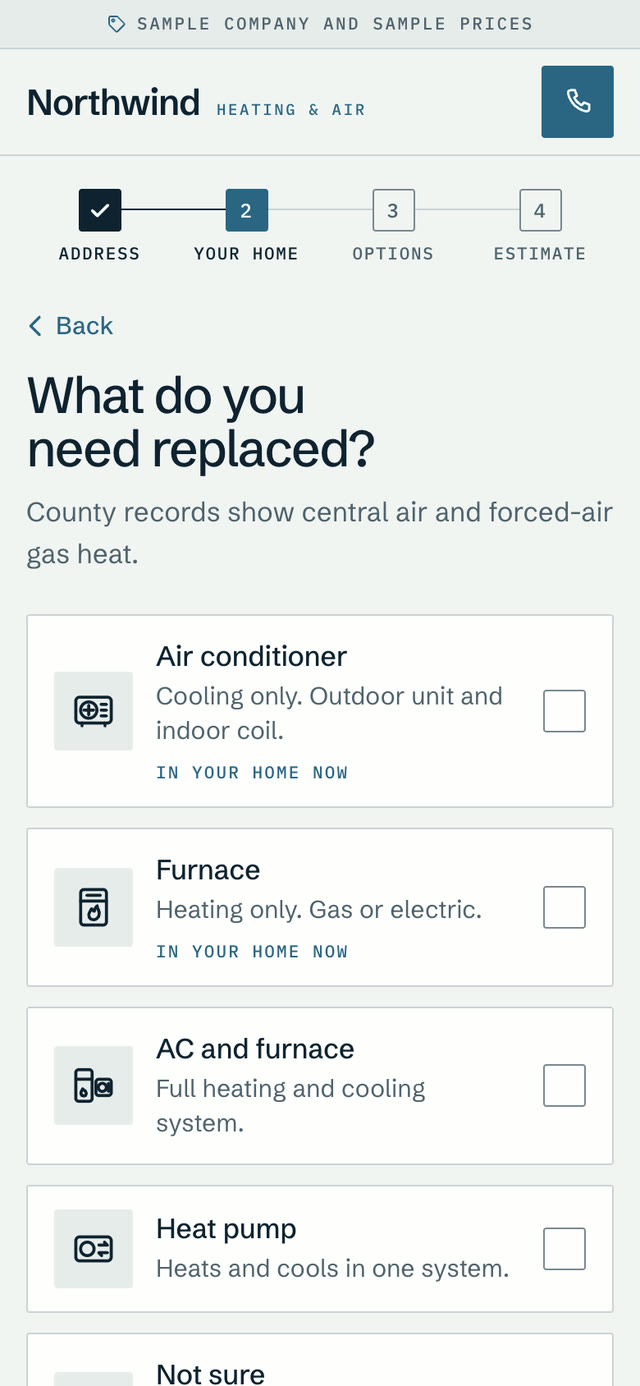
What needs replacing
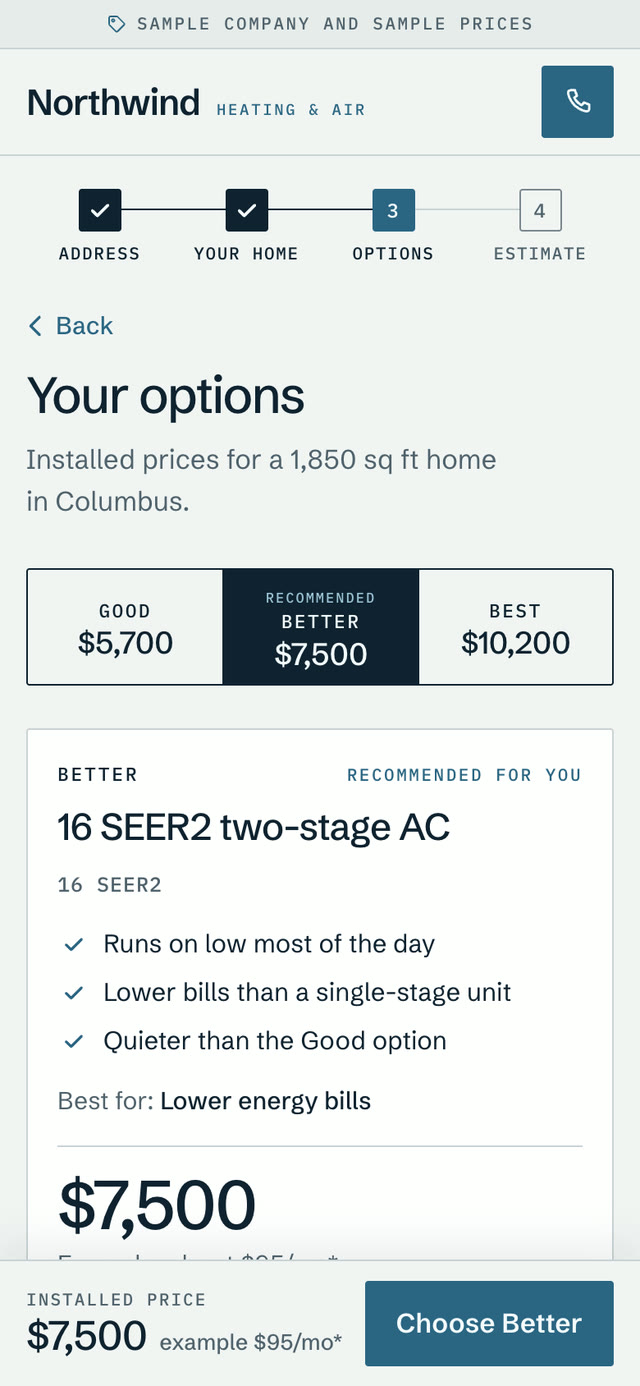
Good, better and best
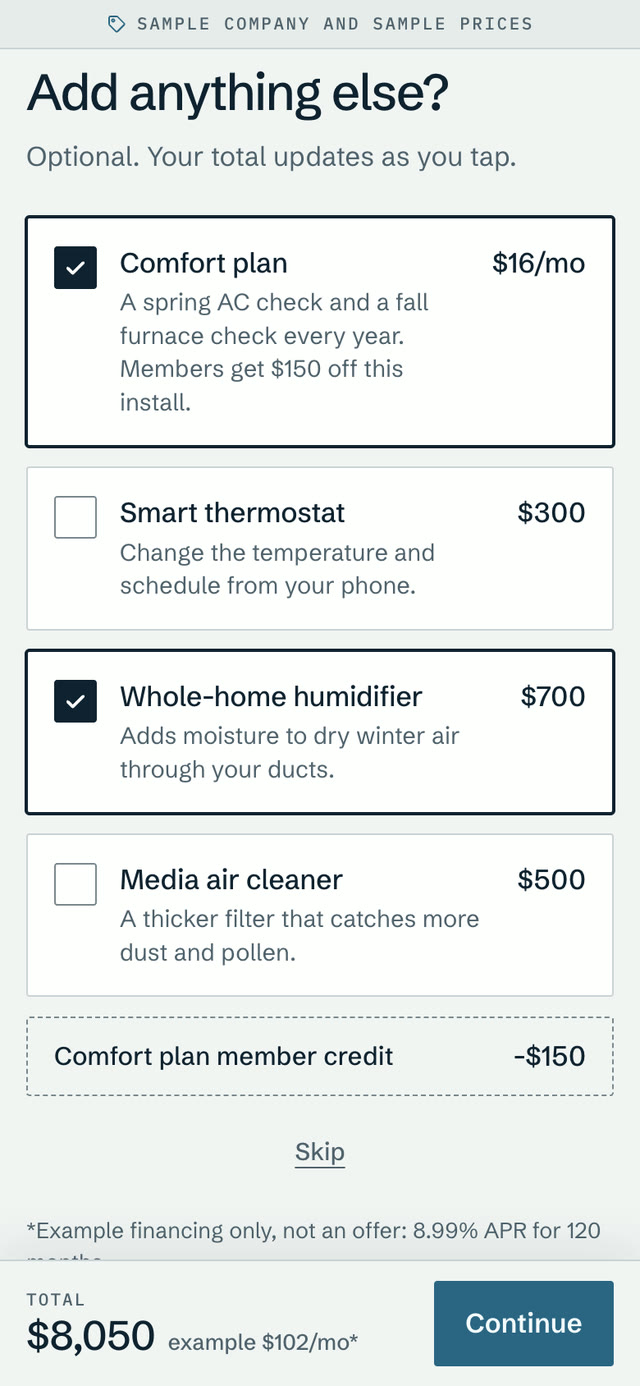
Add-ons and a running total
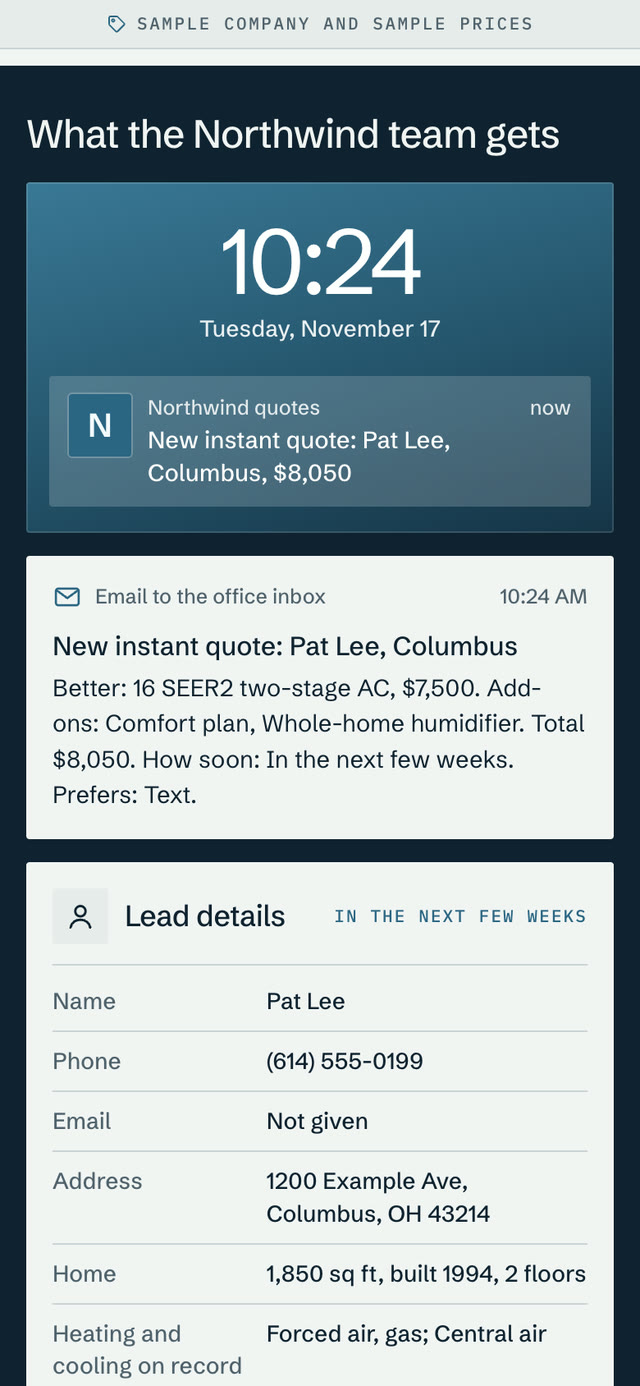
What the office receives


- They type an address
Suggestions appear as they type. Picking one starts the lookup right away, with no extra button to press.
- The tool finds the home
Public property records supply the living area, the year the house was built, the number of floors and the heating and cooling on file. The homeowner confirms it or corrects it. With no record, they enter the size and age by hand.
- They pick what needs replacing
Air conditioner, furnace, heat pump or the whole system. Equipment the records show in the house is tagged "In your home now", so the choice takes one tap.
- Good, better and best, at your prices
Three options, each with its efficiency rating, what it is best for and an installed price for that home. A table compares all three, and a monthly example shows when you offer financing through a lender.
- Add-ons and a running total
A thermostat, an air cleaner, your maintenance plan: whatever you sell. The total updates with each tap, and any answer can be changed without starting over.
- The request reaches your team
Name, mobile number, how soon they need it and whether to call or text, together with the address, the home facts and the option they chose. The homeowner can save or print the estimate.
- Your numbers
- Every price comes from a price guide you give me, by equipment and by tier. Nothing is taken from a national average. Prices can show before the homeowner leaves a phone number or after it; that is a setting, and you choose.
- The home lookup
- The lookup reads only facts about the house: size, year built, floors, heating and cooling. It never shows or stores an owner's name. The records service bills you directly, and the one I use lists 50 free lookups a month and 20 cents for each one after that (checked November 11, 2026). A repeat lookup of the same address is answered from a saved copy, and a monthly cap keeps the bill from running.
- An estimate, not a bid
- The tool gives an estimate and says so. Your tech still confirms the size and the details at the house before anyone signs.
- Made for a phone
- One question to a screen, large buttons, and the price in view the whole way. A homeowner who stops halfway can pick the estimate back up on the same phone within a week.
- What it adds to the price
- The tool is not part of the standard $2,000 build. I quote it in writing before the mockup, along with sending each request into the software you already use, if you want that.
The price
How much does an HVAC website cost here?
One payment of $2,000 covers every repair, replacement, maintenance agreement and town page on this list, with no required monthly fee from me. Hosting usually costs $0 within Google's free allowance. If you want SEO once it launches, that is a separate written quote for your service area, month to month, and you track results in your own Search Console.
| Who builds it | Price |
|---|---|
| An independent designer | $3,800 to $13,000 |
| A U.S. web design company | $7,500 to $19,400 |
| Thryv's Signature plan | $399 a month, $14,364 over three years |
The U.S. company rate is from Clutch's web design pricing guide (opens in a new tab) (updated September 21, 2026) and the Thryv price from Thryv's pricing page (opens in a new tab), both checked November 2, 2026. The hours are my estimate, and so is the independent designer rate. See the math in the website cost calculator.
The short version
Last updated:
- Price
- $2,000one time
- Monthly fee
- None required by me. Hosting usually costs $0 within Google's free allowance; a busy site might pay Google a few dollars a month. Maintenance is optional.
- Timeline
- 2 to 3 weeks from kickoff to a live site
- First step
- A free homepage mockup, so you see the design before you decide anything
See what you own and everything included
- You own
- The domainat your own registrar, renewing to you
- The codea GitHub repository in your name
- The hostinga Firebase project in your Google account, usually $0, with any charge billed by Google to you
- Google Analytics and Search Consoleproperties under your Google account
- Your Google Business Profileyou are the owner, and I am a manager you can remove
- Every form submissiondelivered to the inbox you choose
All of it in your name from day one. I am added as a collaborator for the build and removed by you at handover, and I never hold the only copy of any login.
- What's included
- Pages for AC repair and replacement, heating, heat pumps, mini-splits, ductwork and air quality
- A maintenance agreement page with a sign-up form
- A financing, rebates and credits page
- A page for every town you serve
- A service request form and click-to-call on every page
- Google Business Profile, GA4 and Search Console set up
- Set up on Bing too: Webmaster Tools, which reports how your pages show up in Microsoft Copilot, and Bing Places
The build
How it goes: a mockup you can judge, the pages, then the keys.
Start in the slow season.
Book the mockup in spring or fall, between the rushes, and the site is indexed before the phones light up.
- The free mockup
Tell me your business name and town. You get back a homepage made for your shop, repair, replacement and membership doors included, as a link to open on your phone. There is nothing to sign.
- The pages
Approve the direction and we choose which rows of the page list your shop needs. I write each one, wire up the service request form and the agreement sign-up, and finish your Google Business Profile. Nothing publishes until you have read it.
- The keys
Launch day, analytics and Search Console are already collecting, and the domain, hosting and logins are registered to you. Run your homepage through PageSpeed Insights whenever you like, and open Search Console to see which HVAC searches you show up for.
Live sites we built are on the portfolio. To total up your own page list, use the website cost calculator; the pricing page has the full terms. Renting a site from a builder or a marketing company every month? This is how switching works.
Q&A
What HVAC contractors want to know about their website.
Every trade and service we cover is on the industries page, and the numbers behind no-website listings are in the full 17-trade study. Working on your map pin before the site? Start with the Google Business Profile checklist. Contractor website cost compares six ways to pay for a site like this, added up over three years.
What should an HVAC website include?
A page for each service (AC repair, AC replacement, furnace repair and installation, heat pumps, mini-splits, ductwork, air quality), a maintenance agreement page, a financing and rebates page, emergency service hours and a page for each town you cover. Add tap-to-call on every page, a service request form and photos of your own installs. The rest is optional.
How do I get more same-day repair calls from my website in peak season?
Make the first phone screen answer one question: can you come today? Put the number in the header, a line about same-day and after-hours service near the top, and a short request form that asks for the address and the problem. Then give AC repair and furnace repair their own pages so Google can show them for "ac repair near me" and "furnace not working".
Should I publish system replacement price ranges on my website?
Some contractors do, and buyers read them closely. A range with a clear note on what moves the price (tonnage, efficiency, ductwork, access) filters out people who are not ready and makes the estimate visit easier. If you would rather not publish numbers, explain how you price a replacement and that the in-home estimate is free, if it is.
Can my HVAC website show instant prices for a new system?
Yes. I build an instant quote tool as an add-on to the website. The homeowner types an address, the tool looks up the size and age of the house in public property records, and it shows good, better and best installed prices worked out from your own price guide. Your team receives the request with the home facts and the option picked. The tool is quoted in writing before the mockup.
How do I sell maintenance agreements on my website?
Give the agreement its own page that says what the two yearly visits include, what members get, and what it costs, with a sign-up form at the bottom. Link it from every repair page and from the thank-you message after a service request. A repair customer who just paid for a capacitor is the easiest member you will sign.
How much does an HVAC website cost?
A flat $2,000 one time covers the service pages, the maintenance agreement page, the financing and rebates page, town pages, the request form and Google Business Profile setup. The domain, the code and all the logins are registered to your company. There is no required monthly fee from me, and hosting usually costs $0 within Google's free allowance.
Can my website show financing and rebates without making promises?
Yes. Name the financing partner you work with and link to its terms, and describe the rebate and credit programs that may apply. Utility rebates and federal credits change, so the page should say that you confirm current amounts and eligibility when you write the quote. That keeps the page accurate and still answers the question.
Accepting HVAC Contractors
Send me your business name and town.
Your heating and cooling company gets a free homepage design, with a door for repair calls, one for replacement estimates and one for maintenance members. Look it over on your phone at the job site. Rather talk it through first? The number and email are right here.
Or call (813) 531-8442 or email chris@rasmussenresults.com.