Med Spa Website Design


Free. No call. Usually ready in 48 hours.
The phone number and the main button sit at the top of every page.
Example concept: Aster Skin & Laser is a made-up med spa, and the requests and numbers shown are made up too. Your site is built from your own photos, services and reviews, so it comes out stronger. See real builds
- The Visitor
- On a phone, often from Instagram
- Comparing three spas at once
- The Job
- Book in two taps
- From any treatment page
- Home Market
- Tampa Bay
- Remote builds in any state
Rasmussen Results, a web design studio in Tampa, Florida, builds med spa websites for practices across the United States. Each site is owned by you, down to the domain and the code, and every treatment page carries a book button tied to the booking software you already use.
Tampa, Florida · Remote builds in any US state
The concept
What does good med spa web design look like on a phone?
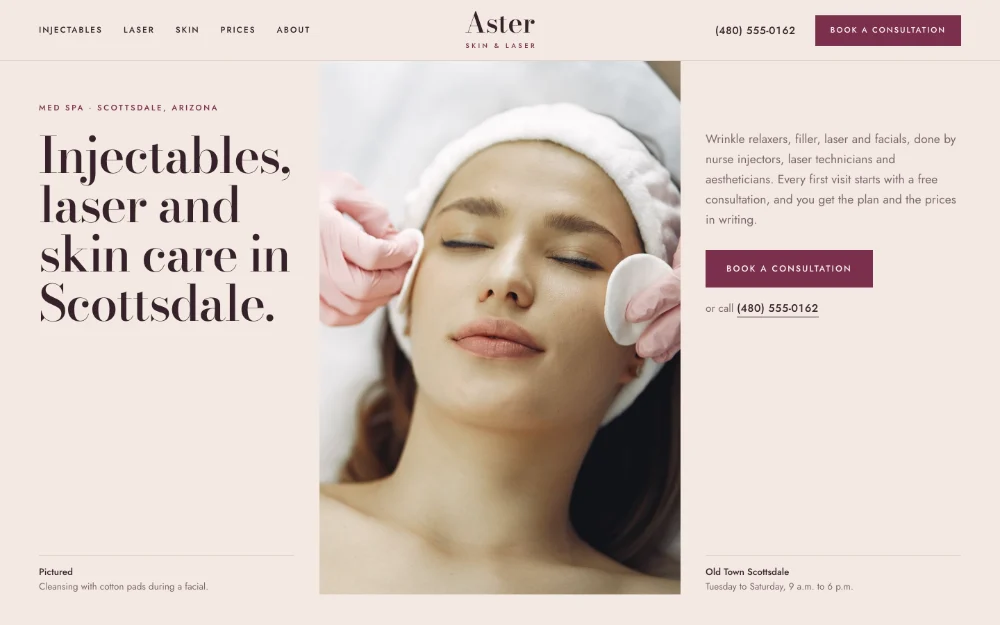
A med spa sells something the client cannot try first, so the website has to carry the trust a consult room carries. The example concept above is a starting layout; a finished build follows the five rules below, and the concept gallery shows it next to the other trades.
- 01
A book button that never scrolls away
It sits in the header on every page and opens your booking software on the right treatment, not on a generic home screen where the client has to start over.
- 02
Treatments named the way clients search
Botox, lip filler, laser hair removal, microneedling. The menu uses the words on the client's phone, not the clever names on the price board in the lobby.
- 03
A price or a range next to each one
Per unit, per syringe, per session or per series, with a line on what the consult can change. A client comparing three spas skips the one that says "call for pricing".
- 04
Your rooms and your people in the photos
Real treatment rooms, the front desk and the injector, shot in good light. Stock photos of a stranger with cucumber slices tell a client nothing about your spa.
- 05
The gallery lives on your site
Before-and-after sets sorted by treatment, each with a short caption. An Instagram embed loads slowly, breaks when the feed changes and sends the visitor back to the app.
Treatment pages with a book button on each, provider pages, the gallery and the membership page are all part of the standard build, at $2,000. When a spa needs more, I send the larger price in writing ahead of its mockup, so you see it before work begins.
The client
She saw a reel at 10 p.m. Here is what she checks before she books.
The price
She searched "lip filler" and her town, or tapped the link in your bio after a reel. She has three spas open in tabs and the first thing she looks for is a number: per unit, per syringe, per session. A spa that hides every price behind "book a consult" asks her to spend an hour before she knows if it fits her budget.
The hands
Next she wants to know who holds the needle. A name, a face, the license (RN, NP, PA), how long they have been injecting, and who the medical director is. This is a medical decision dressed as a beauty one, and a provider page with credentials does more selling than any headline.
The proof and the slot
Then the results on faces like hers, a few reviews, and the first open slot. If the book button drops her on a booking screen for the wrong service, or on a form that promises a call back, she goes back to the tab that let her pick Thursday at 6:30.
Most med spa websites are built to look calm and expensive, and they do. Where they lose the client is the middle of this path: no prices, no provider names, a gallery that is really an Instagram feed. Across the 17 local trades in our listing study, 30.8% of businesses have no website at all, so even a plain page per treatment puts a spa ahead of a lot of its field.
The pages
Which pages does a medical spa website need?
One row, one page. On the left is what a client types into Google, then the page built for it and what that page holds. You keep only the rows that match the menu you actually sell.
- "botox near me", "botox [town]"Neurotoxins
Botox, Dysport or whichever brands you carry, the areas treated, the price per unit or per area, how long results last, and a book button for a neurotoxin appointment.
- "lip filler [town]", "cheek filler"Dermal fillers
Lips, cheeks, jawline and under-eyes, price per syringe, typical swelling and downtime, and before-and-after sets for each area.
- "laser hair removal [town]"Laser hair removal
Areas and session prices, why it takes a series, which skin types your device treats, and a package price if you sell one.
- "microneedling near me", "chemical peel"Skin treatments
Microneedling, peels, resurfacing and facials, each with downtime in days, how many sessions a result takes, and who on your team performs it.
- "body contouring [town]"Body treatments
The devices you own by name, what a session feels like, how many sessions a result usually takes, and a consult button rather than a straight booking.
- "med spa membership"Memberships
Each tier with its monthly price, what it includes and the member discount, plus the cancellation terms, so the page sells the plan without the front desk.
- "[injector name]", "nurse injector [town]"Providers
One block per injector and aesthetician: license, training, years injecting and a photo, plus a line naming your medical director.
- "med spa before and after"Before and after gallery
Sets sorted by treatment and area, shot in the same light and angle, each posted with the client's written consent.
- "med spa specials", "first visit"New-client offer
One clear first-visit offer with its terms and an end date, and its own book button, so a click from an ad or a post lands on a page that matches it.
- "med spa [town]"A page per location
Address, parking, hours, the providers at that location and a map, one page for each site if you run more than one.
Every page has the book button in the header and click-to-call for the client who would rather ask a question first. How those treatment pages climb in Google once they exist is the subject of SEO for med spas.
The booking
Your booking software keeps the calendar. The website fills it.
Wired to the software you run
Boulevard, Vagaro, Mangomint, Zenoti and most of their rivals give you booking links, and many give you a widget. Each treatment page points to that exact service, so a client on the filler page lands on filler times. Your deposits, intake forms and client records stay where they are now.
Memberships and financing
A membership is recurring revenue, and it sells best on its own page: each tier, the monthly price, what it covers and the member rate on treatments. If you offer patient financing such as Cherry or CareCredit, the bigger-ticket pages link to it right under the price, where the question comes up.
Builder site or AI template?
The site that came with your booking software, or one an AI tool writes from a med spa website prompt, gives you a pretty homepage in an hour. It will not know your units, your providers, your devices or your consent rules, and it ships the same layout to every spa that typed the same prompt. That sameness is what a client scrolls past.
The trust
Before-and-after photos, providers and the medical director, shown with care.
A gallery you control
Before-and-after sets sit on your site, sorted by treatment and area, each one posted with the client's written consent on file. Same light, same angle, no filters, and a short caption with the treatment and the number of sessions. A line under the gallery says your medical director reviews what is posted.
Provider pages
One block per injector and aesthetician with a photo, the license, training and the treatments each one performs. The medical director is named with their credentials. Clients often book a person, not a spa, so each provider block gets its own book button where your software allows it.
Photos of your rooms
The site should feel as considered as the treatment rooms, and the fastest way there is a half-day shoot of the real space and the real team. Shoot the entrance, each room, the injector at work and the products on the shelf. Stock images fill gaps only until yours arrive.
The price
How much does a med spa website cost here?
The website is $2,000, paid once, with the treatment pages, provider pages, gallery, membership page and booking buttons above built in. There is no required monthly fee from me. Hosting usually costs $0 within Google's free allowance, and your booking software keeps its own subscription, as it does now. SEO after launch is optional and separate: quoted in writing, month to month.
| Who builds it | Price |
|---|---|
| An independent designer | $2,500 to $8,500 |
| A U.S. web design company | $5,000 to $12,700 |
| Thryv's Signature plan | $399 a month, $14,364 over three years |
The U.S. company rate is from Clutch's web design pricing guide (opens in a new tab) (updated September 21, 2026) and the Thryv price from Thryv's pricing page (opens in a new tab), both checked November 2, 2026. The hours are my estimate, and so is the independent designer rate. See the math in the website cost calculator.
The short version
Last updated:
- Price
- $2,000one time
- Monthly fee
- None required by me. Hosting usually costs $0 within Google's free allowance; a busy site might pay Google a few dollars a month. Maintenance is optional.
- Timeline
- 2 to 3 weeks from kickoff to a live site
- First step
- A free homepage mockup, so you see the design before you decide anything
See what you own and everything included
- You own
- The domainat your own registrar, renewing to you
- The codea GitHub repository in your name
- The hostinga Firebase project in your Google account, usually $0, with any charge billed by Google to you
- Google Analytics and Search Consoleproperties under your Google account
- Your Google Business Profileyou are the owner, and I am a manager you can remove
- Every form submissiondelivered to the inbox you choose
All of it in your name from day one. I am added as a collaborator for the build and removed by you at handover, and I never hold the only copy of any login.
- What's included
- A page per treatment with its own book button
- A treatment menu with prices or ranges
- Provider pages with credentials and the medical director
- A before-and-after gallery built into the site
- A membership page and financing links
- Google Business Profile, GA4 and Search Console set up
- Set up on Bing too: Webmaster Tools, which reports how your pages show up in Microsoft Copilot, and Bing Places
How it runs
How does a med spa web design company like this one work?
1. The mockup
Send me your spa's name and town. I design a homepage for your spa, with your treatments, your colors and a working book button, and send a link to open on your phone. You do not need to get on a call or sign anything.
2. The build
Happy with the direction? Then we pick the pages from the schedule above that match your menu. I write and build them, connect every book button, set up the gallery and provider pages, and complete your Google Business Profile. Nothing is published until you and your medical director have approved it.
3. The handoff
Launch day comes with GA4 and Search Console recording from the start, and the domain and every login sit in your name. Test the speed yourself in PageSpeed Insights, and watch which treatments people search for in your own Search Console.
Rasmussen Results is based in Tampa, and Tampa Bay med spas are the home market, but every step above runs remotely, so the build is the same in any state. Finished builds for other trades are on the portfolio, the full terms are on the pricing page, and the local search basics for clinics are in local SEO for medical practices.
Q&A
What med spa owners ask about a new website.
Looking for a different trade? Every one we build for is on the industries page.
What should a med spa website include?
A page for each treatment you sell with a price or range and a book button, a page for each provider with their credentials, a before-and-after gallery, a membership page and a page per location. Add the new-client offer, your reviews and the name of your medical director. The book button belongs in the header of every page.
Can the website connect to my booking software?
Yes. Boulevard, Vagaro, Mangomint, Zenoti and most similar tools give you booking links or a widget, and each treatment page points to the right service in yours. Your schedule, deposits and client records stay in the booking software. The website only sends the client there at the right moment.
How do I show before-and-after photos safely?
Post only sets you have written consent for, and keep that consent on file. Leave out tattoos, jewelry and anything else identifying unless the client agreed to show it, use the same light and angle for both photos, and caption what was done. Have your medical director review the gallery before it goes live.
Should treatment prices be on my website?
A price per unit, per syringe or per session, or at least a starting range, usually helps. Clients compare spas on price before they book, and a number with a short note on what the consult can change filters out people who were never going to book. If a treatment truly needs a consult first, say so and show the consult fee.
How much does a med spa website cost?
One payment of $2,000 covers the whole build: treatment pages, provider pages, the gallery, the membership page, every book button and your Google Business Profile. The domain, the site files and every login belong to you. Many builder and agency plans bill every month instead, and with many of them those same files and logins stay in the vendor's account.
Why not use the website builder that came with my booking software?
It is quick, but it gives you one template that looks like every other spa on the same software, with little room for a page per treatment or a real gallery. Those pages are what Google shows for "lip filler" plus your town. Keep the booking software for booking, and let your own site do the selling.
Accepting Med Spas
Send me your spa's name and town.
I will mock up a homepage for your med spa at no cost, with your treatments, your prices and a book button that opens your own booking software, then email you the link so you can look it over between clients. Rather talk it through? My number and email are below.
Or call (813) 531-8442 or email chris@rasmussenresults.com.