Handyman Website Design


Free. No call. Usually ready in 48 hours.
The phone number and the main button sit at the top of every page.
Example concept: Fixwell Home Services is a made-up handyman service, and the requests and numbers shown are made up too. Your site is built from your own photos, services and reviews, so it comes out stronger. See real builds
- The Job
- "Do you do this?"
- Answered before they call
- The Business
- The repeat call
- Landlords, managers, neighbors
- The Field
- 31,107 listings checked
- 44.5% have no website
Rasmussen Results, in Tampa, Florida, builds websites for handyman businesses anywhere in the United States for $2,000 once, in 2 to 3 weeks, and the owner keeps the site and the domain. Each site lists every job you take on its own page, shows how you charge, and makes the second booking from a landlord as easy as the first call.
Tampa, Florida · Remote builds in any US state
The first screen
What a handyman homepage can look like.
The hourly rate up front, a to-do list booked for Thursday, and the jobs people ask for most.
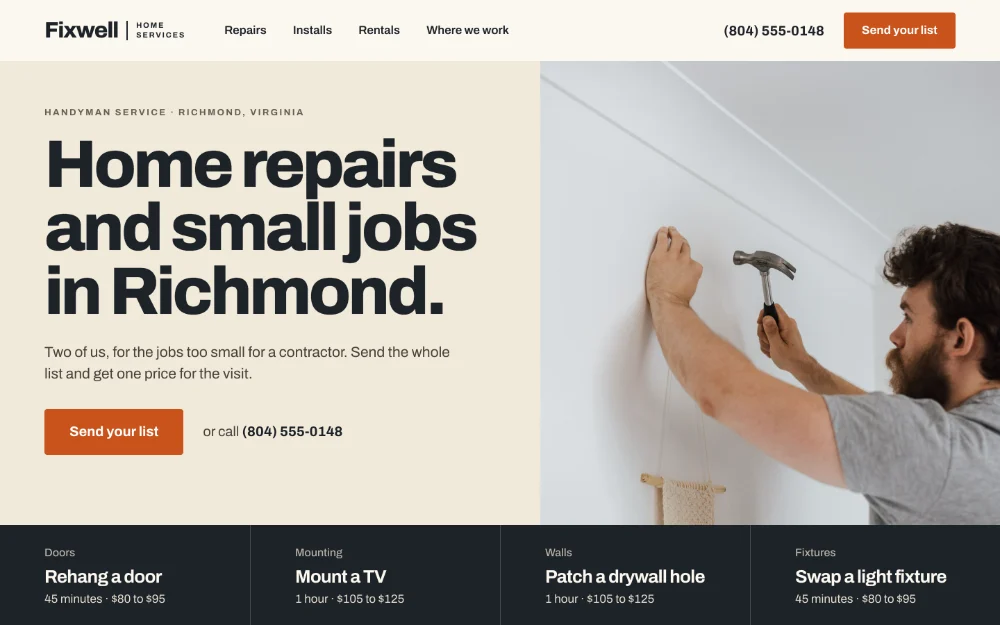
My standard build is $2,000: a page for every type of job you take (TV mounting to furniture assembly), a page on how you charge and one per town. Want more than that? I put the bigger price in writing before making the mockup, and nothing gets built until you have read it.
The list
Your customer shows up with a list of small jobs. Can your site say yes to each one?
Nobody searches for "a handyman" in general. A homeowner has a TV still leaning against the wall, a closet door that drags, a hole in the drywall where the old towel bar was, and a fence board the dog pushed out. A landlord has a unit turning over on the first of the month and a punch list of fourteen items. Both of them are asking the same question as they scroll: does this person do my thing, what will it cost me, and how fast can they come?
Most handyman sites answer none of that. They show a hammer photo, the word "quality", and a phone number. The customer has to call to find out whether you mount TVs on brick, whether there is a minimum charge, and whether you work in their town. Many of them will not call. They go back to the search results and open the next site, the one with a page called "TV mounting" and a photo of a finished wall.
So the site I build for a handyman is organized around the list, not around the company. Every job type you want more of gets its own page in the words customers type. Your rate structure is on the page. The jobs you do not take are on the page too. And the person with a turnover every month gets a form built for them, because repeat customers are where a handyman business makes its money.
The field
How many handyman businesses have no website? 44.5% of the listings we checked.
Between September 8, 2026 and October 10, 2026, we checked 31,107 public Google Maps listings for handyman services in 40 states and 734 towns, and recorded whether each one linked to a website and what kind. 44.5% had no website at all. That is the highest share of the 17 trades in the study, where the average across all of them is 30.8%.
Another 3.8% list a Facebook page as their website, and 2.3% point to a builder subdomain or a link page. None of those can hold a page for drywall repair, a rates page or a town page, so none of them can rank for those searches.
The same crawl shows a pattern by review count: businesses with 1 to 9 reviews had no website 44.4% of the time, against 4.4% for businesses with 100 or more. Whatever the cause, the busiest names in a town usually have a site, and a handyman who wants to compete with them needs one too. The tables by trade and state are in the full 17-trade study.
The pages
Which pages should a handyman website have? One per kind of job, plus rates and towns.
The best handyman websites have the same bones: the customer finds their job by name, sees a finished example, and can ask for a time in one tap. Each row below is one page, the search it answers on the left and what goes on it on the right. You keep the rows for the work you want and drop the rest.
- handyman near me, handyman services [town]Home page
Your towns, the job types as a tap-able list, the phone and text buttons at the top, and the request form one scroll down.
- tv mounting, shelf and mirror hangingMounting and hanging
Wall types you mount on (drywall, plaster, brick), whether you hide the cords, and photos of finished walls, not stock TVs.
- furniture assembly near meAssembly
Flat-pack furniture, beds, cribs, desks, sheds and playsets, with how you price a single piece against a full room.
- drywall repair, patch and paintDrywall and paint touch-ups
Holes, cracks, water spots and nail pops, patched, textured and painted to match, plus a before and after of each.
- door installation, sticking door repairDoors and windows
Interior and exterior doors, hardware, weatherstripping, screens and sash cords, with the brands of lock you install.
- trim carpentry, baseboard installationCarpentry and trim
Baseboard, crown, casing, shelving and stair parts, caulked and painted, with close-up photos of the joints.
- fence repair, gate repairFences and gates
Replacing boards and posts, sagging gates and latches, and the line where a full new fence goes to someone else.
- gutter cleaning, pressure washingOutdoor upkeep (if you offer it)
Gutters, decks, siding and walkways, by season, so the same customer has a reason to call back in spring and fall.
- handyman hourly rate, minimum chargeRates
Your hourly rate or how you quote, the minimum charge, half-day and full-day blocks, and what counts as travel.
- handyman for rental property, turnover repairsLandlords and property managers
Turnover punch lists, lockbox and tenant access, photos sent when the job is done, and how you invoice.
- handyman [town]A page per town
One page for each town you drive to, with the jobs you have done there and the neighborhoods you cover.
Small plumbing and electrical jobs (a faucet, a light fixture, a ceiling fan) get a page only where your state lets you do them. A template from a builder gives you a services grid with six icons. This gives you a page a customer can land on from a search for the exact job, written in your words. To see what a page map like this would come to for a different scope, try the website cost calculator.
Rates and limits
Should you post your rate and the jobs you turn down? Both save you phone calls.
The rate page
"Handyman hourly rate" is one of the searches customers make before they call anyone. A page with your minimum charge, your half-day and full-day blocks, and how you handle materials and travel answers it. If you quote by the job, say so and ask for photos. The customer who books after reading it already agrees with your price.
What you do not take
The rules on what a handyman can do without a contractor license differ by state, and some set a dollar limit per job. I do not interpret them for you. The site states what you do and do not take, in one plain line on the services page and the form, such as "no panel work, no gas lines, no roofing". It keeps the wrong jobs off your phone and tells the right customer you know your lane.
Insurance, photos, reviews
An insurance line in the footer matters more to a landlord than any slogan. Photos from your own phone, a wide shot of the finished wall or door, beat stock images every time. Reviews live on your Google Business Profile first; the profile checklist covers asking for them. The detailed ones can be quoted word for word on the matching job page.
The second call
Landlords and property managers book again when the second request takes a minute.
A homeowner may call you twice a year. A property manager with a few dozen doors can have work for you every week. What they want is simple: send an address, the access details and a list of turnover items, text a few photos, and get the work done without a phone chase. The landlord page gives them exactly that, a form with fields for the unit, the lockbox or tenant contact, the deadline and the punch list, plus a text button for photos.
The same page says how you invoice and that you send photos of the finished work, the two things a manager needs to close a work order. A senior-friendly line can go on the home page if you do grab bars and small safety jobs for older homeowners. And every finished job is a reason to come back: the outdoor upkeep page gives the gutter and deck customer a reminder each season.
Text works too. Some customers would rather text a photo of a broken latch than talk, so the phone button at the top of the site sits next to a text button on mobile.
The price
How much does a handyman website cost?
Builders charge a monthly fee for as long as the site stays up, and agencies often price per page. Here it is one fixed price, paid once, for the whole page map above, and you own the site and the domain when it launches. Search work after launch is optional, quoted in writing and month to month.
| Who builds it | Price |
|---|---|
| An independent designer | $3,800 to $13,000 |
| A U.S. web design company | $7,500 to $19,400 |
| Thryv's Signature plan | $399 a month, $14,364 over three years |
The U.S. company rate is from Clutch's web design pricing guide (opens in a new tab) (updated September 21, 2026) and the Thryv price from Thryv's pricing page (opens in a new tab), both checked November 2, 2026. The hours are my estimate, and so is the independent designer rate. See the math in the website cost calculator.
The short version
Last updated:
- Price
- $2,000one time
- Monthly fee
- None required by me. Hosting usually costs $0 within Google's free allowance; a busy site might pay Google a few dollars a month. Maintenance is optional.
- Timeline
- 2 to 3 weeks from kickoff to a live site
- First step
- A free homepage mockup, so you see the design before you decide anything
See what you own and everything included
- You own
- The domainat your own registrar, renewing to you
- The codea GitHub repository in your name
- The hostinga Firebase project in your Google account, usually $0, with any charge billed by Google to you
- Google Analytics and Search Consoleproperties under your Google account
- Your Google Business Profileyou are the owner, and I am a manager you can remove
- Every form submissiondelivered to the inbox you choose
All of it in your name from day one. I am added as a collaborator for the build and removed by you at handover, and I never hold the only copy of any login.
- What's included
- A page for each job type you take, from mounting to trim
- A rates page with your hourly rate or quoting method and minimum
- A request form that takes photos of the job
- A landlord and property manager page for repeat work
- A page for each town you drive to
- Google Business Profile set up and linked to the site
- Set up on Bing too: Webmaster Tools, which reports how your pages show up in Microsoft Copilot, and Bing Places
What happens next
What happens after you ask for the free mockup.
You see your homepage before you pay anything.
- Send your name and town
Tell me your business name and town. I design a homepage for your business and send it to you to look at on your phone. No call needed, nothing to sign.
- Build the pages
If you like the direction, I build the rest: the job pages, the rates page, the landlord page, the town pages and the request form. You review each page and ask for changes before anything goes live.
- Launch in your name
The site goes live on your domain, with Google Search Console and GA4 set up in your accounts, so you can see the searches and the form requests yourself. Your Google Business Profile points at the new site.
Check it yourself. The live builds are in the portfolio; run any of them through PageSpeed Insights and read the scores. Pricing for every trade is on the pricing page, and other trades are listed on the industries page. Want to look at real ones first? The best contractor websites page has one per trade, and contractor website cost shows what each way of paying comes to.
Q&A
Handyman website questions, answered in a few lines each.
What should a handyman website include?
A list of the jobs you take, with a page for each main type, so a customer can see their exact job before calling. Add your rates or how you quote, your minimum charge, the towns you cover, an insurance line, and a request form that takes photos. Put a phone button and a text button at the top for people on their phones.
Should I list my hourly rate on my handyman website?
Listing at least your minimum charge, and either your hourly rate or how you quote, filters out the calls that were never going to book. Customers comparing handymen want to know if a two-hour job costs about what they expect. If your rates move a lot, publish the structure (minimum, half day, full day) and quote the rest from photos.
How do I show up for "handyman near me"?
The map results lean on your Google Business Profile, how close you are to the searcher, and your reviews. Your website backs that up with pages for the jobs and towns people search for, using the same name, phone and address as the profile. The Google Business Profile checklist on this site covers the profile side step by step.
Can the site handle repeat bookings from landlords and property managers?
Yes. A landlord page with its own form lets a property manager send an address, access notes and a list of turnover jobs in one request, and a text button sends the photos. You can add a short line about how you invoice and send completion photos, which is what keeps a manager calling you for the next unit.
What can a handyman advertise without a contractor license?
The rules differ by state, and some states also set a dollar limit per job or require a license for electrical, plumbing or structural work. I do not give legal advice, so check your state licensing board. What the site does is state plainly what you take and what you do not, so you only advertise work you are allowed to do.
How much does a handyman website cost?
Here it is $2,000 once, with no required monthly fee, and you own the site and the domain. That covers the job pages, the rates page, the landlord page, town pages and the request form. You see a free homepage mockup first, and search work after launch is quoted in writing, month to month, only if you want it.
Taking Handyman Businesses
Send me your business name and town.
I will design a free homepage around the jobs you want more of and send it back for you to judge on your phone. No sales call, nothing to sign. Prefer to talk first? Call or email.
Or call (813) 531-8442 or email chris@rasmussenresults.com.