Electrician Website Design


Free. No call. Usually ready in 48 hours.
The phone number and the main button sit at the top of every page.
Example concept: Brightwire Electric is a made-up electrical contractor, and the requests and numbers shown are made up too. Your site is built from your own photos, services and reviews, so it comes out stronger. See real builds
- Two Calls
- Service calls and planned jobs
- Each with its own button up top
- Trust Line
- License number on every page
- In text Google and buyers can read
- Ownership
- Yours on day one
- Site, domain and every login
Rasmussen Results, in Tampa, Florida, builds custom electrician websites for residential and commercial electrical contractors anywhere in the United States. You own all of it from launch day, and it comes with a page for each job you want more of, from panel upgrades to EV chargers, plus a page for every town you work in.
Tampa, Florida · Remote builds in any US state
The concept
What do the best electrician websites put on the first screen?
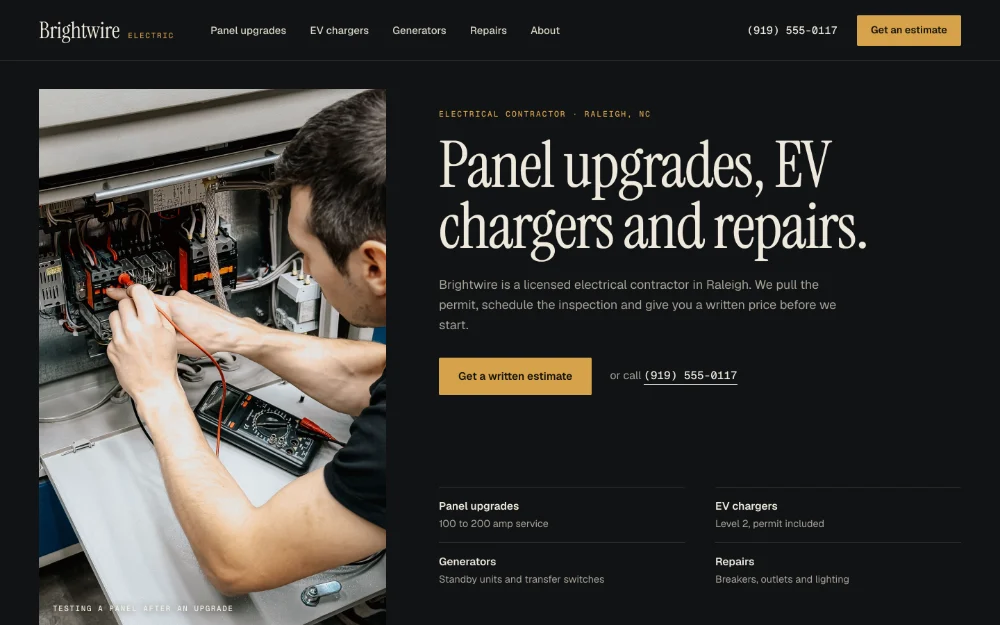
Lists of the best electrician websites are mostly written by companies that sell field-service software, and they praise bold colors and chat widgets. Strip those away and the sites that get calls do four things before anyone scrolls. The example concept above shows one way to lay out that screen, and a finished build does all four; the concept gallery shows it next to the other trades. Ten real electrical contractors that do it well are on best electrician websites.
- 01
A phone number you can tap with one thumb
Big, in the header, on every page. The homeowner standing in a dark kitchen is not going to hunt for it in the footer.
- 02
The license number above the fold
Written out in text, next to the words licensed and insured. For electrical work it is the first thing a careful buyer looks for, and it costs you one line.
- 03
Two clear paths: something is wrong, or I am planning a job
One button for service calls, one for quotes on panels, chargers, rewiring and lighting. Each goes to the page that fits, not to the same long list.
- 04
Finished work from your own trucks
A clean panel with every breaker labeled, a charger mounted in a real garage, recessed lights in a finished room. Single photos or photo pairs, never a stock lightning bolt.
That first screen, a page for each job from panel upgrades to EV chargers and your town pages make up the standard build: $2,000. Bigger sites get their price written out before I touch the mockup, so you hold that number before anything gets built.
Who is calling
A breaker that will not reset, a 200 amp upgrade, a tenant build-out: three different visitors.
Something is wrong right now
Half the house went dark, an outlet is warm to the touch, or the lights flicker every time the AC kicks on. She types "electrician near me" and calls the first licensed company that looks real and answers. She will not read a paragraph. She needs the number, the hours and proof you are licensed, all on one phone screen.
A job he has been planning
He just bought an EV, or the house still has a 100 amp panel, or the insurer flagged old wiring. He compares three companies over a week. He wants the license number, whether you pull the permit, photos of similar jobs, a clear scope and whether you offer financing. The planned jobs are where the bigger tickets are.
A property manager at a desk
Commercial buyers search "commercial electrician" plus the town, then look for the jobs you have done, a certificate of insurance and a way to send a scope by email. A site that only talks to homeowners loses this work without anyone noticing.
Good electrician web design gives each of these people a path from the first screen, then a page that answers them. A homepage that tries to talk to all three at once ends up talking to none of them.
The field
How many electricians have no website? We checked 2,361 listings.
Between September 8, 2026 and October 10, 2026, we checked 2,361 public Google Maps listings for electricians in 30 towns across 30 states, and recorded whether each one linked to a website and what kind. No business is named.
31% link to no website at all, and another 1.3% send visitors to a Facebook page instead. Neither can hold a panel upgrade page or a page for the next town over, so neither gives Google anything to rank for those searches. The trade and state tables are in the full study.
The pages
Which pages does an electrician website need?
Each row is one page: what the customer types, the page that answers it, and what goes on it. Google shows a page for a search, not a company, so "EV charger installation" and "panel upgrade" each need their own. You only get the rows that match work you actually do.
- "electrician near me", "emergency electrician [town]"Emergency and same-day service
What counts as an emergency (no power to part of the house, a burning smell, a hot outlet, a breaker that trips again the second you reset it), your hours, and the number in large type.
- "panel upgrade", "200 amp service upgrade"Panel and service upgrades
When a 100 amp service runs out of room, what a load calculation is, the permit and the inspection, and photos of panels you replaced, labeled and tidy.
- "EV charger installation", "Level 2 charger installer"EV charger installation
The 240 volt circuit a Level 2 charger needs, when the panel has room for it and when it does not, garage and driveway mounts, and the brands you install.
- "rewire old house", "knob and tube replacement"Whole-home rewiring
Signs an older house needs it, how you work room by room with the family still living there, patching, and the final inspection.
- "generator installation", "whole house surge protector"Standby generators
Standby units, manual and automatic transfer switches, sizing to what the owner wants to keep running, whole-house surge protection, and the best time to book before storm season.
- "recessed lighting installation", "landscape lighting"Lighting
Recessed cans, under-cabinet strips, fixtures, outdoor and landscape lighting, and commercial retrofits, with night photos where the work is outside.
- "GFCI outlet installation", "ceiling fan installation"Outlets, GFCI and fans
The small jobs that fill a slow week: added outlets, GFCI and AFCI protection, USB outlets, fan and fixture swaps.
- "failed electrical inspection", "code correction"Code corrections and inspection repairs
Home sale repair lists, insurance requests, failed inspections, and what you need from the owner to quote one fast.
- "commercial electrician [town]"Commercial electrical
Tenant build-outs, lighting retrofits, dedicated circuits, service calls for property managers, and a certificate of insurance on request.
- "electrician [town]"A page per town
The jobs you finished there, the permit office you deal with, and the older neighborhoods where rewiring and panel work come up most.
Every page carries click-to-call, your license line and the same short quote form, plus a text button so a customer can send a photo of the panel or the problem from their phone. Mostly install chargers or lighting? Then those pages lead the menu, so the same build covers EV charger installer and lighting installer website design. Ranking these pages after launch is the job of SEO for electricians.
Builder or custom
Is a website builder for electricians good enough, or do you need a custom site?
What a builder does fine
Wix, Squarespace and the website add-on bundled with some field-service software will give you a decent homepage in a weekend. If you need a phone number, a few photos and a contact form online by Friday, that is a reasonable start, and it beats a map pin with nothing behind it.
Where it stops
A dozen service pages plus a page for each town is a lot to write and keep organized in a drag-and-drop editor, and few owners have the evenings for it. Heavy themes load slowly on a phone, the structured data that tells Google you are an electrician is often thin, and the design lives on the platform. It usually can't be exported and moved to another host.
What $2,000 once buys instead
Every page in the schedule above, written for your services and towns, fast on a phone, with Electrician schema on every page. The code, the domain and the hosting account are in your name. No monthly plan from me is required, so there is nothing you have to cancel later.
So the best website builder for electricians depends on the goal. For a placeholder, any builder works. For a site meant to win searches for each job and each town, a custom build is cheaper over a few years than paying a monthly plan. If you are on one now, here is how switching works, and across the 17 trades in our listing study, 30.8% of the listings we checked had no website at all, so even a basic site puts you ahead of a lot of the map.
The details
License numbers, permits, and an electrician website redesign that keeps your rankings.
The license line
Your master electrician or contractor license number, the state that issued it, and a plain insured line, written in text in the header area and the footer. If you are licensed in two states, both go there. It is a small thing that answers the first question a careful buyer has.
Permits and inspections, shown
Say on the panel, rewiring and generator pages that you pull the permit and schedule the inspection. A photo of a clean rough-in before the drywall goes up, or a passed inspection sticker, does more than a paragraph about quality. Single finished photos, or a before and after pair shot from the same spot, work best.
Redesigning a site that already ranks
If your current site brings in some calls, a rebuild should not throw that away. Every old address gets a permanent redirect to its new page, titles that rank are kept, and Search Console is checked after launch. More on that on the website redesign page.
The price
How much does an electrician website cost here?
The website is $2,000, paid once, with the service pages and town pages above built in. There is no required monthly fee from me; hosting usually costs $0 within Google's free allowance. SEO after launch is optional and separate: quoted in writing for your towns and services, month to month, and measured in your own Search Console.
What others charge for an electrician website like this one, with 6 to 10 pages: about $2,500 to $8,500 from an independent designer, $5,000 to $12,700 from a U.S. web design company, or $399 a month on Thryv's Signature plan ($14,364 over three years).
The U.S. company rate is from Clutch's web design pricing guide (opens in a new tab) (updated September 21, 2026) and the Thryv price from Thryv's pricing page (opens in a new tab), both checked November 2, 2026. The hours are my estimate, and so is the independent designer rate. See the math in the website cost calculator.
The short version
Last updated:
- Price
- $2,000one time
- Monthly fee
- None required by me. Hosting usually costs $0 within Google's free allowance; a busy site might pay Google a few dollars a month. Maintenance is optional.
- Timeline
- 2 to 3 weeks from kickoff to a live site
- First step
- A free homepage mockup, so you see the design before you decide anything
See what you own and everything included
- You own
- The domainat your own registrar, renewing to you
- The codea GitHub repository in your name
- The hostinga Firebase project in your Google account, usually $0, with any charge billed by Google to you
- Google Analytics and Search Consoleproperties under your Google account
- Your Google Business Profileyou are the owner, and I am a manager you can remove
- Every form submissiondelivered to the inbox you choose
All of it in your name from day one. I am added as a collaborator for the build and removed by you at handover, and I never hold the only copy of any login.
- What's included
- Pages for emergency service, panel upgrades, EV chargers, rewiring, generators and lighting
- A page for every town you work in
- Your license number in the header area and footer
- A quote form, plus a text button for photos of the panel
- Click-to-call on every page
- Google Business Profile, GA4 and Search Console set up
- Set up on Bing too: Webmaster Tools, which reports how your pages show up in Microsoft Copilot, and Bing Places
How it runs
Mockup, build, keys: how hiring an electrician website company works here.
1. You see a homepage first
Tell me your business name and town. I design a homepage for your company and send a link to open on your phone. No call needed, nothing to sign.
2. I write and build the pages
If the mockup is right, we pick the rows from the schedule that fit your shop. I write every page, set up the quote form, and claim and fill in your Google Business Profile with Electrician as the main category. You read each page before it goes live.
3. You get the keys
The site launches with GA4 and Search Console running, and every login is yours. Test the speed yourself in PageSpeed Insights, then watch which searches find you in your own Search Console.
Finished builds for other trades are on the portfolio. The pricing page explains the one-time fee and what SEO after launch looks like, if you want it.
Q&A
What electricians ask before hiring for web design services.
Other trades, and the SEO and Google Ads pages for each, are on the industries page.
Should an electrician use a website builder or a custom site?
A builder is fine for a one-page site with your number, a few photos and a contact form. It gets harder when you want a separate page for every service and every town, fast load times on a phone, and the structured data that tells Google you are an electrician. A custom site does all of that, and here it costs $2,000 once with no required monthly fee.
What should an electrician website include?
A page for each service you want more of (panel upgrades, EV chargers, rewiring, generators, lighting, emergency calls), a page for each town you work in, your license number, click-to-call on every page and a quote form. Add photos of finished work from your own jobs. Most other features are optional.
Should my license number be on my website?
Yes. Put it in the header area or near the top of the homepage, and again in the footer, written as text rather than inside an image. Careful buyers look it up before they call about a panel or a rewire, and some states and cities require it in advertising. If you hold licenses in more than one state, list each one.
How do I get more panel upgrade and EV charger calls from my website?
Give each job its own page. A homeowner who searched "EV charger installation" and lands on your charger page, with photos of garages you wired and a note about panel capacity, is far more likely to call than one dropped on a homepage. Then link each page from your Google Business Profile and ask every customer for a review in their own words.
How much does an electrician website cost?
Here it is $2,000, paid once, for the whole build: service pages, town pages, quote form, license line and Google Business Profile setup. You own the site, the domain and every account. Builder plans and the website add-ons sold with some field-service software charge every month for as long as the site stays up.
Can you redesign my current electrician website without losing my rankings?
Yes, if the move is done carefully. Every old address gets a permanent (301) redirect to its new page, page titles that already rank are kept or improved rather than replaced, and the new site is checked in Search Console after launch. The free mockup comes first, so you see the redesign before anything changes.
Accepting Electrical Contractors
Send me your business name and town.
I will design a free homepage for your electrical company, with a button for service calls and a button for quotes, and send it back for you to judge on your phone. Prefer to talk first? Call or email.
Or call (813) 531-8442 or email chris@rasmussenresults.com.