Restaurant SEO

Free. No call. Usually ready in 48 hours.
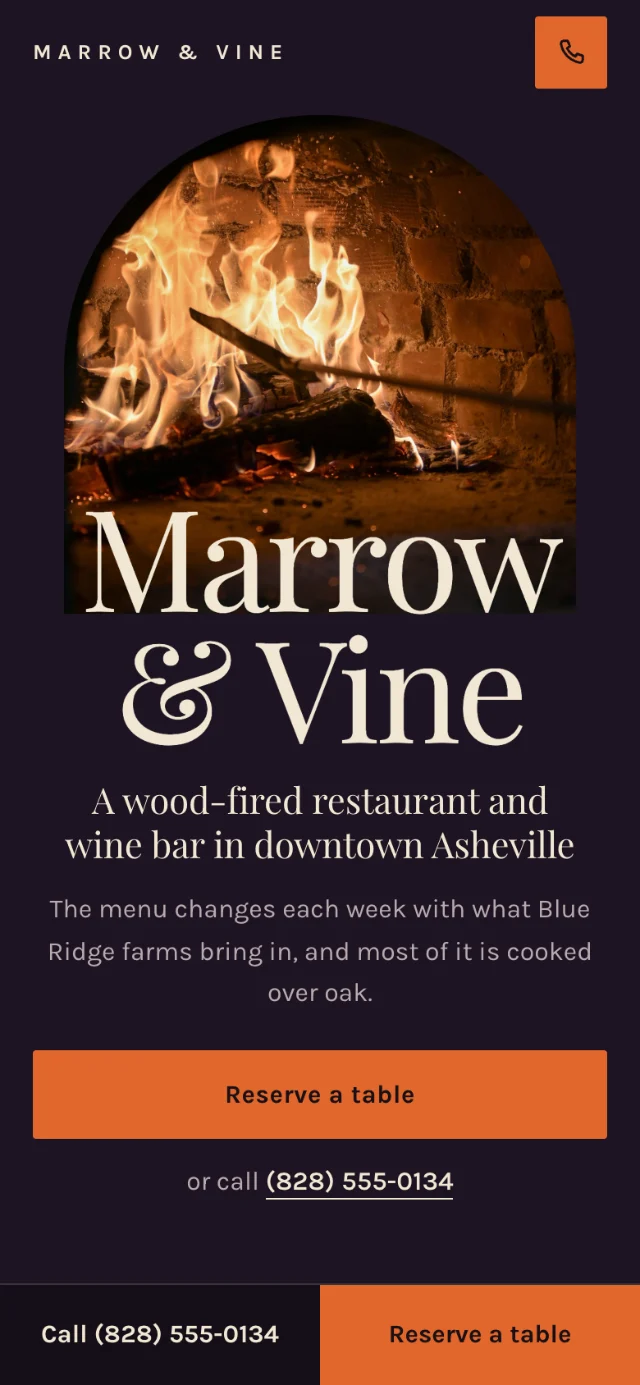
The phone number and the main button sit at the top of every page.
Example concept: Marrow & Vine is a made-up restaurant, and the requests and numbers shown are made up too. Your site is built from your own photos, menu and reviews, so it comes out stronger. See real builds
- The Moment
- An hour before the meal
- On a phone, often deciding for a group
- The Pages That Pay
- Catering and private dining
- High tickets a map pin cannot carry
- Read In
- Your own Search Console
- And your GA4, not a report from me
Rasmussen Results, Tampa, Florida, does SEO for independent restaurants, cafes and bars with kitchens across the United States. The website comes first: your menu as real text, reservations, your own pickup ordering and a catering page. SEO after launch is quoted in writing and runs month to month. The aim is plain: an hour before dinner, someone nearby searches "[cuisine] near me", you are one of the three pins, and the tap lands on your site, not on an app that bills you for it.
Tampa, Florida · Remote builds in any US state
The hour
How a restaurant gets picked on Google: the hour before the meal.
Most of the people who will eat with you tonight have not decided yet. At a quarter to seven someone is standing in a kitchen with three other opinions and a phone, typing "restaurants near me", "best thai in [town]" or "late night food near me". Google answers with a map and three pins, and the choice gets made inside that box.
What they weigh is not a mystery: the photos, the star rating and how many people gave it, the price level, how far you are, whether you are open right now, whether the menu is there to read, and whether they can book or order with the next tap. The listing that answers all of it gets the table. The one with four old photos and no menu gets scrolled past, and the kitchen never gets to argue its case.
You are not the only one bidding for that tap. Google's own menu listings, Yelp, TripAdvisor and the delivery apps show up for the same search, and the apps take a cut of every order they route. Restaurant SEO is the work of making your Business Profile the pin they pick and your own site the place the tap lands, so the booking, the pickup order and the catering inquiry happen on something you own.
There is a second buyer who moves slower and spends more: the person planning a rehearsal dinner, an office lunch for forty, or a birthday for twelve that needs a patio. They search "private dining [town]", "catering [town]" and "restaurants for large groups" days or weeks ahead, open your site, and look for the page that answers them. A map pin cannot hold a catering package. A page can.
The standing objection is that a restaurant should spend its hours on Instagram, not SEO. Half right. Instagram fills the room with people who already follow you; the map pack, the menu page and the catering page fill it with people who are searching and do not know you yet.
The site those searchers land on is the standard build, $2,000: your menu as real text, reservations, your own pickup ordering, catering and private dining pages and a page per location. A larger restaurant site is priced in writing before its mockup, so the cost is on paper before work begins.
The map pack
How to rank a restaurant on Google Maps: the Business Profile does most of the work.
Google's own help page on local ranking names three factors: relevance, distance and prominence. Distance you cannot move. Relevance is whether your profile says what the searcher typed; prominence is how much Google trusts you, which for a restaurant is mostly reviews and photos. The fields that carry both are under "What the profile has to say".
The primary category is the cuisine itself, "Thai restaurant" rather than "Restaurant", because the cuisine is the word in the search. Secondary categories cover what else you are: bar, brunch restaurant, caterer, event venue. Hours have to be right, with holiday hours set ahead, because "open now" is a filter and a wrong closing time earns a one-star review from someone at a locked door. The menu, reserve and order links point at your own pages, never at a PDF or a third-party listing.
Reviews do two jobs. The count and the recency feed prominence; the words inside them feed relevance, because when enough guests write "great patio" or "good for groups", Google shows those phrases on your listing and matches them to searches. Ask at the table, with a QR code on the check presenter, and answer every review, the bad ones first. The field-by-field pass is in the Google Business Profile checklist, and the longer version of the method is in how to rank on Google Maps in Tampa.
The pages
What a restaurant website needs to rank: one page per reason people search.
Google ranks pages and people read pages, so the site is laid out by the searches that bring people in. Each row is one page: the search it answers, then what has to be on it. A one-room taqueria needs about half of these; a group with a banquet room needs all of them.
- [cuisine] restaurant [town], best [dish] in [town]Homepage
Cuisine and town in the first sentence, today's hours, the menu, reserve and order buttons, the room, and the dishes people come back for.
- [restaurant] menu, [dish] near me, vegan [cuisine] [town]Menu
Real text with prices and dietary marks, Menu schema, edited from your phone. The page your Business Profile's menu link points to.
- reservations [restaurant], book a table [town]Reservations
Your own widget or an OpenTable or Resy embed on your domain, plus the large-party policy.
- [restaurant] order online, takeout [town]Pickup ordering
First-party ordering from your POS, linked from every page and from the Business Profile's order button. The apps as a channel, not the front door.
- catering [town], office catering near meCatering
Packages with per-person pricing, minimums, lead time, delivery radius, photos of real spreads, and a request form someone answers the same day.
- private dining [town], rehearsal dinner venue [town]Private dining and events
Each room with seated and standing capacity, minimums by night, sample menus, A/V and parking notes, and an inquiry form.
- brunch [town], happy hour near me, restaurants with a patioOccasion pages
One page per occasion you actually own, with that occasion's hours and menu. Not a paragraph on the homepage.
- [restaurant] [second town]A page per location
Its own address, phone, hours, parking, photos and Business Profile. Two locations sharing one page rank for neither town.
- [restaurant] gift cardsGift cards
Your POS's gift card link, bought online, emailed or shipped. Linked from the header in December.
- who owns [restaurant], [chef] restaurantThe story
Who cooks, since when, where the recipes come from, and the press and awards with their dates. Your voice, not a brand statement.
- is [restaurant] kid friendly, parking near [restaurant]Questions
Parking, kids, dietary options, dress code, dogs on the patio, corkage, large parties. What your host answers on the phone, written down once.
- restaurante [cuisine] [town]Spanish pages
Where your town speaks Spanish: the menu, hours and ordering on their own Spanish pages, not behind a translate button.
Every page carries today's hours, the address, tap-to-call and the three buttons. Built sites are in the portfolio, first-screen concepts for other trades in the concept gallery, and the other verticals on the industries page.
The price
How much does restaurant SEO cost here?
The website costs $2,000, one payment, and the pages in the list above are what it buys. The SEO that follows launch is quoted separately, in writing, for your number of locations and the searches you want. It bills month to month, there is no retainer to get locked into, and you read the results in your own Search Console and GA4. There is no flat SEO price on this page because a one-room taqueria and a three-location group with a banquet hall are not the same amount of work.
The short version
Last updated:
- Price
- $2,000one time
- Monthly fee
- None required by me. Hosting usually costs $0 within Google's free allowance; a busy site might pay Google a few dollars a month. Maintenance is optional.
- Timeline
- 2 to 3 weeks from kickoff to a live site
- First step
- A free homepage mockup, so you see the design before you decide anything
See what you own and everything included
- You own
- The domainat your own registrar, renewing to you
- The codea GitHub repository in your name
- The hostinga Firebase project in your Google account, usually $0, with any charge billed by Google to you
- Google Analytics and Search Consoleproperties under your Google account
- Your Google Business Profileyou are the owner, and I am a manager you can remove
- Every form submissiondelivered to the inbox you choose
All of it in your name from day one. I am added as a collaborator for the build and removed by you at handover, and I never hold the only copy of any login.
- What's included
- Your menu as a real web page with prices and Menu schema
- Reservations and your own pickup ordering, linked from every page
- Catering and private dining pages with real packages and forms
- A page per location with its own hours, parking and photos
- Price and hours edits from your phone that go live within about ten minutes
- Business Profile, Search Console and GA4 in your name
- Set up on Bing too: Webmaster Tools, which reports how your pages show up in Microsoft Copilot, and Bing Places
How it runs
Three steps, and the numbers stay in your accounts.
The mockup is free, the site is a fixed price, the SEO is month to month.
- Free homepage mockup
Send me your restaurant name and town. I design your homepage and send it back for you to judge on your phone. No call, nothing to sign, yours either way.
- The $2,000 site
The pages above get built: the text menu, reservations, your own pickup ordering, catering, private dining, a page per location, and Search Console and GA4 in your name. Two to three weeks from kickoff. You own the domain, the code and every login the day it goes live.
- SEO, month to month
Once the site is live, the SEO is quoted in writing for your locations and the searches you want: the Business Profile kept current, the review ask running, new pages as you add brunch or a second room, and a monthly read of your own Search Console. No retainer lock-in. Stop any month and keep everything.
Check it yourself. Open any site in the portfolio and run it through PageSpeed Insights. Once yours is live, Search Console in your name shows which searches bring people in, and GA4 counts menu views, reservation clicks, order clicks, phone taps and direction taps, so "is it working" is a question you can answer without me. Full terms are on the pricing page.
Q&A
SEO for restaurants: the six questions owners ask before they say yes.
How does a restaurant get into the Google map pack?
Google picks the three pins on relevance, distance and prominence, by its own description. Distance you cannot move, so the work is the other two: a Business Profile whose primary category is your cuisine, with hours, attributes and the menu, reserve and order links pointing at your own pages, plus a steady run of recent reviews and your own photos. The category and the menu link are the usual misses.
Should my restaurant menu be a PDF?
No. To Google a PDF is close to a picture of a menu: it cannot match "birria tacos near me" to a dish it cannot read, and on a phone it means pinch and zoom. Put the menu on a page as text, with sections, descriptions, prices and dietary marks, and Menu schema behind it. On the sites I build you change a price from your phone and it goes live within about ten minutes.
Do I need my own online ordering if I am already on DoorDash and Uber Eats?
If you want to keep the margin on pickup orders from people who searched for you by name, yes. The apps reach strangers; they are an expensive way to serve your own regulars. Your POS (Toast, Square, Clover and most others) includes an ordering page, and the site's Order button and your Business Profile's ordering link both point there, so a search for your name ends in an order you keep.
How much do reviews and photos affect where a restaurant ranks?
A great deal, in two ways. Review count, recency and rating are prominence, one of the three local ranking factors Google names. The words inside reviews, and what your photos show, are relevance: Google reads "great patio" and "good for kids" and shows your listing for searches that use those words. The habit that works is a QR code on the check presenter, a reply to every review, and your own photos uploaded every month.
I have two locations. Does each one need its own page?
Yes, and its own Google Business Profile. A location page carries that address, phone, hours, parking, photos and the reviews from that room, and it is the page that location's profile links to. Two locations pointed at one homepage leave Google guessing which one serves "[cuisine] [second town]", and it tends to guess neither. Share the menu if it really is the same; the hours and the ordering link rarely are.
How long until a restaurant page ranks on Google?
The Business Profile moves first, often within weeks when the category, hours or links were wrong, because that is Google reading a corrected listing, not re-ranking the web. New pages are usually indexed within a few weeks; where they rank depends on the phrase and the town. "Catering [town]" in a smaller city can take a position in a couple of months; "best brunch" in a large metro is a longer climb. You watch it in your own Search Console, and nobody can promise a date, me included.
Accepting Independent Restaurants
Send me your restaurant's name and town.
I will design a free homepage for your restaurant, with your cuisine and town in the first line and the three buttons where a hungry person expects them, and send it back for you to judge on your phone. No sales call, nothing to sign. Rather talk first? Email or call.
Or call (813) 531-8442 or email chris@rasmussenresults.com.