Pest Control Website Design

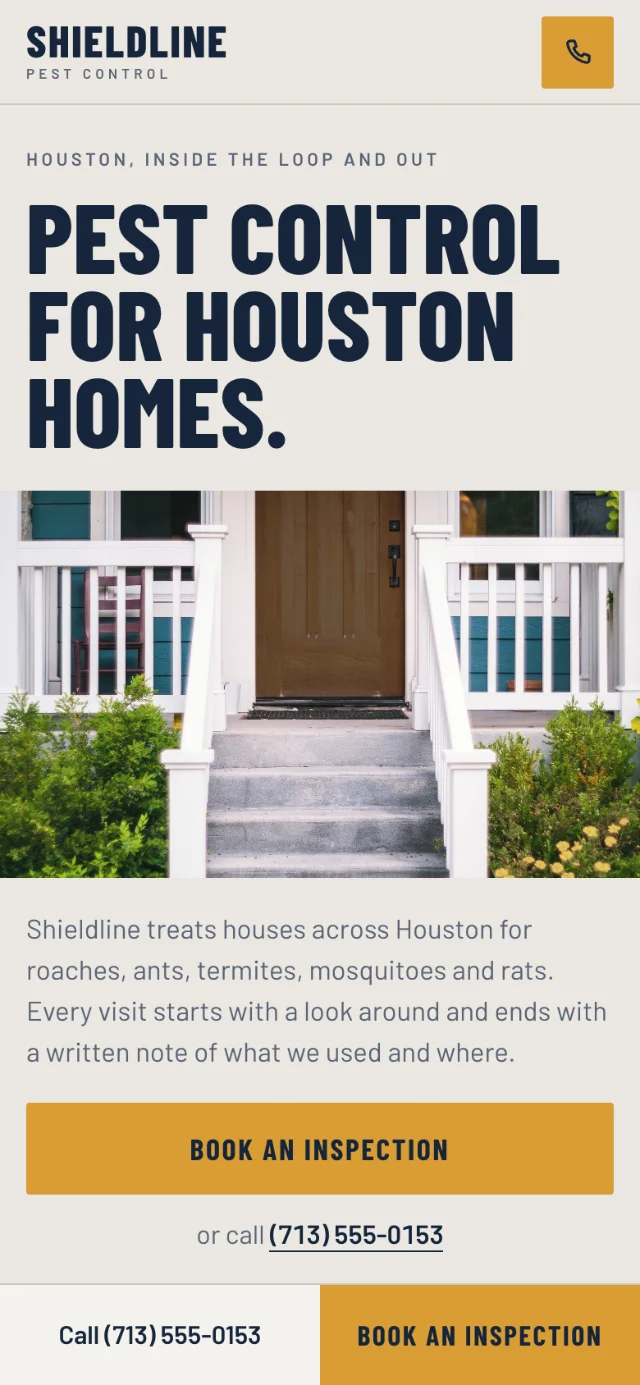
Free. No call. Usually ready in 48 hours.
The phone number and the main button sit at the top of every page.
Example concept: Shieldline Pest Control is a made-up pest control company, and the requests and numbers shown are made up too. Your site is built from your own photos, services and reviews, so it comes out stronger. See real builds
- The Money
- Service plans, not single sprays
- A page that sells the next visit
- Search Habit
- People search by the bug
- So each pest gets its own page
- Ownership
- Yours from launch day
- Site, domain and every login
Rasmussen Results, in Tampa, Florida, designs websites for pest control and exterminator companies anywhere in the United States for $2,000 once, and the owner holds the domain and every login. Each site gets a page for every pest you treat, a service plan page that turns one-time sprays into recurring visits, and a page for every town on your route.
Tampa, Florida · Remote builds in any US state
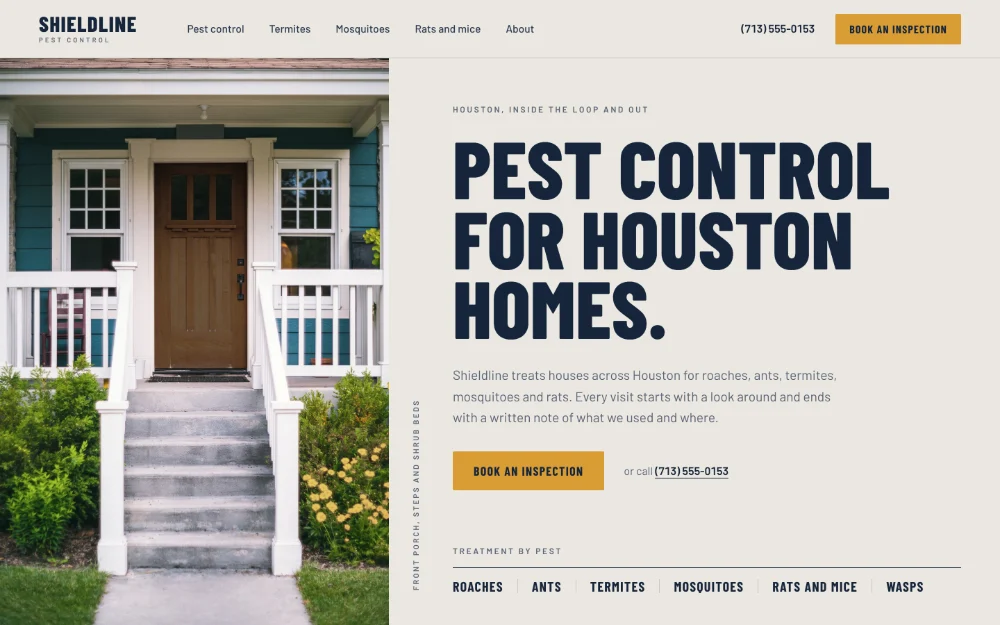
The first screen
What a pest control homepage can look like.
Pick the pest, see the plan price, and read how free re-treatments work.
For $2,000, the standard build covers your homepage, a page for each pest you treat, the service plan page and a page per town on your route. A bigger job is priced in writing before I make the mockup, so you have that figure before I build a page.
Who is searching
Ants on the counter, a house closing, a restaurant account: who lands on a pest control website?
Pest control has a buyer most trades never see: the customer who pays you four or twelve times a year.
- The homeowner with a problem tonight
- Ants marching along the kitchen counter, a roach under the sink, a wasp nest over the front door, scratching in the attic. She searches "exterminator near me" or "pest control" plus her town on her phone and calls the first company that looks licensed, careful around kids and the dog, and able to come this week.
- The customer who wants it to stop coming back
- He has paid for two one-time sprays and the ants returned both times. Now he is shopping for a quarterly or monthly service plan, so he reads: what each visit covers, whether re-treatments between visits are free, and what it costs per month after the first visit.
- The agent with a closing date
- A buyer's lender or contract calls for a termite inspection, often written up on the NPMA-33 form or a state form. The agent needs a company that inspects within days and sends a clean report.
- The property or restaurant manager
- Commercial accounts want scheduled service, a logbook or digital record of every visit, the products used, and paperwork that holds up when the health inspector or an auditor asks. A site that never mentions commercial work never gets the call.
The first two people are the same household a month apart. A site that ends every page at "call for a free quote" gets the first call and leaves the plan to chance.
The first screen
What do the best pest control websites show before anyone scrolls?
Four things on one phone screen
Most "best pest control websites" lists come from software vendors and grade colors and mascots. The sites that get booked agree on these four.
- Tap to call, in the header, on every page
A large number that dials with one thumb, plus the hours you answer it. Pest calls get made while the problem is in plain view, often with the phone in one hand.
- Two buttons: "I have a pest problem" and "Start a service plan"
The first goes to the pest pages and a short quote form. The second goes to the plan page with what each visit includes. Mixing them on one long homepage loses both buyers.
- Your license line, in text
The business license or certified applicator number your state issues, the state, and an insured line, near the top and again in the footer. It answers the first question careful customers have, and Google can read it.
- A plain line about families and pets
What you do and how, in calm words: targeted treatments, products applied by the label, and what the household does during and after a visit. Not a promise that anything is "100% safe", which many pesticide advertising rules do not allow.
Pages by pest
Which pages should a pest control company website have?
Nobody searches "pest control services" and stops there. They type the bug, the sign or the deadline. Each row below is one page. You get only the rows your license and your crew actually cover.
- "pest control near me", "exterminator [town]"General pest control
Ants, roaches, spiders and the other common invaders, what the first visit covers, and how soon you can come.
- "termite inspection", "termite treatment"Termite inspection and treatment
Swarmers versus flying ants, mud tubes, what the inspection covers, liquid or bait treatment, and any renewal warranty, worded as in your contract.
- "rodent control", "mice in attic"Rodent control and exclusion
Trapping, sealing entry points, attic and crawl space work, follow-up visits, and photos of the gaps you closed on real houses.
- "mosquito treatment", "mosquito spraying for yard"Mosquito treatment
The season you spray, how often, what the yard needs before a visit, and event treatments for a backyard party or wedding.
- "bed bug treatment", "bed bug exterminator"Bed bugs
Heat or chemical treatment (whichever you use), how to prepare the room, and how many visits it usually takes.
- "wasp nest removal", "bee removal"Wasps, hornets and bees
Nest removal for stinging insects, and whether you relocate honey bees or refer them to a beekeeper. A near-the-door wasp nest is a same-week call.
- "wildlife removal", "raccoon in attic"Wildlife removal (if you offer it)
Raccoons, squirrels, bats and snakes, humane trapping, exclusion and repair. Left off if your license does not cover it.
- "quarterly pest control", "pest control plan"Service plans
Quarterly, bimonthly or monthly visits, exactly what each visit includes, which pests are covered, free re-service between visits if you offer it, and how to cancel.
- "termite letter", "WDO inspection"Real estate inspections
Wood-destroying insect reports for buyers, sellers and agents, the form your state uses, turnaround time, and how to send the closing date and access details.
- "commercial pest control [city]"Commercial pest control
Restaurants, property managers, offices and warehouses, scheduled service, visit records and the documentation an inspector or auditor asks for.
- "pest control [town]"A page per town
The pests that show up there (fire ants by the coast, scorpions in the desert, termites in older wood-frame neighborhoods), your service days for that area, and the jobs you have done nearby.
Each page ends with the phone number, the license line and the same short quote form, plus a text button so a customer can send a photo of the droppings, the mud tube or the nest from their phone. Pest calls behave like the emergency trades, which is why the ranking side looks a lot like SEO for plumbers: the map pack, the town pages and fast phone pages carry most of it. If you also cut grass or treat lawns, the lawn care website design page covers that side.
Plans and prices
Should a pest control company put its service plan prices on the website?
The initial visit
Many companies charge more for the first treatment, because it is the heavy one: the full inspection, inside and out, and the knockdown. Say so on the site and say why. A customer who knows the first visit costs more is not surprised by it at the door.
The plan, visit by visit
The plan page is where the recurring revenue is won. List what a visit includes (exterior perimeter, eaves and entry points swept for webs and nests, interior on request), how often you come, which pests are covered and which cost extra, whether you come back free between visits, and how to cancel.
How to show the number
In most cases, publish at least a starting price, for example the initial visit from one figure, then each quarterly visit from another. If price moves with square footage or the size of the problem, publish the range and say what moves it. Termites, bed bugs and wildlife stay "inspection first". It is how this site's own pricing page works too.
License and labels
How do you show a license and talk about kids and pets without overpromising?
Commercial pest control is regulated in every state, usually through the department of agriculture or a pest control board, and the details differ: some states license the business, some the certified applicator, many both. Whatever numbers you hold go in the header area and the footer as text, with the issuing state. If your state requires the number in advertising, the site already meets that line. This is not legal advice; your regulator has the last word.
The families-and-pets question is trickier. Parents want to hear "safe", and many state pesticide rules restrict exactly that word, along with "non-toxic" and "harmless", in pest control advertising. So the site describes what you do instead: you treat where the pests are, you apply products according to the label, and you tell the household how long to keep children and pets off treated areas.
Both figures come from our count of public Google Maps listings, published as the full 17-trade study. Pest control is not counted yet, so read them as the wider picture.
The price
How much does a pest control website cost here?
The website is $2,000, paid once, with the pest pages, the service plan page, the real estate and commercial pages and the town pages above built in. There is no required monthly fee from me; hosting usually costs $0 within Google's free allowance. SEO after launch is optional: quoted in writing for your towns and pests, month to month, and measured in your own Search Console.
| Who builds it | Price |
|---|---|
| An independent designer | $3,800 to $13,000 |
| A U.S. web design company | $7,500 to $19,400 |
| Thryv's Signature plan | $399 a month, $14,364 over three years |
The U.S. company rate is from Clutch's web design pricing guide (opens in a new tab) (updated September 21, 2026) and the Thryv price from Thryv's pricing page (opens in a new tab), both checked November 2, 2026. The hours are my estimate, and so is the independent designer rate. See the math in the website cost calculator.
The short version
Last updated:
- Price
- $2,000one time
- Monthly fee
- None required by me. Hosting usually costs $0 within Google's free allowance; a busy site might pay Google a few dollars a month. Maintenance is optional.
- Timeline
- 2 to 3 weeks from kickoff to a live site
- First step
- A free homepage mockup, so you see the design before you decide anything
See what you own and everything included
- You own
- The domainat your own registrar, renewing to you
- The codea GitHub repository in your name
- The hostinga Firebase project in your Google account, usually $0, with any charge billed by Google to you
- Google Analytics and Search Consoleproperties under your Google account
- Your Google Business Profileyou are the owner, and I am a manager you can remove
- Every form submissiondelivered to the inbox you choose
All of it in your name from day one. I am added as a collaborator for the build and removed by you at handover, and I never hold the only copy of any login.
- What's included
- Pages for general pests, termites, rodents, mosquitoes, bed bugs, stinging insects and wildlife (only those you offer)
- A service plan page with what each visit includes
- Real estate inspection and commercial pages
- A page for every town you treat in
- Your license line in the header area and footer
- A quote form, plus a text button for photos of the pest or the damage
- Google Business Profile, GA4 and Search Console set up
- Set up on Bing too: Webmaster Tools, which reports how your pages show up in Microsoft Copilot, and Bing Places
Three steps
A free homepage first, then the pest pages, then the keys.
1. You judge a homepage
Send me your business name and town. I design a homepage for your company and send a link to open on your phone. No call, nothing to sign.
2. I write every page
If the homepage is right, we choose the rows from the site map that fit your company, and I write each pest page, the plan page and the town pages. I also claim and fill in your Google Business Profile with Pest control service as the main category. You read each page before launch.
3. Everything is yours
The site goes live with GA4 and Search Console running and every login in your name. Check its speed in PageSpeed Insights, and see which searches find it in your own Search Console. Finished builds for other trades are on the portfolio.
Paying a monthly fee for a site you do not own? Read how switching from a monthly website plan works, or run your own numbers in the website cost calculator.
Q&A
Pest control owners ask these before they hire anyone for a website.
Other trades, with their SEO and Google Ads pages, are listed on the industries page. For real examples, see the best contractor websites. For the money side, contractor website cost adds up six ways to pay over three years.
What should a pest control website include?
A tap-to-call number, your license line, a page for each pest or service you want more of (termites, rodents, mosquitoes, bed bugs, general pests), a service plan page that lists what each visit covers, and a page for every town you treat. Add a short quote form with a text button for photos. Real estate and commercial pages are worth it if you do that work.
Should I publish my pest control service plan prices?
In most cases, yes, at least a starting price. A line such as "initial visit from $X, then quarterly service from $Y per visit" filters out bargain hunters and gives serious buyers a reason to call you instead of the company that hides it. If prices swing with square footage or infestation, publish the range and say what moves it.
How do I show my license and that treatments are careful around kids and pets?
Put your state license or certified applicator number in text near the top of the site and in the footer, with the issuing state. For families and pets, describe what you actually do (targeted treatments, products applied by the label, how long to keep pets off treated areas) instead of calling anything "safe". Pesticide advertising rules in many states restrict safety claims, so check your state's wording rules.
Can my pest control website book inspections online?
Yes, in one of two ways. If your scheduling software has an online booking or customer portal page, the site links to it or embeds it from the inspection and plan pages. If not, a request form asks for the address, the pest, the closing date for real estate jobs and two preferred times, and lands in your inbox or phone.
How much does a pest control website cost?
Here it is $2,000, paid once, for the whole build: pest pages, the service plan page, town pages, quote form, license line and Google Business Profile setup. You own the site, the domain and every account. Website plans sold by marketing companies and some field software add-ons bill every month for as long as the site stays live.
Do I need separate pages for termites, rodents and mosquitoes?
Yes, if you want to be found for them. People search by the pest ("termite inspection", "mice in attic", "mosquito spraying"), and Google ranks a page for each search, not a company. A single services page with one paragraph per pest rarely ranks for any of them. Each pest page also gets its own photos, questions and quote button.
Accepting Pest Control Companies
Send me your business name and town.
I will design a free homepage for your pest control company, with one button for a pest problem and one for a service plan, and send it back for you to judge on your phone. Prefer to talk first? Call or email.
Or call (813) 531-8442 or email chris@rasmussenresults.com.