SEO for HVAC Companies

Free. No call. Usually ready in 48 hours.
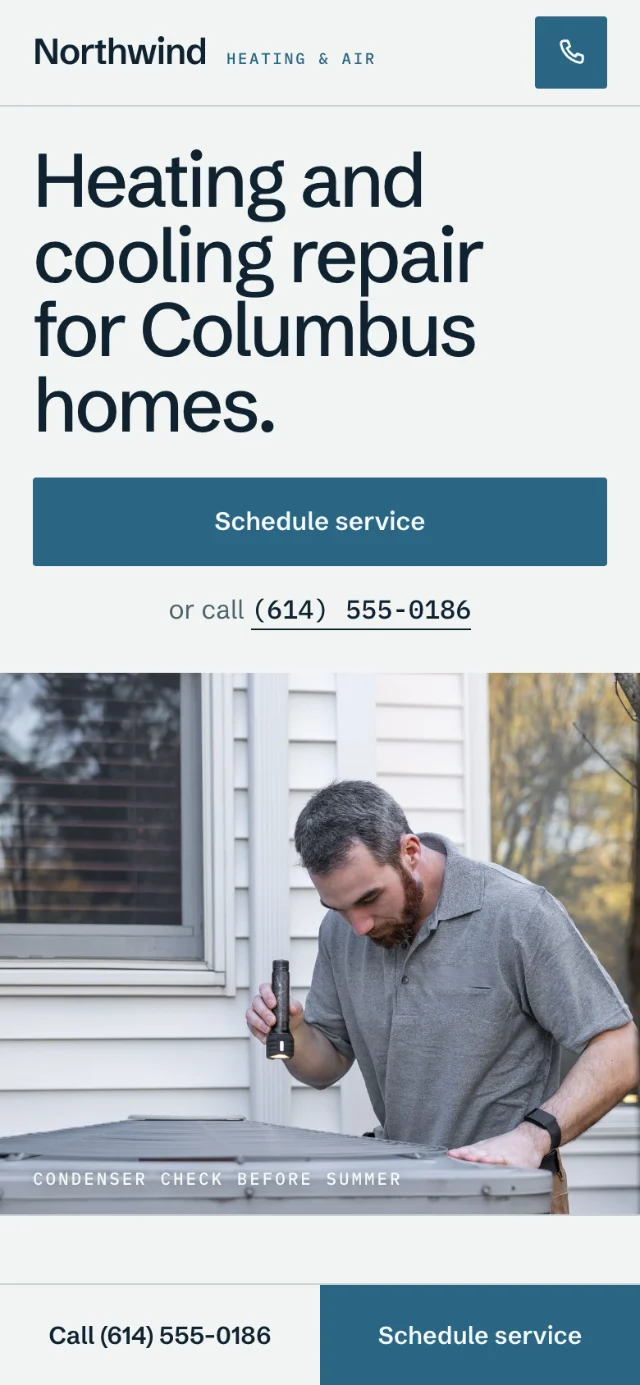
The phone number and the main button sit at the top of every page.
Example concept: Northwind Heating & Air is a made-up heating and air company, and the requests and numbers shown are made up too. Your site is built from your own photos, services and reviews, so it comes out stronger. See real builds
- Breakdown Season
- Map pack + LSA
- "AC repair near me," "AC not cooling"
- Install Season
- Organic pages
- "AC replacement cost," "heat pump installation"
- Measured In
- Your Search Console
- And your GA4, from day one
Rasmussen Results, in Tampa, Florida, builds websites and runs SEO for HVAC companies across the United States. The site is yours, with a page for every service and town; SEO after launch is quoted in writing and runs month to month. The aim is plain: when the AC quits in one of your suburbs, the homeowner finds you in the map pack and your replacement page answers the price question.
Tampa, Florida · Remote builds in any US state
The calendar
Two seasons, two different searches.
SEO for HVAC companies is a calendar problem before it is a keyword problem. HVAC demand has two shapes. The first is the breakdown: the first 95-degree week arrives, the AC quits, and the homeowner types "AC repair near me," "AC not cooling" or "emergency AC repair" from a hot kitchen. In a cold snap it is "furnace not turning on." The ticket is a service call and a part, and Google answers with the map pack and Local Services Ads.
The second shape is the install decision: "AC replacement cost," "new AC unit," "ductless mini split installation," "heat pump vs furnace." That homeowner is comparing quotes, reading about SEER2 ratings, asking about financing and taking a week or three to decide. The ticket is several thousand dollars, and Google answers with pages, because the searcher wants an explanation, not three pins on a map.
Both seasons share one problem: demand spikes and rankings do not. A page that goes live during the first heat wave is still being found while the calls go to someone else. So the work is scheduled around your market's calendar, and the replacement page ships first. Across the 17 trades in our study of local trades without websites, 30.8% of listings have no website at all, so a real page per search is still a real edge.
For $2,000, the standard build gives you the site that carries both seasons: a page for every service from AC repair to replacement and a page per town. A bigger site comes with a written quote before its mockup, and you have the price in hand before work starts.
The field
We checked 2,147 HVAC listings in 30 states. 23.1% have no website.
Between September 8, 2026 and October 10, 2026, we checked 2,147 public Google Maps listings for HVAC companies in 30 towns across 30 states, recording whether each one linked to a website and what kind. No business is named. It is a field survey, not a census.
23.1% of those listings have no website, and 0.9% point to a Facebook page instead. A homeowner researching a replacement opens two or three tabs. A listing with nothing to open is not one of them, and a Facebook page cannot rank for "heat pump installation". The full tables by trade and by state are in the study.
The competition
Outranking the franchise and the roll-up.
The company above you in the map pack is probably not a better HVAC company. It is a franchise on a national template, or a private-equity roll-up that bought four local shops and put them under one brand. They win on budget. They do not win on local signal, and local signal is what the map pack is ranked on. Google's own documentation names relevance, distance and prominence. Budget is not on the list.
Distance is a radius around the searcher, which is why a one-truck shop in the suburb can beat the franchise across the county for searches from that suburb. Relevance is category precision. Prominence leans on reviews, and recent ones count: a shop that asks at every invoice outpaces a roll-up whose reviews are split across six acquired names. Their town pages are one paragraph with the name swapped, the thin pattern Google filters. A suburb page that names the neighborhoods, the equipment common there and the tech who covers it beats that. The plumbing version of this work fights the same roll-ups with the same three signals.
Page families
Repair, replacement, maintenance: the pages HVAC SEO services should build.
Most HVAC sites have one "Services" page listing AC repair, installation, furnace repair, duct cleaning and maintenance in a row. That page cannot rank for any of them, because each is a different search with a different question behind it. The site gets split into three page families, plus the suburb pages that carry them into the towns you serve.
The repair page answers the breakdown in the homeowner's words: blowing warm air, tripping the breaker, ice on the line, water around the air handler. It states the hours, the response window and the diagnostic fee, and whether that fee is credited toward the repair, with click-to-call on screen. The replacement page answers the install decision: what drives the price (tonnage, SEER2 rating, ductwork condition, permits), the brands you install, the financing you actually offer and what install day looks like. The maintenance page sells the plan: what a tune-up includes, two visits a year, priority scheduling in season.
Furnace, heat pump and ductless pages get built where your metro searches for them. In a heating-dominant market the furnace page is the money page. Ductless mini splits have searchers almost everywhere: garages, additions, older homes without ducts, the enclosed lanai that never cools. The long-tail questions ("AC blowing warm air but running," "should I repair or replace a 12-year-old AC") get answered in a page's first paragraph, the part an AI overview or a featured snippet lifts.
The profile
Where HVAC company local SEO services start: the Google Business Profile.
The profile decides the breakdown season, so it gets set field by field, not claimed and forgotten. Primary category: HVAC contractor. Secondaries: Air conditioning repair service, Air conditioning contractor, Furnace repair service, Heating contractor, and only the ones you actually do. Each wrong one dilutes the right ones.
Hours matter. If you genuinely answer at 2 a.m., say so, and the "open now" filter includes you during the overnight breakdown. If you do not, do not claim it; a missed 2 a.m. call is a one-star review by 8. If you have no walk-in shop, clear the address and set the service area to the suburbs you cover, which is what Google asks of a service-area business anyway. Photos are installs and trucks: the condenser you set last week, the air handler swap, the truck in a driveway in one of your towns.
The services list mirrors the page families. Then the review request: it goes out with the invoice, from the tech's phone, while the house is cool again. Every field is in the Google Business Profile checklist, and the setup is done for you, not handed back as homework.
The price
What do HVAC SEO services cost?
The website is $2,000 once, and you own it. SEO after launch is quoted in writing once the audit shows what your market needs, runs month to month, and is measured in your own Search Console and GA4. There is no long contract to get out of in July.
The short version
Last updated:
- Price
- $2,000one time
- Monthly fee
- None required by me. Hosting usually costs $0 within Google's free allowance; a busy site might pay Google a few dollars a month. Maintenance is optional.
- Timeline
- 2 to 3 weeks from kickoff to a live site
- First step
- A free homepage mockup, so you see the design before you decide anything
See what you own and everything included
- You own
- The domainat your own registrar, renewing to you
- The codea GitHub repository in your name
- The hostinga Firebase project in your Google account, usually $0, with any charge billed by Google to you
- Google Analytics and Search Consoleproperties under your Google account
- Your Google Business Profileyou are the owner, and I am a manager you can remove
- Every form submissiondelivered to the inbox you choose
All of it in your name from day one. I am added as a collaborator for the build and removed by you at handover, and I never hold the only copy of any login.
- What's included
- Separate AC repair, AC replacement and maintenance plan pages
- Furnace, heat pump and ductless pages where your metro searches for them
- A town page for each suburb you roll trucks to
- Google Business Profile set field by field, HVAC contractor as the primary
- HVACBusiness schema, click-to-call on every page and a quote form that works at 9 p.m.
- Search Console and GA4 in your name, with calls tracked as conversions
- Set up on Bing too: Webmaster Tools, which reports how your pages show up in Microsoft Copilot, and Bing Places
How it works
How it works: mockup, audit, then pages in season order.
Four steps. The replacement page ships before the rest.
You see the homepage concept first. The audit names what is broken before a page gets written.
- Free homepage mockup
You send your business name and town. I design a homepage concept with the repair and replacement paths already split. No sales call, no deposit.
- The audit
Which of your pages Google holds and which it dropped, your categories, your review pace against the three profiles in your map pack, whether Local Services Ads are live, and every name, address and phone mismatch across Angi, HomeAdvisor and Yelp. In priority order.
- Profile and pages in season order
The profile gets fixed first, because it moves fastest. Then the replacement page, which carries the biggest ticket and any ad traffic, then repair, maintenance and the town pages.
- Launch and watch it in your own data
Search Console and GA4 are yours from launch, with calls counted. After the first season your own numbers say which suburbs and which page family to add next.
Timing
When will it rank? Nobody can promise that. Here is what moves it.
Any HVAC SEO company that gives you a date is guessing. What moves a ranking is known: Google has to find and index the page, the Business Profile has to be right, reviews have to keep arriving (the ones that happen to name the service and the town help most), and there has to be a real page for each service and each suburb. The profile usually moves first. Pages take longer, and how long depends on your market and who is already there.
You do not have to take my word for any of it. Search Console and GA4 are in your name from day one, so you see which pages Google holds, which searches show you and which calls came in. The second season is where this work compounds: the pages have a year of clicks, the reviews mention the suburbs, and the profile has a photo history a new competitor cannot buy.
If the season is already here, paid channels fill the gap. Local Services Ads first, for repair calls: they sit above everything, charge per lead and share reviews with your profile. Search ads for replacement leads once the replacement page is live, because "AC replacement cost" is one of the most expensive local clicks in home services and should land on the answer, not the homepage. The details are on Google Ads for HVAC.
Fit
Who this is for, and where to look next.
It is made for the owner-operator with a defined service area, a truck or ten, and a phone that should ring more in July than it does. It is not for a company that wants a backlink package bolted onto a slow template, or a report it never checks against its own Search Console.
If the site itself is the problem, start with HVAC website design. For calls this week, see Google Ads for HVAC. Ten real company sites worth copying are on best HVAC websites. The full terms are on pricing, real builds are in the portfolio, the same SEO for other trades is on plumber SEO, electrician SEO and roofer SEO, every other trade is on industries, the seven usual reasons a service-area business misses the map are in the home services Google Maps guide, and the listing numbers are in the trades study.
Q&A
SEO for HVAC contractors: the questions I get on the first call.
When should an HVAC company start SEO to be ranked by summer?
Late winter, if you can. A new page has to be built, found and indexed before it can climb, and nobody can promise how long that takes in your market. Starting before the first heat wave means the pages are already in Google when the calls start. If it is already hot, start anyway and run Local Services Ads for repair calls meanwhile.
Can a one-truck HVAC shop outrank the franchises on Google Maps?
Yes, inside its own radius. Google ranks local results on relevance, distance and prominence, and a franchise across the county cannot fake distance to a homeowner in your suburb. Precise categories, honest service areas and recent reviews are things a small shop controls. Budget buys ads, not map pins.
Do I need a page for AC replacement separate from AC repair?
Yes, and it is usually the most valuable page on the site. The repair searcher wants a truck today and asks about the diagnostic fee. The replacement searcher wants to know what drives the price, which brands you install and whether you offer financing. One page that tries to answer both answers neither.
What Google Business Profile category should an HVAC company use?
HVAC contractor as the primary. Then add only the secondaries you really do, such as Air conditioning repair service, Furnace repair service, Heating contractor or Air duct cleaning service. Every category you do not offer dilutes the ones you do. Do not use plain Contractor.
Why do I show up in Maps in winter but not summer?
Because the search changes. In winter people type "furnace repair", and if your reviews mostly mention furnaces, Google sees you as the answer. In summer it is "AC repair", and every company with a cooling category and fresh AC reviews competes for the same three pins. The fix is cooling secondaries, a real AC repair page and AC reviews collected in summer.
Do maintenance plans help SEO?
More than most owners expect. Two scheduled visits a year are two calm moments to ask for a review, which is the steadiest review pace an HVAC company can get. Searches like "AC tune up" and "furnace inspection" are quiet and land in the slow months. And a plan customer calls you first when the system dies.
Should I run Local Services Ads if I am doing SEO?
Yes, and not as a substitute. Local Services Ads sit above the map, charge per lead and draw on the same profile reviews the SEO work builds. They fill the schedule while pages climb, but they stop the day you pause them. Pages keep working.
Can you work with my existing HVAC website, or is it a rebuild?
The audit decides, and I will tell you straight. A slow template that cannot hold a page per service and per suburb hits a ceiling fast, and a rebuild is the honest answer. A modern site with one Services page can often be fixed in place. Either way you see the mockup and the audit before you spend anything.
Accepting HVAC Companies
Get the free homepage mockup before the next spike.
Send me your business name and town. I will design a homepage concept with the repair and replacement paths already split. No sales call, no obligation.
Or call (813) 531-8442.