Remodeling Contractor Website Design

Free. No call. Usually ready in 48 hours.
The phone number and the main button sit at the top of every page.
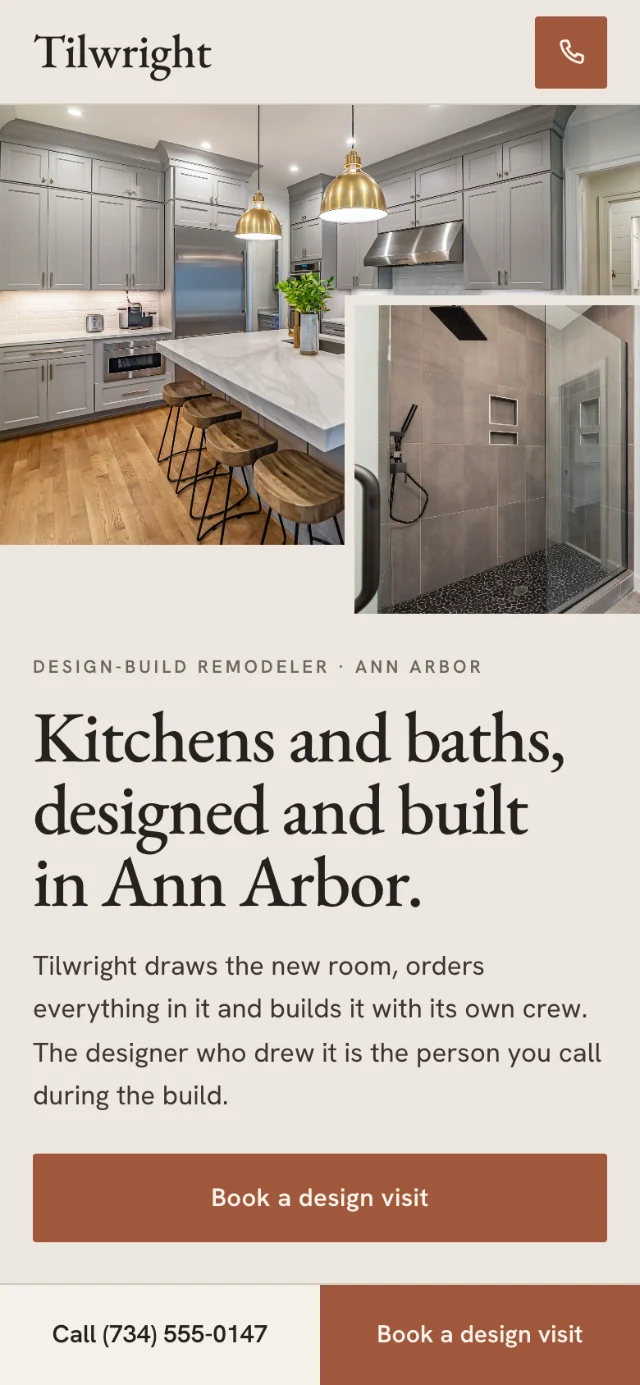
Example concept: Tilwright Kitchen & Bath is a made-up kitchen and bath remodeler, and the requests and numbers shown are made up too. Your site is built from your own photos, services and reviews, so it comes out stronger. See real builds
- The Sale
- An estimate, not an emergency
- Weeks of looking at photos before one request
- The Field
- 29.1% of remodeling listings
- link to no website, of 40,207 we checked
- Updated
- Numbers, sources and prices on this page checked
Rasmussen Results, in Tampa, Florida, builds remodeling contractor websites for kitchen, bath, basement and whole-home remodelers anywhere in the United States, for $2,000 once. You get a page for each room you remodel, a page for each finished project and an estimate form that tells you the room, the budget band and the timing before you drive out.
Tampa, Florida · Building for remodelers in every US state
The first screen
What should a remodeler's homepage show before anyone calls?
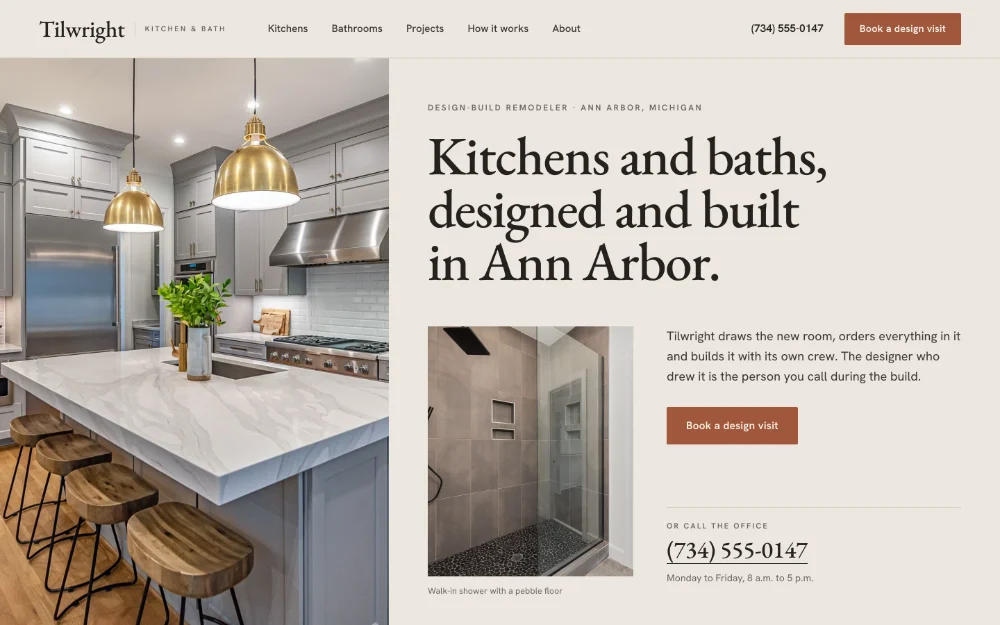
The example concept above opens its estimate with a choice of room and puts three captioned projects beside it. The design gallery has a concept for every trade, and these real contractor websites show what other builders put on screen one. A finished build follows four rules.
- Finished rooms, each with a caption
- A kitchen, a primary bath, a finished basement, shot wide in daylight. Under each one: the room, the neighborhood and what changed. A photo with no caption is decoration; a captioned one is evidence.
- The rooms you take on, and the ones you pass on
- Kitchens, baths, basements, whole floors. If you have a minimum project size or skip small repairs, saying so near the top saves you calls from people who wanted a handyman.
- An estimate button that starts with the room
- Kitchen, bath, basement or whole home is the first tap. Budget band and timing come next. It feels like planning a project, not filling out paperwork.
- Who will be working in the house
- Your face or your lead carpenter's, how the crew protects floors and holds dust in, and how the owner hears about progress. Someone who will live through the work wants to know this before picking tile.
Three visitors
Who visits a remodeling website, and what is each person looking for?
The planner
She is a year out, saving kitchen photos and reading at night. She will not fill out a form yet. What keeps you on her list is a project page for a room like hers, with the scope and the weeks it took.
The ready homeowner
The budget is set and the timing is close. He wants to know you work in his town, how soon you can come measure and what happens after he asks. A short estimate form and a process page answer that before he picks up the phone.
The referral
A neighbor, a designer or a cabinet showroom gave her your name. She is not shopping around yet; she is checking you are real. A license line, an address, a link to your Google reviews and projects from her part of town settle that in a minute.
This page is for firms whose work happens inside a house people are living in. If you build new homes, run commercial jobs or sell general construction, the general contractor website page is the better fit.
The field
How many remodelers have no website? 11,692 of 40,207 listings.
The method: public business listings checked September 8, 2026 through October 10, 2026. That covered 40,207 Google Maps listings for remodeling contractors in 753 towns across 40 states, each noted for where its website link pointed. 11,692 of them (29.1%) link to nothing, 887 (2.2%) link to a Facebook page, and 405 (1%) go to a site-builder subdomain or link page. No business is named.
In an estimate sale, that gap costs more than in an emergency trade. Nobody lets a stranger measure the kitchen on the strength of a map pin. When the homeowner's check ends at a listing with no site, the referral you earned goes to the remodeler she could look up.
The average for all 17 trades in the study is 30.8%. Method and state tables are in the trades-without-websites study.
The pages
Which pages does a remodeling contractor website need?
Each row below is a search a homeowner types, the page that answers it, and what that page holds.
- "kitchen remodel near me", "kitchen remodeling [town]"Kitchen remodeling
Same-footprint refresh versus moving walls and plumbing, cabinet lines you install, counters, lighting, and how the family eats while the kitchen is torn out.
- "bathroom remodel [town]", "tub to shower conversion"Bathroom remodeling
Hall baths, primary baths and powder rooms, the waterproofing system behind your tile, and how many days the room is out of service.
- "basement finishing", "basement remodel near me"Basement finishing
How you check for water before framing, family rooms, bars, guest suites, a bathroom below grade, and bedrooms with the window size the code requires.
- "whole house renovation", "design build remodeler"Whole-home and design-build
One team from layout drawings to the last outlet cover, a sample schedule by phase, and whether the family stays in the house.
- "home addition contractor", "primary suite addition"Additions
Only if you build them: bump-outs and suites, who draws the plans, and how the new room ties into the old roof and heating.
- "aging in place remodeling", "walk-in shower for seniors"Aging-in-place and accessibility
Curbless showers, blocking for grab bars, wider doorways, first-floor suites. Name NAHB's CAPS credential only if someone on your crew holds it.
- "[your company] projects", "remodel before and after"Projects, one page each
Every finished job as its own page: before and after pairs, the scope, the timeline and the town.
- "how long does a kitchen remodel take"How a remodel goes
Measure, design and selections, written contract, permits, demo, rough-in and inspections, finish work, final walkthrough.
- "kitchen remodel financing"Financing
Only if you offer it: the lender's name, a link to its terms, and nothing that promises approval.
- "licensed remodeling contractor [town]"About, license and insurance
Your license number for each state, the insurance line, and EPA lead-safe firm certification if you work in homes built before 1978.
- "remodeler near me", "[town] kitchen and bath"Town pages
Jobs completed in that town, the age and style of the houses you open up there, and the permit office you deal with.
- "remodeling estimate", "free in-home estimate"Request an estimate
Room, budget band, timing and address, a text-a-photo button, and what happens after the request is sent.
The lead-safe row comes from the EPA: firms paid to disturb paint in homes built before 1978 must be certified, sole proprietors included (EPA's Renovation, Repair and Painting program page). Ranking these pages after launch is the job of SEO for contractors, and paid estimate requests are covered on Google Ads for contractors. Build decks too? Outdoor work reads differently, as the deck builder website page shows.
Project photos
How should a remodeler show before and after photos?
One project per page, with before and after pairs taken from the same spot, a short scope, the timeline and the town. A gallery of fifty loose photos proves you work; a project page shows how you work.
- Same spot, both times
- Stand in the doorway for the before shot and stand there again at the end. The pair only works when the homeowner can see it is the same room: the window in the same place, the layout changed around it. Close-ups of grout lines belong further down the page.
- What each project page holds
- The room and the town, what was there before, what changed (walls moved, tub out, plumbing relocated), the weeks on site, and the finishes by name if the homeowner agreed. A budget range only if you choose to publish one. A line from the homeowner only if they wrote it themselves.
- Fast on a phone
- Photos straight off a phone are large files. On the site, every photo is resized for the screen it lands on, saved in a modern format like WebP, given its width and height so the page does not jump, and loaded only when the visitor scrolls near it.
- Rooms that disappear
- Some of your best work ends up behind paint: rerouted plumbing, new framing, a leveled floor. Take a phone photo of each stage before it closes up. Trades like drywall sell almost entirely on that kind of pair, which is why the drywall contractor page is built around it.
Estimate requests
What should a remodeling estimate form ask?
Enough to decide whether to drive out, and nothing more: which room, a rough budget band, when they want to start, and the address. Name and a way to reach them finish it. A photo can come later by text.
Long forms lose people. A twenty-question form that asks for cabinet style, square footage and appliance brands reads like homework, and most of those answers change at the walkthrough anyway. Ask what helps you qualify the job, then let the conversation do the rest.
Write the budget bands in your own numbers, the way you would say them on the phone, and add "not sure yet." A homeowner who picks the lowest band for a full kitchen is a phone call to set expectations, not a lost lead. Every request goes to your own inbox, with click-to-call on every page for the people who would rather talk.
- 01
Which room? Kitchen, bathroom, basement, whole home, something else.
- 02
Rough budget? Three or four bands in your numbers, plus "not sure yet."
- 03
When? Soon, in a few months, or just planning.
- 04
Where? Street address or town, so you know it is in your area.
- 05
How do we reach you? Name, phone, email. Photos by text, if they want.
The price
What does a remodeling contractor website cost with me?
The price is $2,000 in one payment for the room pages, your first project pages, the town pages and the estimate form, with no required monthly fee from me. On your own Google account, hosting usually costs $0 within Google's free allowance. Anything larger, like a second brand or a separate showroom site, is quoted in writing before the mockup.
| Who builds it | Price |
|---|---|
| An independent designer | $3,800 to $13,000 |
| A U.S. web design company | $7,500 to $19,400 |
| Thryv's Signature plan | $399 a month, $14,364 over three years |
The U.S. company rate is from Clutch's web design pricing guide (opens in a new tab) (updated September 21, 2026) and the Thryv price from Thryv's pricing page (opens in a new tab), both checked November 2, 2026. The hours are my estimate, and so is the independent designer rate. See the math in the website cost calculator.
The short version
Last updated:
- Price
- $2,000one time
- Monthly fee
- None required by me. Hosting usually costs $0 within Google's free allowance; a busy site might pay Google a few dollars a month. Maintenance is optional.
- Timeline
- 2 to 3 weeks from kickoff to a live site
- First step
- A free homepage mockup, so you see the design before you decide anything
See what you own and everything included
- You own
- The domainat your own registrar, renewing to you
- The codea GitHub repository in your name
- The hostinga Firebase project in your Google account, usually $0, with any charge billed by Google to you
- Google Analytics and Search Consoleproperties under your Google account
- Your Google Business Profileyou are the owner, and I am a manager you can remove
- Every form submissiondelivered to the inbox you choose
All of it in your name from day one. I am added as a collaborator for the build and removed by you at handover, and I never hold the only copy of any login.
- What's included
- Kitchen, bath, basement, whole-home and aging-in-place pages
- A page for each finished project, with before and after pairs
- A "how a remodel goes" page and a license and insurance line
- A page for every town you work in
- An estimate request form that asks room, budget band and timing
- Google Business Profile, GA4 and Search Console set up
- Set up on Bing too: Webmaster Tools, which reports how your pages show up in Microsoft Copilot, and Bing Places
The build
How does the build go, from mockup to launch?
Pull your photos first.
Your best finished jobs, with a before shot where you have one. They become the project pages.
- The free mockup
Send me your business name and town, and a homepage made for your remodeling company comes back as a link, ready to open on your phone. No call, nothing to sign.
- Rooms, projects, towns
We agree the page list in writing. I write the room pages and town pages, build the project pages from the photos you send or approve, and set up the estimate form. You read every page before it goes live.
- Launch and handover
The site goes live with analytics and Search Console running, a 301 redirect for every old address, and the domain, hosting and logins in your name. Swap photos and fix captions from your phone whenever a job wraps up.
Finished sites for other trades are on the portfolio, and the pricing page has the full terms. Already have a site that just looks dated? Read how a website redesign works first, and check who owns your current website before you cancel anything. Leasing a site from Hibu? The Hibu switching guide walks through the move.
Q&A
What remodelers ask about their website.
Every trade with its own page is listed on the industries page.
How much does a remodeling contractor website cost?
I charge $2,000 once, half at kickoff and half when you approve the finished site. That covers the pages for each room you remodel, your first project pages, a page per town and the estimate form. Hosting usually costs $0 within Google's free allowance, with no required monthly fee from me.
How many project pages should a remodeler start with?
Start with your best six to ten finished jobs, spread across the rooms you want more of. A kitchen company with only bathroom projects online will keep getting bathroom calls. A new project page can be added after launch without rebuilding the site.
Can I update my remodeling website from my phone?
Yes for the pages you have. Every site comes with a phone editor for words, photos, headings and page titles, and a change goes live within about ten minutes, so you can swap a photo or fix a caption from the driveway. A brand-new project page is added in the code, which you own: I can add it for you, or anyone you hire can.
Does a remodeler need a page for every town?
If you want to show up when someone types "kitchen remodeling" plus a town name, yes. Each town page shows the projects you finished there and the kind of houses you work on. One page that lists twenty towns rarely ranks for any of them.
Should my remodeling website show prices or budget ranges?
That is your call. Some remodelers publish a typical range per room to filter out people who are not ready, and others explain how they price and leave numbers for the walkthrough. A budget band question on the estimate form works either way, because it tells you where the homeowner stands before you drive out.
Do I need financing information on my website?
Only if you actually offer financing through a lender. Then name the lender, link to its terms and keep the wording plain. If you do not offer it, leave it off rather than writing "financing available" with nothing behind it.
Will my Houzz or Facebook photos carry over to the new site?
Nothing moves over by itself. I rebuild your project pages from the photos you send me or approve, so send the originals from your phone or camera when you have them. Photos you pick from your Houzz or Facebook pages work too, as long as they are your own work.
How long does it take to build a remodeling website?
Two to three weeks from kickoff to a live site. The free homepage mockup comes first, usually within 48 hours of your request. You can start today by pulling your best project photos together, since they become the project pages.
Accepting Remodelers
Send me your business name and town.
Back comes a free homepage design for your remodeling company, with your rooms up front and an estimate button that starts with the project. Open it on your phone between walkthroughs. Want to talk it over before you send anything? Call or email me directly.
Or call (813) 531-8442 or email chris@rasmussenresults.com.