SEO for Plumbers

Free. No call. Usually ready in 48 hours.
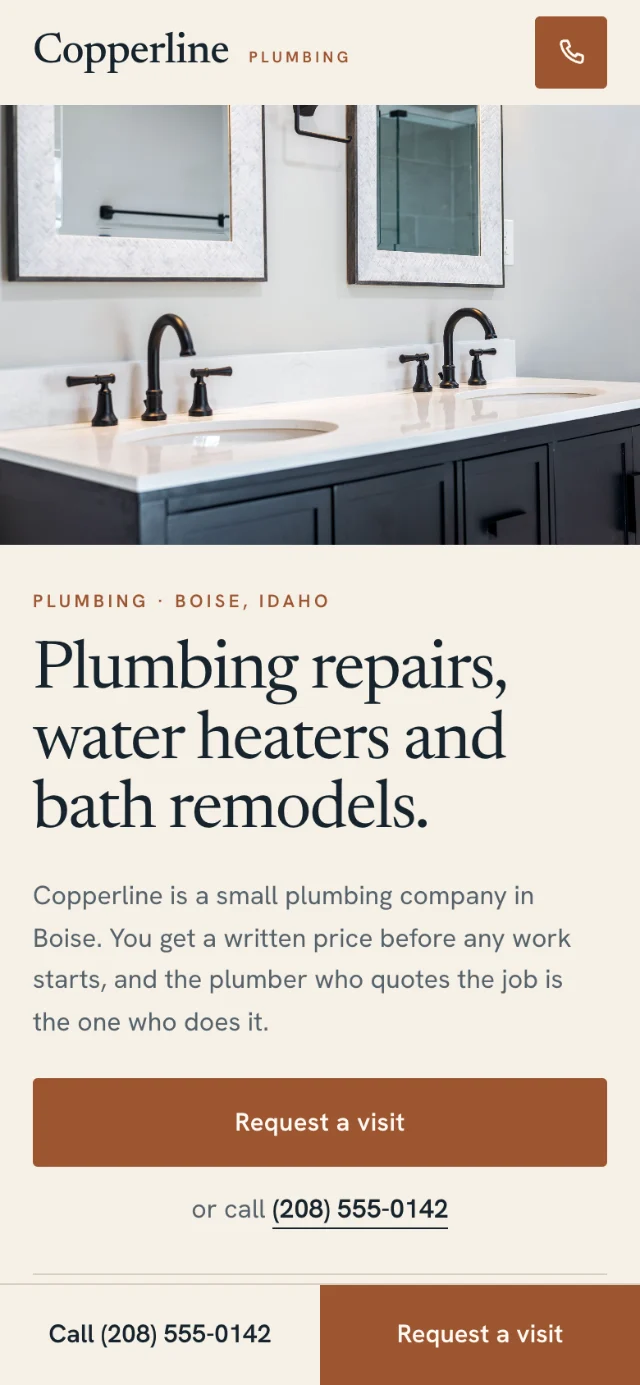
The phone number and the main button sit at the top of every page.
Example concept: Copperline Plumbing is a made-up plumbing company, and the requests and numbers shown are made up too. Your site is built from your own photos, services and reviews, so it comes out stronger. See real builds
- The Goal
- Pack + pages
- Emergency in Maps, water heaters in organic
- Measured In
- Your Search Console
- And your GA4, from day one
- Ownership
- All yours
- Site, domain, profile, GA4 and GSC
Rasmussen Results, in Tampa, Florida, builds the website and runs the SEO for plumbing companies across the United States. A burst pipe at 2am and a planned tankless conversion are different searches, won on different layers of Google, and the site is built for both. You own the site; SEO after launch is quoted in writing and runs month to month.
Tampa, Florida · Remote builds in any US state
The funnel
The plumbing search funnel: four moments, four layers of Google.
A homeowner looks for a plumber in four different moments, and each one is decided on a different layer of Google. The first is the burst. A pipe lets go at 2am, the water heater is dumping into the garage, the sewer is backing up into the tub. That search is "emergency plumber near me" on a phone, and the person taps the first business that looks open. Local Services Ads sit at the top, the map 3-pack sits under them, and everything else is below the fold.
The second moment is planned work: a water heater in its fifteenth year, a repipe on a house with polybutylene, a tankless conversion. That homeowner opens two or three websites and compares, so the organic results under the map do the work. The third is price research, "how much does a water heater replacement cost," won by a service page that gives price ranges. The fourth is the review check, where someone who already has your name reads your profile before they dial.
Most plumbing sites are built for none of the four. The profile is thin, so the emergency call goes to the shop in the pack. There is one Services page, so the planned job goes to the site with a real water heater page. There is no emergency page, so the 2am search has nothing to land on. More on how home-service profiles reach the pack in how home service businesses rank in Google Maps.
A site built for all four moments, with an emergency page, a page per plumbing service and your town pages, is the standard build: $2,000. Past that, the bigger build is quoted on paper before any mockup, so the cost is settled before anything is built.
The field
How many local trades still have no website at all.
Between September 8, 2026 and October 10, 2026, we checked public Google Maps listings for 17 local trades and recorded whether each one linked to a website. Across all of them, 30.8% of listings had no website at all. For an emergency trade that matters twice: the 2am caller who cannot see your services, towns or hours on a page calls the shop that shows them.
For plumbing, we checked 2,305 listings in 30 towns across 30 states. 23.7% have no website, and another 1% point to a Facebook page in place of one. Those are the shops a real emergency page and a real water heater page beat first.
No business is named and the counts are ours, a field survey rather than a census. The method, the state table and every trade are in the study of local trades without websites.
Local SEO
Local SEO for plumbers: the category, the service area, the reviews.
The primary category on your Google Business Profile decides which map searches you are even eligible for. For a plumbing company it should be Plumber, not Contractor, not Handyman, not Home Improvement. I find the wrong primary on more audits than you would expect, usually because whoever set the profile up years ago picked the first thing that looked close.
Secondaries tell Google about the specific work: Water heater repair service, Drainage service, Gas installation service, and Septic system service where you actually pump and repair septic. Each one is a search you become eligible for, and each one added without doing the work is a call you cannot take. The service descriptions under each category deserve real sentences about the job, not a keyword list.
Then the details that are plumbing-specific. Hours set to open 24 hours only if a human answers at 2am, because a missed emergency call earns a one-star review. If homeowners never visit your shop, hide the address and set service areas, up to twenty, that match the towns you roll to; Google's own guidance keeps that footprint within roughly two hours of driving. Photos of the trucks, the crew and the water heater install in the customer's garage, not a stock wrench. And a review request that goes out the day the job closes, with a direct link, because reviews arriving weekly read as a working plumber and reviews arriving in quarterly bursts read as a campaign. The field-by-field version is the Google Business Profile checklist.
Service pages
Service pages, ranked by what they are worth.
Google ranks pages, not companies, so every service you want calls for needs a page whose whole job is that service. I build them in order of what the job is worth and how often it is searched. Emergency plumbing first, because it is the highest-intent search in the trade. Water heater repair and replacement second, with tank and tankless in separate sections, because the ticket is large and the search is planned. Drain cleaning and hydro jetting third, because the volume holds all year.
Here is what the water heater page contains, so this is not abstract. An H1 that names the service and your main city. A short section on tank versus tankless and when each makes sense. The towns you install in. Price ranges, so the price-research search lands on you instead of a national site. Three or four questions homeowners ask, answered. Photos of your installs, a tap-to-call button, a quote form and a text button for photos. That page ranks for "water heater replacement [city]," which the map pack cannot do alone.
The rule for the rest is simple: if you would send a different truck or quote it differently, it is a different page. Sewer line repair and camera inspection, repiping, slab leaks, gas lines, fixtures, backflow testing, commercial work. Each gets its own URL, title and Service schema. The design side of this page map is on plumber website design.
Three layers
Local Services Ads vs the map pack vs organic, for plumbers.
For a plumbing search, Google usually stacks its results in a fixed order: Local Services Ads with the Google Verified badge (called Google Guaranteed until October 2025), then the regular paid ads, then the map 3-pack, then the organic pages. A plumber who ignores any one layer hands it to a competitor.
Local Services Ads charge per lead rather than per click, which fits plumbing: an emergency call is worth paying for, and plumbing clicks are among the most expensive in home services. Getting in takes a background check and license verification, and the unit is ordered mostly on proximity, reviews, responsiveness and hours. The catch is that LSA leads stop when the budget does, and the rating comes from the same profile that feeds the map pack.
Organic pages carry what the other two cannot. Nobody researches a tankless conversion inside an LSA unit; they read a page. For a shop that needs volume this week, the paid side is on Google Ads for plumbers.
Keywords
Plumbing SEO keywords, mapped to the page that should rank for each.
Plumbing SEO keywords fall into four buckets, and each cluster gets exactly one page. Two pages chasing the same phrase split the signal and both lose. Service phrases map to the service pages. After-hours phrases map to the emergency page, and only the emergency page. Town phrases map to the town pages and to the homepage for your base city. Symptom phrases, the ones with a problem in them, map to a question block on the right service page, or to a short article when the question is big enough.
In the audit I pull the real phrases for your towns and sort them into these groups before a page is drafted. That is plumbing search engine optimization in its plainest form: find the phrases, give each cluster a page, write the page for the person typing. What it leaves out is "plumbing" on its own and "plumber" without a city. Those are searched from everywhere and book nothing anywhere.
The price
How much does SEO for plumbers cost here?
The website is $2,000, paid once, with the emergency page, the service pages and the town pages built in. SEO after launch is separate: the profile, review and page work quoted in writing for your towns, billed month to month, and measured in your own Search Console and GA4. A one-truck shop in a small town and a twelve-truck metro company are not the same job, so there is no single SEO price on this page.
The short version
Last updated:
- Price
- $2,000one time
- Monthly fee
- None required by me. Hosting usually costs $0 within Google's free allowance; a busy site might pay Google a few dollars a month. Maintenance is optional.
- Timeline
- 2 to 3 weeks from kickoff to a live site
- First step
- A free homepage mockup, so you see the design before you decide anything
See what you own and everything included
- You own
- The domainat your own registrar, renewing to you
- The codea GitHub repository in your name
- The hostinga Firebase project in your Google account, usually $0, with any charge billed by Google to you
- Google Analytics and Search Consoleproperties under your Google account
- Your Google Business Profileyou are the owner, and I am a manager you can remove
- Every form submissiondelivered to the inbox you choose
All of it in your name from day one. I am added as a collaborator for the build and removed by you at handover, and I never hold the only copy of any login.
- What's included
- An emergency page with tap-to-call in the first screen
- A page for each service: water heaters, drains, sewer, repipe, gas
- A page for each town you send trucks to
- Plumber schema and Service schema on every page
- A quote form and a text button for photos
- Business Profile, Search Console and GA4 in your name
- Set up on Bing too: Webmaster Tools, which reports how your pages show up in Microsoft Copilot, and Bing Places
How it works
How it works: mockup, audit, profile, pages, launch.
Step one is free, and you keep it.
SEO services for plumbers start here with a homepage mockup. Send me your business name and town; it comes back before you decide anything.
- Free homepage mockup
Send me your business name and town. I design a real homepage with the emergency call and your top-ticket work where a homeowner on a phone finds them. Nothing to sign, and you keep it.
- Audit and baseline
Before anything is built I write down the starting point: pages Google has indexed, your primary category, your review count and pace, whether you run Local Services Ads, and every name, address or phone mismatch across Yelp, Angi, HomeAdvisor and Apple Maps.
- Profile and listings
The Plumber category, the right secondaries, real service descriptions, honest hours, service areas that match where you work, and photos of your trucks and installs. Then the old directory listings get corrected so Google sees one company.
- Service pages and the review request
Emergency, water heaters, drains and sewer first, then the rest, each with schema, its towns and a tap-to-call button. The review request goes live the same week, so reviews arrive with the jobs.
- Launch and hand over
The site goes live with Search Console and GA4 in your name and phone taps counted as conversions. Every login is yours. If you want SEO work after launch, it is quoted in writing and runs month to month.
Timing + fit
What nobody can promise, what usually moves, and who this is for.
Nobody can honestly promise when a plumbing page will rank, and a plumber SEO company that names a date is guessing. What usually moves things is known. Pages have to be indexed before they rank at all. The Business Profile, with the right category, service areas and a steady pace of reviews, tends to respond first. Pages per service and per town widen what you show up for as they are added. You watch every step in your own Search Console from the first day.
This fits the owner-operator plumbing company with a defined service area, more than one service, and a phone that should ring for water heaters and sewer lines, not only emergencies. It fits a shop with two trucks and a shop with twelve, and a new company with no site at all. It does not fit a shop that wants to keep a directory-built site and bolt on a backlink package, or one that would rather buy every lead from a broker and own nothing.
Q&A
SEO for plumbers: the questions owners actually ask.
Should a plumber run Local Services Ads and SEO at the same time?
If the budget allows it, yes. Local Services Ads sit above everything on a plumbing search and charge per lead, so they are the fastest way to get the phone ringing, but the leads stop the day the budget does. Google pulls your rating and category from the same Business Profile that feeds the map pack, so the profile work pays on both. Let LSA carry emergency volume and let the pages carry water heater, drain and sewer searches.
How do I rank for water heater replacement instead of just plumber near me?
Give replacement a page of its own. The H1 names the service and your main city, and the page covers tank versus tankless, what a swap involves, the brands you install and price ranges, with photos of your own installs and a tap-to-call button. Plumber near me is won by the profile; water heater replacement is won by the page that says it most clearly.
Do I need a separate page for every town I serve?
Not every town. Build a page for each town where you already do real work and can say something true about it: the neighborhoods, the jobs, the drive time from your shop. A page with the same paragraph and a swapped city name is the kind Google skips. Start with your home city and the three or four towns that produce the most invoices.
Why does my plumbing company show up in Maps on my own street but not across town?
Distance is one of the three things Google weighs in Maps, along with relevance and prominence. Across town, plumbers nearer the searcher get the distance edge, so you have to beat them on the other two. Relevance comes from the Plumber category, complete services and town pages; prominence comes from reviews, how often they arrive, and consistent listings.
What Google Business Profile category should a plumber use?
Plumber as the primary, never Contractor, Handyman or Home Improvement. Then add secondaries only for work you actually do, such as Water heater repair service, Drainage service, Gas installation service or Septic system service. A wrong secondary brings calls you cannot take.
Does putting 24/7 in my business name help or hurt?
It usually hurts. Google says the profile name should match the name on your trucks, signage and license, and competitors do report keyword-stuffed names. A suspension takes longer to fix than any rank it gained. Put 24/7 in your hours, if someone really answers overnight, and on the emergency page.
How long before plumbing SEO shows results?
Nobody can honestly promise when a page will rank. What usually moves first is the Business Profile: the right category, service areas and a steady pace of reviews. Service pages need to be indexed before they can rank at all, and town pages widen what you show up for over time. You watch all of it in your own Search Console from the first day, so you never have to take my word for it.
Accepting Plumbing Companies
Send me your business name and town. I will send back a homepage.
Tell me your business name and town. I design a real homepage for your plumbing company with the emergency call and your top-ticket services where a homeowner on a phone will find them. Free, no call to book, and you keep it either way.
Or call (813) 531-8442 or email chris@rasmussenresults.com.