Google Ads for HVAC Companies

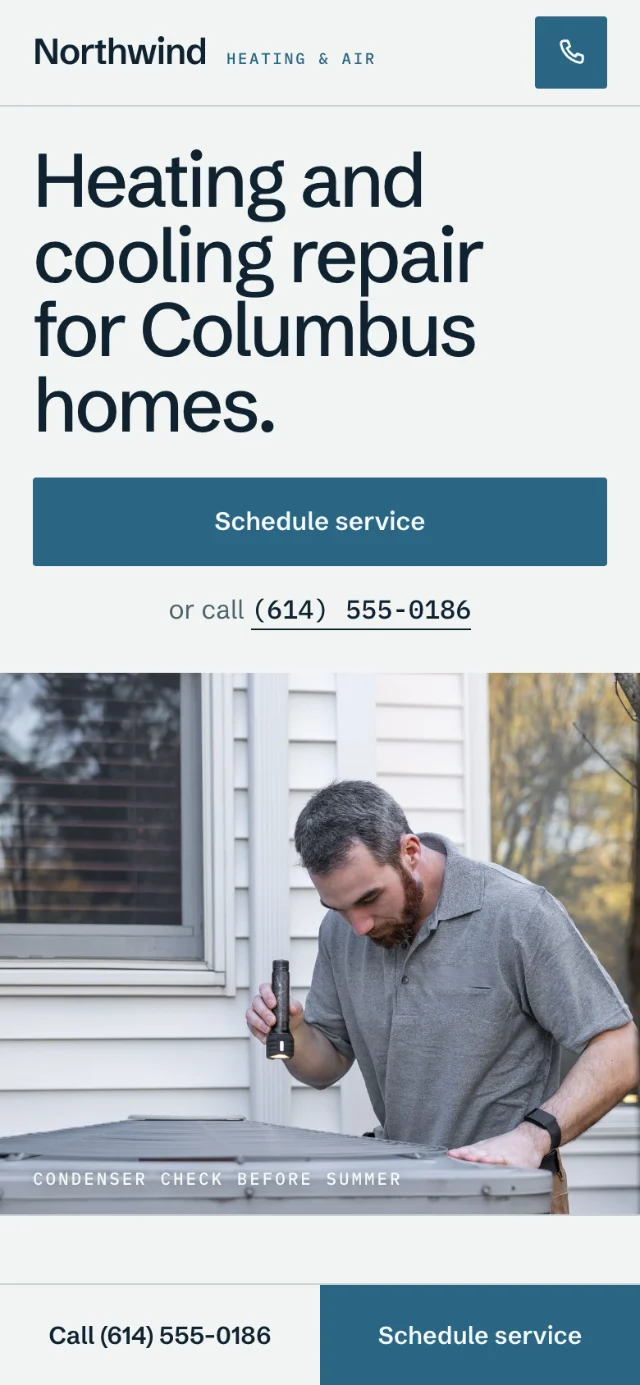
The phone number and the main button sit at the top of every page.
Example concept: Northwind Heating & Air is a made-up heating and air company, and the requests and numbers shown are made up too. Your site is built from your own photos, services and reviews, so it comes out stronger. See real builds
- Hot and Cold Weeks
- Repair campaigns up
- No-cool and no-heat calls
- Mild Weeks
- Plans and quotes up
- Tune-ups and replacement estimates
- Landing Pages
- One per job
- Site, domain, and accounts in your name
An HVAC ad account can lose money in two directions. In the first hot week of the year it can run out of budget before lunch, while the repair calls are still coming in. Then it keeps spending the same amount through a mild October on people pricing tune-ups. Google Ads for HVAC companies works when the budget follows the thermometer, when repair, replacement, and maintenance plans run as separate campaigns, and when every click lands on a page built for the job the homeowner searched for. If you need those pages, I build the site and you own it. Ads management is quoted separately.
Tampa, Florida · Remote builds in any US state
The swing
One daily budget cannot cover July and October.
Plenty of trades get busier in one season than another. HVAC demand moves with the thermometer, and it moves in days. The first stretch of mid-90s heat sends people to Google typing "AC repair near me," "AC not cooling," and "AC blowing warm air." The first hard freeze does the same thing to "furnace not working" and "heat pump blowing cold air." Then the weather settles, and those searches go quiet until the next swing.
An account with one campaign and one fixed daily budget handles that badly both ways. In the hot week, the money can be gone by late morning, and the ads disappear during the hours when calls are worth the most. In the mild weeks, the same budget keeps buying clicks, and Google spends it on whatever searches are left: filter sizes, thermostat manuals, "how much is an AC tune up," and people comparing prices with nothing broken.
Spending more does not solve it. A plan written month by month does: a repair campaign ready to scale the day the forecast turns, a maintenance plan campaign that carries the shoulder weeks, and a replacement campaign that runs all year, because a system near the end of its life can fail in any month.
Those campaigns need pages to land on. If your site has none, the standard build is $2,000 for repair, replacement and financing pages plus one per town; a bigger build gets a written quote ahead of the mockup, so you know that cost before work starts.
The campaign split
Why AC repair and AC replacement never share a campaign.
Each campaign gets its own budget, its own conversion value, and its own page.
Google's automated bidding learns from what you tell it a conversion is worth. Count a repair call and a replacement quote as the same conversion and it cannot tell them apart, so it chases whichever one is cheaper to get. The example headlines below show the structure; your real ads say only what is true about your company.
- Repair: no-cool and no-heat
Searches like "AC repair near me," "AC not cooling," "furnace not turning on," and "heat pump repair." The goal is a phone call within the hour, so the ads carry a call button, run only while someone answers, and land on a repair page with the number at the top. A call counts as a lead only after it passes a minimum length.
Example headline: "AC Repair in [Town] | Call Now"
- Replacement and new systems
Searches like "AC replacement cost," "new AC unit," "furnace replacement," "heat pump installation," and "ductless mini split installer." This homeowner is collecting quotes and may take weeks to decide, so the conversion is a quote request or an in-home estimate, valued higher than a repair call, and the page explains how you quote a new system.
Example headline: "New AC System Quotes | [Town]"
- Maintenance plans and tune-ups
Searches like "AC tune up," "furnace tune up," "HVAC maintenance plan," and "spring AC service." This campaign carries the mild weeks before each season, when tune-ups are easiest to schedule. It is judged on plan sign-ups and tune-up bookings, not on the repair calls it was never built to produce.
Example headline: "Spring AC Tune-Up in [Town] | Book Online"
- Your company name
Competitors are allowed to bid on your business name. A small brand campaign puts your own ad on the page when a past customer, or someone who saw your truck, searches for you by name to find the number.
Example headline: "[Company Name] | Heating and Cooling"
No heat, no cool
Emergency ads that run only while someone answers the phone.
A no-heat or no-cool search is a phone call waiting to happen. Someone typing "no heat" at 6 a.m. in January, or "AC stopped working" on a Saturday in August, is usually not comparing three websites. They want a number to call, from a company that looks local and believable. The emergency campaign exists to put your number in front of them, and only during the hours when the call gets picked up.
Ad scheduling does the work. Google Ads lets each campaign run on the days and hours you choose, with bids raised or lowered by time of day. If calls after 7 p.m. reach an answering service or an on-call tech who can book the job, the emergency campaign keeps running overnight with its own bids. If they reach voicemail, the campaign stops at close, because a paid click that hits voicemail buys nothing when the homeowner hangs up and dials the next ad.
The ad has to say what is true. A call asset puts your number beside the ad, a location asset ties it to your Google Business Profile, and the headline names the problem: "No Heat? Furnace Repair in [Town]." It does not promise an arrival window your schedule cannot keep. The landing page repeats the number at the top and lists the symptoms the way a homeowner describes them: a furnace that clicks but never lights, a heat pump stuck in defrost, an outdoor unit humming with the fan still, a breaker that trips every time the compressor starts.
The forecast
Scheduling HVAC ads by the ten-day forecast and the hour of the day.
Google Ads has no weather switch built in. Budgets respond to weather because someone watches the forecast and moves them. The routine is plain: when the ten-day forecast shows the first run of hot days, or the first hard freeze, the repair campaign's budget goes up a few days early, so the ads are already at full strength when the calls start. When the weather breaks, the budget comes back down before Google spends it on the tail end of the searches.
Inside each day, bids follow answered calls. At launch the schedule matches your office hours and your after-hours coverage, nothing fancier. Once the account has a few weeks of call data, it shows which hours produce calls that turn into jobs, and the schedule bids up in those hours and down in the rest.
Across the year, each month gets its own budget. In a cooling-first market like Tampa, AC repair carries most of the year and heating runs for a handful of cold weeks. A heating-first market reverses that, with furnace and heat pump repair carrying the winter. Either way, the shoulder months move money to maintenance plans and replacement quotes, when a homeowner has time to plan a system change instead of reacting to a failure. Storm-driven trades run a similar playbook: Google Ads for roofers is built around hail and wind instead of heat and cold.
LSA or search
Local Services Ads versus search ads, sorted by HVAC job type.
Local Services Ads sit above the regular ads for many HVAC searches, show the Google Verified badge once you pass Google's background and license checks, and charge per lead instead of per click. You do not pick keywords. You pick the job types you take and the area you cover, and Google decides when to show you based on factors like how close you are to the searcher, your reviews, how quickly you respond to leads, and your business hours.
That makes Local Services Ads a strong fit for repair calls: short, local, urgent, and priced per lead. It makes them a weaker fit for replacement work, where you want control over which searches you pay for, what the ad says about brands and financing, and which page the homeowner reads before calling. Search campaigns give you that control, at a price per click whether or not the click turns into a call.
So the usual setup is both, split by job type, with the same phone line and the same Google Business Profile underneath. Your profile reviews show on Local Services Ads, which is why the review work in the Google Business Profile checklist pays off on the paid side too. Where Google does not offer Local Services Ads for HVAC in your area, search campaigns carry both jobs. The management model behind all of it, a flat fee and an account in your name, is laid out on the Google Ads services page.
Landing pages
Where the click lands: repair, replacement quote, and financing pages.
The site is $2,000 one time. Ads management is quoted separately.
An ad is only as good as the page it sends people to. A no-cool click that lands on a homepage slider, or a heat pump click that lands on a duct cleaning page, is paid for and wasted. Each campaign needs a page written for its search: a repair page with the number at the top, a replacement page that explains how you quote a new system and what changes the price, a maintenance page that says what a plan visit includes, and a page for each town you cover.
If your current site has those pages and loads fast on a phone, the ads point there. If it does not, I build the site for a flat $2,000 one time: no required monthly fee, no retainer, no long-term contract, and 2 to 3 weeks from kickoff to live. It is server-rendered, fast, and mobile-first, with a page per service, service-area pages, schema, and GA4, Search Console, and Clarity set up in your name. You own the site, the domain, and every account, and a free homepage mockup comes first so you see the direction before you pay.
Replacement and financing pages need the most care. If you offer financing, the replacement page names it plainly, says where to apply, and matches the ad word for word. If you do not, neither the ad nor the page mentions it. The quote form asks what you need to quote a system: its age, the size of the home, gas or electric, ducted or ductless. The full build standard is described on the contractor website design page.
See the website buildTracking
Call tracking that separates a repair call from a replacement quote.
An HVAC account that only counts form fills misses every job that started with a phone call. Google Ads can count calls placed straight from the ad and calls from your website after an ad click, and it lets you set a minimum call length before a call counts, so a wrong number or a quick hang-up is not reported as a lead.
What makes those numbers useful is keeping the job types apart. A repair call, a replacement quote request, and a maintenance plan sign-up are set up as separate conversions with different values. That way the bidding learns that a quote request for a new system is worth more than a tune-up booking, and the monthly report shows cost per call and cost per quote for each campaign instead of one blended number.
On the landing pages, GA4 records calls and form submissions as events, and Microsoft Clarity shows where people stop reading and what they tap. If you log which calls became booked jobs, those results can be imported back into Google Ads, so the account learns from jobs and not just from rings. The events worth tracking are in five GA4 events every small business site should track.
Cost
How much do Google Ads cost for an HVAC company?
The closest published figure is $8.33 a click and $90.92 a lead, the 2026 average for home services in LocaliQ's benchmark report. The report has no row for heating and cooling alone, and a yearly average hides the season.
At that average, $1,000 of ad spend comes to about 11 leads ($1,000 divided by $90.92). A repair call and a replacement quote are worth very different amounts, so the account counts them as separate conversions. This is what Google charges for clicks; management is a separate flat fee.
| Average | Home & Home Improvement | All industries |
|---|---|---|
| Cost per click | $8.33 | $5.42 |
| Click-through rate | 6.47% | 6.64% |
| Clicks that become a lead | 8.05% | 8.18% |
| Cost per lead | $90.92 | $66.69 |
What you get
What an HVAC Google Ads account includes, line by line.
- 01Separate repair, replacement, and maintenance plan campaigns, each with its own budget and landing page
- 02An emergency no-heat and no-cool campaign scheduled to the hours a person actually answers the phone
- 03A budget set for each month, raised ahead of forecast heat or cold and lowered when the weather breaks
- 04Local Services Ads set up and linked to your profile where Google offers them for HVAC in your area
- 05Call tracking with a minimum call length, so a wrong number or a quick hang-up never counts as a lead
- 06Separate conversion values for repair calls, replacement quote requests, and maintenance plan sign-ups
- 07Negative keywords for filters, parts, thermostat manuals, trade school, and job seekers, reviewed monthly
- 08Location targeting set to people in the zip codes you drive to, not people who are merely interested in them
- 09A flat management fee quoted up front, never a percentage of spend, in a Google Ads account you own
Ads management quoted separately as a flat fee · Website build $2,000 one time · You own the Google Ads account and every page.
How it works
How it works: audit, tracking, pages, then campaigns in season order.
Five steps, starting with a free audit and no sales call.
Tracking goes in before any money is spent, and campaigns launch in the order your calendar needs them. If you also want the organic side, the SEO for HVAC build uses the same pages.
- Free Google Ads audit
You send your business name and town, with a note on the months your phone is busiest. If you already run ads, I read the account month by month: where the budget went in the hot weeks and the mild ones, whether calls are counted at all, and whether repair and replacement are mixed in one campaign. If you do not, I map the campaigns your market supports. No sales call.
- Tracking before spend
Call tracking and separate conversions for repair calls, replacement quotes, and plan sign-ups go in before a dollar runs, each with its own value. GA4 and Microsoft Clarity go on the landing pages. The Google Ads account is created in your name, or stays in your name if you already have one.
- Landing pages
If your site already has a fast repair page, replacement page, and maintenance page, the ads point there. If it does not, I build the site: $2,000 one time, 2 to 3 weeks from kickoff to live, a page per service and per town, and a free homepage mockup first. You own it.
- Launch in season order
The campaign that matches the calendar goes first. Heading into summer, that is AC repair. Heading into winter, it is furnace and heat pump repair. In the shoulder months, maintenance plans lead. The replacement campaign runs all year, because an old system can fail in any month.
- Monthly review and the next swing
Every month I read the search terms Google actually matched, add negatives, and set next month's budgets against the forecast and your schedule. You see cost per call and cost per quote request by campaign, in your own account, whenever you want to look.
Q&A
Google Ads for HVAC companies, question by question.
How much should an HVAC company spend on Google Ads?
Plan the budget by month, not as one yearly number, because HVAC demand does not hold still. Start from what one booked job is worth to you: a repair, a replacement, a maintenance plan. The cost per booked call you can afford comes out of that, and a peak-month budget is roughly the number of extra calls you can actually run times that cost. The free audit uses Google's own search volume and bid estimates for your towns to check whether the math works before you spend. Your ad budget is paid to Google directly. My management fee is separate, quoted up front as a flat amount, and never a percentage of what you spend.
Should I raise my Google Ads budget during a heat wave?
Yes, if you can run the extra calls, and ideally a few days before the heat arrives rather than after it. Searches for AC repair climb with the temperature, and a budget that runs out by midday leaves the afternoon calls to whoever is still showing. The limit is your schedule, not the ad account. If the board is already booked several days out, more spend buys calls you have to turn away or push to next week, and those homeowners will likely call someone else. The plan sets a peak budget in advance, and a ceiling tied to how many jobs you can take per day.
Should AC repair and AC replacement be in separate Google Ads campaigns?
Yes. Repair and replacement are different searches with different values and different landing pages, and one campaign cannot bid correctly for both. A repair search wants a truck today. A replacement search wants a quote and may take weeks to decide. If both count as the same conversion, Google's bidding treats a diagnostic visit and a full system quote as equal and spends toward whichever is cheaper to get. Separate campaigns get separate budgets, separate conversion values, and separate pages: the repair ad lands on the repair page, and the replacement ad lands on a page that explains how you quote a new system.
Are Local Services Ads better than search ads for HVAC?
They are better for some jobs and worse for others. Local Services Ads charge per lead, sit above the regular ads for many HVAC searches, and carry the Google Verified badge once you pass Google's screening, which suits urgent repair calls. You do not choose keywords, though. You choose job types and a service area, and Google weighs things like distance, reviews, responsiveness, and business hours when deciding who to show. Search ads cost per click, but you pick the searches, write the ad, and choose the page, which suits replacement quotes and specific equipment like heat pumps or ductless systems. Running both, split by job type, covers each.
Can I run HVAC ads only for after-hours no-heat and no-AC calls?
Yes. Ad scheduling lets a campaign run only in the hours and days you choose, so an emergency campaign can cover evenings, overnight, and weekends while a daytime campaign covers the rest. The condition is that a person answers. If after-hours calls reach an answering service or an on-call tech who can book the job, the campaign runs through the night with its own bids. If they reach voicemail, the campaign should stop at close, because paying for a click that reaches voicemail buys nothing when the homeowner hangs up and dials the next ad. The ad should state your real hours and never promise a response time you cannot keep.
Should I mention financing in my HVAC ads?
Only if you offer it, and only in the replacement campaign. A homeowner facing a full system replacement may be weighing how to pay for it, so a financing line in a replacement ad can be the reason they call you instead of the next listing. It does nothing for a repair ad, where the searcher wants a truck today. Whatever the ad says, the landing page has to say the same thing: who provides the financing and where to apply, without promising approval or terms you do not control. If you do not offer financing, leave it out of the ads and the page entirely.
Do maintenance plan ads pay off for HVAC companies?
They can, if you judge them by the customer and not by the tune-up price. A maintenance plan campaign targets searches like "AC tune up," "furnace tune up," and "HVAC maintenance plan," and runs hardest in the mild weeks before each season, when tune-ups are easiest to schedule. Judged on one visit, it can look expensive. The value is the recurring visits, the chance to spot a failing system before it quits, and a homeowner who already has your number when a replacement is due. Track plan sign-ups as their own conversion so the campaign is measured on sign-ups, not on repair calls it was never meant to produce.
Can my Google Ads point to my existing HVAC website?
Yes, if it has a page for each job you advertise and it loads fast on a phone. A repair ad needs a repair page with the number at the top, a replacement ad needs a page that explains how you quote a new system, and a maintenance ad needs a page that says what a plan includes. Sending all three to the homepage wastes the click. If your site does not have those pages, I build one: a flat $2,000 one time, no required monthly fee, 2 to 3 weeks from kickoff to live, with a page per service, a page per town, and GA4, Search Console, and Clarity in your name. You own it, and a free homepage mockup comes first.
Can I pause my HVAC Google Ads in the slow season?
Yes. The account is in your name, and the budget is yours to raise, lower, or pause at any time. Pausing keeps the campaigns, the conversion history, and the keyword lists intact, so they restart where they stopped instead of starting cold. A full pause is not always the best use of the quiet months, though. Shifting the budget to maintenance plans and replacement quotes keeps the account collecting data and can fill the schedule ahead of the next peak. Your site pages and Google Business Profile keep working while the ads are off, which is why ads and SEO for HVAC do more together than either does alone.
Accepting HVAC Companies
Get a free Google Ads audit before the next hot or cold spell.
Send me your business name and town, with a note on the months your phone is busiest. If you already run ads, I will show you where the budget went by month and by campaign. If you do not, I will map the repair, replacement, and maintenance campaigns your market supports. No sales call.
Or call (813) 531-8442.