Google Ads for Contractors

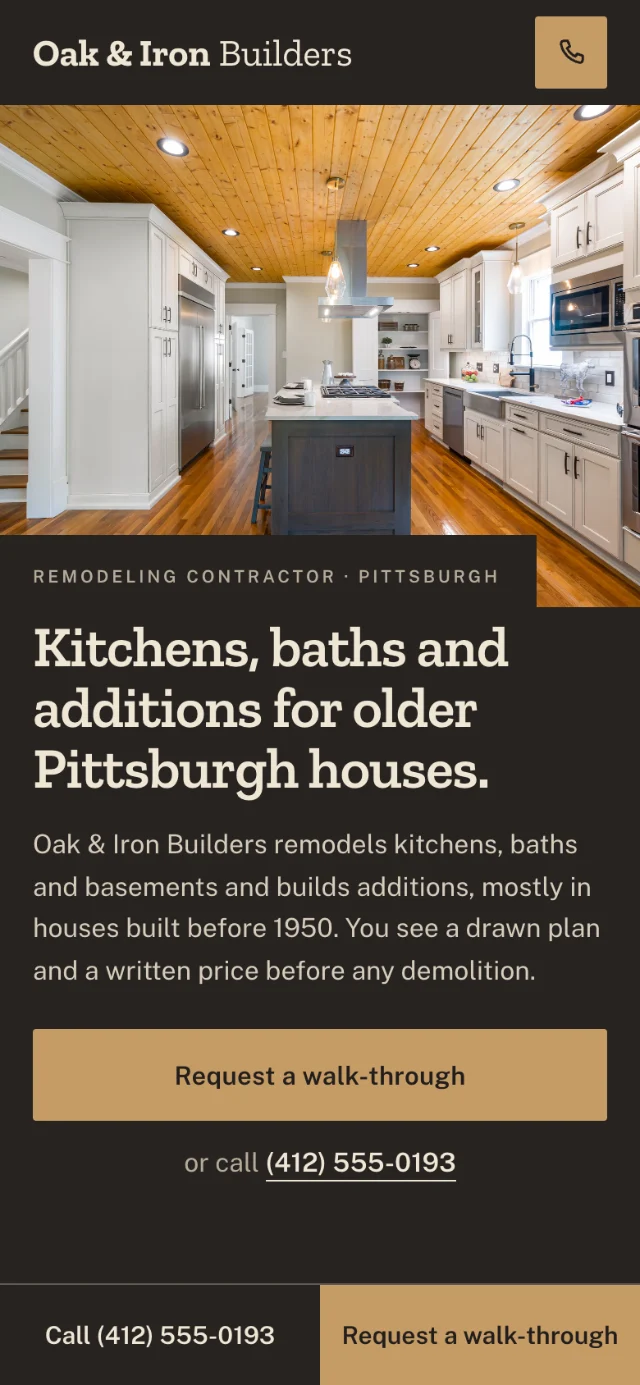
The phone number and the main button sit at the top of every page.
Example concept: Oak & Iron Builders is a made-up remodeling contractor, and the requests and numbers shown are made up too. Your site is built from your own photos, services and reviews, so it comes out stronger. See real builds
- Fee
- Flat monthly
- Not a percentage of spend
- Tracking
- Calls + conversions
- Wired into GA4 from day one
- Ownership
- You own the account
- Cancel anytime, keep the data
Most contractors run Google Ads and have no idea which clicks ring the phone. I fix that. Call tracking and conversion tracking go in before a dollar of spend, you pay a flat monthly fee instead of a cut of your budget, and you own the Google Ads account outright. Plumbers, roofers, electricians, and HVAC contractors all bid on the same urgent searches. The goal here is cost per booked job, not a clicks report nobody can read.
Tampa, Florida · Remote builds in any US state
The problem
Why do contractors burn money on Google Ads?
Most contractors who try Google Ads quit convinced it does not work. The truth is the account was set up to fail. Two mistakes cause almost all of it. First, there is no call tracking, so the phone rings and nobody knows which keyword drove the call. Google reports "clicks" and "conversions" that have nothing to do with the jobs you actually booked. You are paying for traffic and guessing at results.
Second, the campaign bids on the wrong jobs. Broad keywords with no negative lists pull in renters, price shoppers, people in the next county, and homeowners looking for a DIY answer instead of a contractor. A plumber ends up paying for clicks on "how to fix a toilet" and a roofer pays for "roof shingle prices." The budget drains into searches that were never going to book a job, and because there is no tracking, the owner cannot even see where it went.
The fix is not a bigger budget. It is tracking first and tight targeting second. Put call tracking and conversion tracking in before you spend, geo-target to your real service area, and block the wrong searches with negative keywords. Do that and the same budget that felt like a waste starts producing booked jobs at a cost you can finally see. This is the same measurement discipline behind my analytics and tracking work.
High-intent search
The searches that book emergency and high-ticket jobs.
Google Ads works for contractors because of how homeowners search when something breaks. The intent is urgent and the wallet is open. When a pipe bursts at 9pm, nobody scrolls for an hour. They search "emergency plumber near me," tap the first credible ad, and call.
Those are the searches a contractor campaign is built around. For plumbers it is "emergency plumber," "water heater replacement," and "burst pipe repair." For roofers it is "roof leak repair," "storm damage roof," and "roof replacement quote." For electricians it is "electrician near me," "panel upgrade," and "no power in house." For HVAC it is "AC not cooling," "furnace repair," and "AC installation cost." These are high-intent and often high-ticket, the jobs where a single booked call pays for the click many times over. The whole campaign is tuned to win those searches in your service area, not to rack up cheap clicks on terms that never call. If you also want to own those searches organically over time, that is where SEO for the trades comes in.
Tracking
Call tracking and conversion tracking, in before a dollar of spend.
This is the part most agencies skip, and it is the part that makes everything else work. Before any ad goes live, I put a tracking phone number on your campaign so every call is logged and tied back to the exact search that drove it. Form fills are tracked the same way. Both feed into GA4 as real conversion actions, so the report shows phone calls and booked-job intent instead of meaningless click counts.
Why it matters for contractors specifically: most of your leads call, they do not fill out a form. An agency that only tracks form submissions is invisible to 80 percent of what your ads actually produce. With call tracking on, you can finally answer the only question that matters. Which keyword rang the phone, and what did that call cost? That is how we lower your cost per booked job month over month instead of guessing.
Measurement is the core of how I work. The reason I can promise this is that tracking and attribution are my background, not an afterthought. The same rigor lives in the analytics and conversion tracking I build for every client, and it is exactly what turns a Google Ads budget from a gamble into a measurable lead source.
The model
A flat monthly fee, not a percentage of your ad spend.
Here is the conflict baked into most agency pricing. When they take 15 or 20 percent of your ad spend, every dollar you spend is a dollar they earn. They get paid to spend more, not to lower your cost per job. That is exactly backwards from what you want.
I charge a flat monthly management fee that does not move whether your budget is $1,000 or $5,000. My pay is the same either way, so the only thing left for me to optimize is your result: more booked jobs at a lower cost per job. You own the Google Ads account, you see every dollar of spend, and you can cancel anytime without losing your data or your campaign history. No percentage cut, no long contract, no account locked inside an agency login you cannot access. If you want the broader picture of how I run paid search, it lives on the Google Ads management page. The contractor version on this page is the same model, tuned for the trades.
Cost
How much do Google Ads cost for contractors?
LocaliQ's 2026 benchmark report puts the average for home services at $8.33 a click and $90.92 a lead. Those are averages across every home trade, so a roofer and a handyman both sit inside them.
At that average, $1,000 of ad spend comes to about 11 leads ($1,000 divided by $90.92). That money goes to Google. My flat monthly fee is separate and quoted in writing.
| Average | Home & Home Improvement | All industries |
|---|---|---|
| Cost per click | $8.33 | $5.42 |
| Click-through rate | 6.47% | 6.64% |
| Clicks that become a lead | 8.05% | 8.18% |
| Cost per lead | $90.92 | $66.69 |
By trade
Built for plumbers, roofers, electricians, and HVAC.
The trades search differently, so the campaigns are built differently. For plumbers, the money is in emergency and replacement work: burst pipes, water heaters, sewer lines. The campaign weights toward urgent terms and day-parts so the budget runs when someone can answer at 2am. PPC for plumbers lives and dies on call tracking, because almost every one of those leads calls.
For roofers, the jobs are high-ticket and often weather-driven: leak repair, storm damage, full replacements. Google Ads for roofers leans on tight geo-targeting and ad copy that signals you can be out there fast, because a homeowner with water coming through the ceiling is not comparison shopping for a week. For electricians, it is panel upgrades, no-power emergencies, and EV charger installs, where intent runs high and the wrong keywords pull in DIY searches you want to block with negatives.
For HVAC contractors, the calendar drives everything: "AC not cooling" in July and "furnace repair" in January are different campaigns with seasonal budgets. Google Ads for HVAC rewards day-parting and fast bid adjustments when a heat wave spikes demand. Whatever the trade, the structure is the same, tracking first, tight targeting, negatives, and ad copy written for how that homeowner actually searches.
Proof
The tracking discipline that makes paid search work.
Straight talk: I sell the model and the measurement, not a fake ad case study.
Here is the honest version. I do not have a published Google Ads case study yet, and I am not going to fabricate one to win your business. What I do have is the exact skill that makes paid search profitable: tracking and attribution done right, so you can see which click became a call and what that call cost.
The proof of that discipline is inspectable. Every contractor site I build ships with Search Console, GA4, and call tracking set up in the owner's name from day one, so every click, call, and quote request is tracked in accounts you own, not an agency vault. That same tracking rigor is what every Google Ads campaign I run is built on. You cannot lower a cost per job you cannot see.
An ad click also needs a page to land on. Plenty of local trades still have no website at all, which my study of trades without websites measures trade by trade.
Read the full breakdown of the build standard on the painter website design page, and see the organic long-game on the SEO for the trades page. Ads buy you leads this week. Owning the rankings keeps them coming after the budget stops.
See the contractor build standardWhat is included
Every contractor Google Ads engagement ships the full stack.
- 01A search campaign built around emergency and high-ticket job searches
- 02Call tracking on every ad, so you know which clicks became phone calls
- 03Conversion tracking wired into GA4 for calls and form fills
- 04Negative keyword lists that block tire-kickers and the wrong jobs
- 05Geo-targeting tight to the towns and zip codes you actually serve
- 06Ad copy and extensions written for plumbers, roofers, electricians, and HVAC
- 07Day-parting so your budget runs when crews can pick up the phone
- 08A live dashboard showing spend, calls, cost per lead, and cost per job
- 09You own the Google Ads account, the data, and every conversion action
Flat monthly fee · Not a percentage of spend · Cancel anytime · You own the Google Ads account, the conversions, and the data.
How it works
From free audit to a tracked, job-booking campaign.
It starts with a free Google Ads audit. Tracking goes in before spend.
You see exactly where your budget is leaking and what the plan is before you commit. Five steps, no surprises.
- Free Google Ads audit
You send me your business name and town, with a note if you already run ads. I review your current account (or build the plan from scratch), show you where money is leaking, and tell you straight whether ads make sense for your trade. No sales call you have to sit through.
- Tracking before traffic
Call tracking and conversion tracking go in first, wired into GA4. Before a single dollar of spend, we can already see calls, form fills, and which keyword drove them. Most contractors run ads for months without this, which is why they cannot tell what worked.
- Build the campaign
Tight geo-targeting to your real service area, ad groups split by job type, negative keywords to block the searches that waste budget, and ad copy written for the way homeowners search for a plumber, roofer, electrician, or HVAC tech in an emergency.
- Launch and read the data
Ads go live. Within days the dashboard shows spend, calls, cost per lead, and which searches book real jobs. We kill the losers fast and push budget toward the keywords that ring the phone, because the tracking makes that obvious instead of guesswork.
- Optimize for cost per job
Every month is about lowering cost per booked job, not chasing clicks or impressions. Bids, negatives, schedules, and ad copy get tuned against what actually converted. You see the math, you own the account, and you can cancel anytime.
The combination
Ads for leads this week, SEO for leads that compound.
Google Ads and SEO are not a choice, they are a sequence. Ads put you at the top today and stop the day you stop paying. SEO is slower to start but keeps working without a per-click bill. The smart contractor runs both.
Paid search can put your ad in front of buyers the day it goes live, while the tracking shows you exactly which clicks turn into calls. Underneath it, a structured site you own climbs the organic rankings, so over time more of your leads come in for free. As the SEO matures, you can lean less on the ad budget without the phone going quiet. I build and manage both sides, so you are not paying one vendor for ads and another for SEO while they blame each other for the lead count. Start with a contractor website built to convert, run ads on top of it for speed, and let the organic rankings compound underneath. That is the full system, owned by you.
Home services & construction
PPC for home services and construction companies.
PPC for home services covers more than the four trades this page leans on. The same playbook runs for remodelers, general contractors, concrete crews, fence and deck builders, garage door techs, and construction companies bidding on bigger projects. Whatever the trade, the structure is the same: tracking first, tight geo-targeting, negative keywords, and ad copy written for how that homeowner or property manager actually types the search. Contractor PPC is not a different product per trade, it is one disciplined system pointed at the searches that book your kind of work.
The reason advertising for contractors pays off is the split between emergency and high-ticket intent. A remodeler bidding on "kitchen remodel contractor" or "bathroom renovation near me" is paying for a click that can turn into a five-figure job, so even a higher cost per click is cheap against the value of one booked project. Google Ads for construction companies works the same way on terms like "commercial concrete contractor" or "metal building contractor," where a single lead can cover a month of spend. Emergency searches sit at the other end: "emergency electrician," "24 hour plumber," "storm damage roof repair." Those ring the phone now, and call tracking ties every one back to the keyword so you see which searches actually earned the job.
Why PPC
Why does pay-per-click work for contractors?
The benefits of pay per click come down to one thing: control. You only pay when someone actually clicks your ad, so you are not buying impressions or hoping a billboard gets seen. A homeowner who taps your ad already typed a search that means work, which is why contractor advertising online beats almost every passive channel for getting in front of buyers at the exact moment they need you.
From there the levers are all yours. Pay-per-click buys instant top placement, so the day the campaign goes live you are above competitors who waited years for organic rankings. You control the radius, so the budget only chases jobs inside the towns and zip codes you actually serve, not the next county over. You control the hours, so day-parting runs your spend when a crew can pick up and pauses it overnight if you cannot answer. And because call tracking and conversion tracking go in before a dollar of spend, every lead is tracked back to the keyword that drove it. That is the real edge of PPC for contractors: it is the rare marketing channel where you can see exactly what each booked job cost and turn the dial up or down accordingly. Honest, flat-fee management keeps that dial pointed at your cost per job instead of my paycheck.
Q&A
Google Ads for contractors, answered straight.
How much should a contractor budget for Google Ads?
It depends on your trade, your market, and how many leads your crews can actually handle, but most local contractors start somewhere between $1,000 and $3,000 a month in ad spend. The honest answer is that the right budget is whatever produces booked jobs at a cost you are happy with, and you only learn that once call tracking and conversion tracking are running. I would rather start you smaller, prove the cost per job, and scale up than burn a big budget before we know what converts. The management fee is flat and separate from your ad spend, so scaling the budget never raises my fee.
Why do you charge a flat fee instead of a percentage of ad spend?
Because a percentage of spend rewards the wrong thing. When an agency takes 15 or 20 percent of your budget, every dollar you spend is a dollar they earn, so they are quietly incentivized to spend more, not to lower your cost per job. A flat monthly management fee removes that conflict completely. My pay does not change whether your budget is $1,000 or $5,000, so the only thing left to optimize is your result. You also own the Google Ads account outright, so you can see every dollar and cancel anytime.
Do you have a Google Ads case study I can look at?
I will be straight with you: I do not have a published paid-ads case study yet, and I am not going to invent one. What I can show you is the measurement discipline behind the work. Every contractor site I build ships with Search Console and Analytics set up in the owner's name from day one, with a dedicated page for every service and every town served, the structure Google actually ranks, and it is built the same way as the site you are reading right now. The same tracking and attribution rigor is exactly what makes Google Ads work: you cannot improve cost per job if you cannot see which click became a call. That measurement strength is the whole pitch.
Does call tracking really matter for a plumber or roofer?
It matters more for the trades than almost any other business, because most of your leads call instead of filling out a form. Without call tracking, Google Ads will report "clicks" and "conversions" that have nothing to do with your phone ringing, and you are flying blind on which keywords actually book jobs. Call tracking puts a trackable number on your ads so every call is logged, recorded if you want, and tied back to the exact search that drove it. For a plumber, roofer, electrician, or HVAC company, that is the difference between knowing your cost per job and guessing at it.
Who owns the Google Ads account?
You do, completely, from day one. The Google Ads account is created in your name, the conversion actions live in your account, and the call tracking and GA4 data are yours. If we ever stop working together, you keep the account, the campaign history, and every conversion you paid to learn. This is the opposite of agencies that run your ads inside their own account so you walk away with nothing. You own it, you can see everything, and you can cancel anytime without losing your data.
How fast will I get leads from Google Ads?
Fast, and that is the main reason contractors run paid search instead of waiting on SEO. Once tracking is in and the campaign is approved, ads can start showing the same day, and the first qualified calls often come within the first week. That speed is exactly why ads pair so well with SEO: paid search puts you at the top of the results today while your organic rankings mature underneath it. Many contractors run ads for the fast leads and lean on the SEO as it climbs, so they are not dependent on the ad budget forever.
Should I run Google Ads or focus on SEO?
For most contractors the real answer is both, in sequence. Google Ads buys you leads this week but stops the day you stop paying. SEO is slower to start but compounds and keeps working without a per-click bill. The smart play is to run ads for immediate cash flow while a structured, owned website climbs the organic rankings, then lean more on SEO as it matures. I build and manage both, so you are not juggling two vendors who blame each other. If you want to see the organic side in action, the painter SEO build is the clearest example of the long game.
Will Google Ads work for my specific trade?
For plumbers, roofers, electricians, and HVAC contractors, Google Ads tends to work well, because homeowners search with urgent, high-intent terms like "emergency plumber near me," "roof leak repair," or "AC not cooling," and those searches convert. It works less well for trades with very long sales cycles or razor-thin margins where a single lead cannot justify the click cost. The free Google Ads audit exists to answer this honestly for your trade and your market before you spend a dollar. If ads are not the right move for you, I will tell you that instead of selling you a campaign.
What is Google Local Services Ads and should contractors use it?
Local Services Ads are the listings at the very top of the results with the Google Verified badge, which replaced "Google Guaranteed" in October 2025, and you pay per lead instead of per click. For many home services and the trades they are worth running alongside a search campaign, because they capture buyers who trust the badge and they bill on contact, not clicks. You do have to pass Google background and license checks to qualify. I will tell you in the audit whether Local Services Ads make sense for your trade and market, and how to split budget between them and a standard contractor PPC campaign.
Do you manage contractor PPC for a flat fee?
Yes. I charge a flat monthly management fee for contractor PPC, not a percentage of your ad spend, so my pay does not change whether your budget is $1,000 or $5,000. That removes the conflict baked into agencies that earn more every time you spend more. You own the Google Ads account outright, you see every dollar of spend and every tracked call, and you can cancel anytime without losing your data or campaign history. The flat fee keeps the only thing left to optimize pointed at your result: more booked jobs at a lower cost per job.
Accepting Contractors
Get your free Google Ads audit.
Send me your business name and town, with a note if you already run ads. I will review your account (or build the plan from scratch), show you where the money is leaking, and tell you straight whether ads make sense for your jobs. Flat fee, you own the account, cancel anytime. No sales call you have to sit through.