Auto Repair Shop SEO

Free. No call. Usually ready in 48 hours.
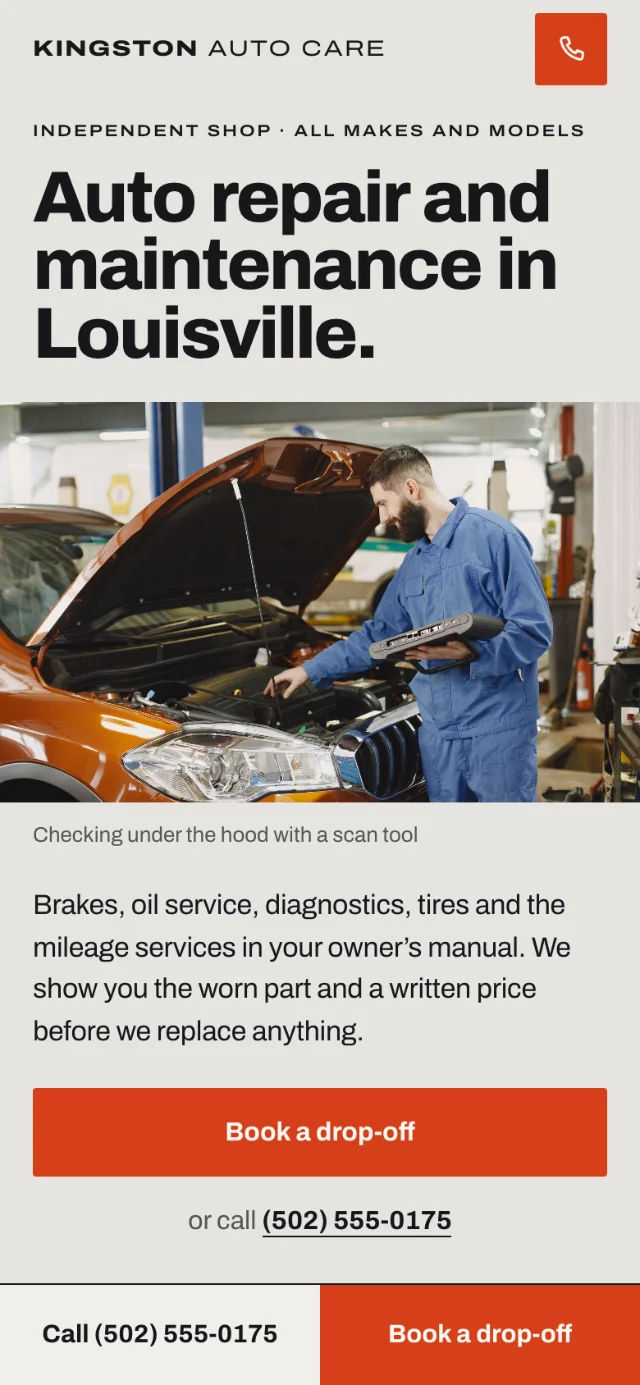
The phone number and the main button sit at the top of every page.
Example concept: Kingston Auto Care is a made-up auto repair shop, and the requests and numbers shown are made up too. Your site is built from your own photos, services and reviews, so it comes out stronger. See real builds
- The Search
- "brakes grinding [town]"
- Symptom first, service name second
- The Decision
- Map pack, then one call
- Distance, rating, hours, the diagnostic fee
- The Proof
- Your own Search Console
- Queries and clicks in your name, calls in GA4
Rasmussen Results is a web design and SEO practice in Tampa, Florida, working with independent auto repair shops, mechanics, brake and transmission specialists and body shops across the United States. The website stays in the shop's name; SEO after launch is quoted in writing, month to month, no retainer. Both exist for one moment: a driver with a symptom, a phone, and a decision to make today.
Tampa, Florida · Remote builds in any US state
The moment
How a driver picks a mechanic: the map pack first, then one phone call.
Nobody shops for a mechanic the way they shop for a kitchen. There is a symptom or a deadline: the check engine light came on this morning, the brakes started grinding, the AC quit in July, the inspection runs out Friday, or the car is on a flatbed and the tow driver wants an address. The search happens on a phone, in the driver's words, and it is over in minutes.
The first cut is the map pack, the three pins Google shows before any normal result. Drivers choose on distance, star rating and review count, whether the shop is open right now, and whether it works on their make. Nearly all of that is your Google Business Profile, not your website. Local SEO for auto repair shops starts there, and anyone who says a small shop needs nothing else is half right.
Then the driver taps through, and the website gets one question: can I trust this shop with my car and my card? It answers with the diagnostic fee, the warranty terms, the ASE certificates, photos of the bays, and reviews that mention the repair at hand. It is also the only thing that ranks for the searches a pin never will: "brake repair [town]", "check engine light diagnostic", "[make] repair". Auto repair shop SEO is both halves, built so they agree.
The website half is the standard build, $2,000: a page per repair and per make, the pricing, warranty and fleet pages, tap-to-call and an appointment form. Anything bigger is priced in writing before I build the mockup, so the shop knows the number before work starts.
The page map
One page per repair: the page map for an auto repair shop website.
The site is organized the way a driver searches: one page per repair, not one Services page with twelve bullets. Each row is a page, the search it answers, and what it must hold to rank and get the call. Build the rows you do in your own bays; skip the work you sublet.
- "brake repair [town]", "brakes grinding"Brakes
Pads, rotors and calipers, what a brake inspection costs, same-day turnaround, and the warranty.
- "check engine light diagnostic [town]"Check engine diagnostics
The fee, whether it is applied to the repair, and what the hour covers beyond reading the code.
- "oil change near me"Oil changes
Conventional and full synthetic prices, how long it takes, and whether a walk-in is fine.
- "car AC blowing warm"AC repair
Recharge versus leak diagnosis, R-134a and R-1234yf, and how fast a car gets in when it turns hot.
- "wheel alignment [town]", "tire shop near me"Tires and alignment
Brands you stock, mount and balance, the alignment price, TPMS, and when a car needs one.
- "transmission shop near me"Transmission
Diagnosis before any quote, rebuild versus remanufactured, fluid service, and the warranty.
- "steering wheel shaking"Suspension and steering
Struts, shocks, ball joints and tie rods, written from the symptoms that bring the car in.
- "timing belt replacement [make]"Timing belt and water pump
Intervals by make, why both are done in one job, and a price range for your common makes.
- "car won't start"Battery and electrical
Testing and replacement, alternator and starter, and no-start diagnosis.
- "pre-purchase inspection [town]"Pre-purchase inspection
What gets checked, the price, how soon you can fit one in, and a sample report.
- "state inspection near me"State inspection or emissions
Only where your state requires it: hours, walk-in or appointment, and why cars fail.
- "Honda repair [town]", "BMW specialist near me"A page per make you specialize in
OEM versus aftermarket parts, the factory scan tool you run, the techs' certifications, and why the owner can skip the dealership.
Around those sit the pages that close the sale more than they rank: warranty, financing, fleet service, your towing partner, coupons and specials, "what a diagnostic costs", reviews, and a location page with hours, drop-off, and whether a loaner or shuttle is available. Tap-to-call and the appointment form go on every page.
Two pages, written out
The brake repair page and the check engine diagnostics page, top to bottom.
Brake repair and diagnostics are the two searches almost any independent shop can win in its own town, and the two pages most shop sites get wrong. For a brake shop, this is most of your brake repair shop SEO.
The brake repair page
- Title tag
- Brake Repair in [Town] | Pads, Rotors, Same Day | [Shop Name]
- First screen
- Tap-to-call, today's hours, and one sentence on what a brake inspection costs and how fast most jobs leave.
- Symptoms
- Grinding, squealing, a pulsing pedal, pulling to one side, each in the driver's words with what it usually means.
- Prices and parts
- A range for pads and rotors on your common makes, the brands you install, and the warranty.
- Proof and links
- Your brake jobs on the lift, reviews that mention brakes quoted word for word, links to the diagnostics and make pages, and AutoRepair schema.
The check engine diagnostics page
- Title tag
- Check Engine Light Diagnostic in [Town] | $[Fee], Applied to the Repair | [Shop Name]
- First screen
- The fee, whether it is applied to the repair, and how soon the car can be on a scan tool.
- What the hour buys
- A parts-store code read names the code, not the cause. Say what the hour buys: live data, wiring and grounds, a smoke test for an evap code, a road test.
- Steady or flashing
- One plain paragraph on the difference, and why a flashing light should not be driven far.
- Codes and links
- The codes you see most and what they tend to point to, no repair price before the diagnosis, and links to the make and pricing pages.
Pricing, makes, fleet
Three pages that answer the upsell fear: the pricing page, the make pages, and fleet service.
A plain pricing page
Drivers walk in braced to be upsold, and a site that hides every number confirms it. The pricing page gives the diagnostic fee, the labor rate, the prices of the common services (oil change, brake inspection, alignment, AC recharge) and the warranty terms, next to the ASE certificates by name and photos of the bays and the techs. "What does a diagnostic cost" is a search; the shop that answers it gets the visit.
Make pages and the dealer alternative
"Honda repair [town]" and "BMW specialist near me" come from owners who want dealership-level work without the dealership's service drive. A make page carries what that owner checks: OEM or OE-equivalent parts, the factory scan tool you run (Techstream, ISTA, HDS), the techs' training on that make, and the maintenance schedule by mileage with your prices. One page per make that fills your bays, not one for every badge on the road.
Fleet service
Fleet managers search differently ("fleet maintenance [town]", "DOT inspection near me") and buy on turnaround, pickup and delivery, a preventive maintenance schedule, and monthly billing. One page that states all four, plus the vehicle classes your lifts can take, is how those accounts find you, and a fleet account is repeat work every week.
Body shops
SEO for auto body shops: a different buyer, a shorter page map.
A collision customer is not searching a symptom. There is a claim number, an adjuster, and a rental car on a clock. The searches are "auto body shop near me", "collision repair [town]", "paintless dent repair", and an insurer's name plus "approved shop". A body shop site needs fewer pages and more proof: an estimate form that takes photos from a phone, a page on the insurance process (direct repair programs, the customer's right to choose the shop, how supplements and the rental work), I-CAR or manufacturer certifications, and before-and-after pairs of real jobs by repair type.
The map pack rules are the same as for mechanical repair; the content is not. If you run both sides, collision work gets its own section of the site, its own Business Profile category and its own reviews, so "bumper repair" never lands on the oil change page.
Local SEO
Auto repair SEO in plain terms: the local SEO work behind a shop that gets the call.
Auto repair SEO is search engine optimization for one shop and the towns its customers drive in from. It is local work, not national: the goal is the map pack and the first organic results for repairs within reach of your bays, not traffic from three states away. Local SEO for auto repair shops comes down to three jobs, and they only work when they agree with each other.
One name, address and phone everywhere
The shop name, street address and phone number read the same on the Business Profile, the website footer, Bing Places, Apple Maps, Yelp, and any program you belong to, such as AAA Approved Auto Repair or RepairPal. Search engines cross-check those listings. An old address on one and a new one on another splits the signal, which is common after a shop moves or changes its number.
A page for every repair you sell
That is the page map above, with each page naming the repair and the town in its title and first line. It is what lets "transmission shop [town]" land on the transmission page instead of the homepage, and it is the half of auto repair SEO the Business Profile cannot do.
Proof a search engine can read
Reviews that name the repair and the car, AutoRepair structured data on every page, and Search Console and GA4 set up in your name. The first two help Google match the shop to the search. The last two are how you see which repairs bring the searches and the calls.
Hiring for it? Three questions sort the auto repair SEO services worth paying for from the rest: whose name is on the Search Console and Business Profile access, whether you can stop any month and keep every page, and whether the monthly report shows searches and calls or only impressions.
The price
How much does auto repair shop SEO cost here?
The website is $2,000, paid once, with the page map above built in. SEO after launch is separate: ongoing work quoted in writing for your repairs, makes and towns, billed month to month with no retainer lock-in, and measured in your own Search Console and GA4. There is no single SEO price because a two-bay independent in one town and a transmission specialist pulling from three counties need different work each month.
The short version
Last updated:
- Price
- $2,000one time
- Monthly fee
- None required by me. Hosting usually costs $0 within Google's free allowance; a busy site might pay Google a few dollars a month. Maintenance is optional.
- Timeline
- 2 to 3 weeks from kickoff to a live site
- First step
- A free homepage mockup, so you see the design before you decide anything
See what you own and everything included
- You own
- The domainat your own registrar, renewing to you
- The codea GitHub repository in your name
- The hostinga Firebase project in your Google account, usually $0, with any charge billed by Google to you
- Google Analytics and Search Consoleproperties under your Google account
- Your Google Business Profileyou are the owner, and I am a manager you can remove
- Every form submissiondelivered to the inbox you choose
All of it in your name from day one. I am added as a collaborator for the build and removed by you at handover, and I never hold the only copy of any login.
- What's included
- A page for every repair you do in your own bays
- A page for each make you specialize in
- A pricing page with the diagnostic fee and labor rate
- Warranty, fleet and location pages with hours and drop-off
- Tap-to-call and an appointment form on every page
- Business Profile, Search Console and GA4 in your name
- Set up on Bing too: Webmaster Tools, which reports how your pages show up in Microsoft Copilot, and Bing Places
How it runs
How the work runs, and how you check it in your own Search Console.
Three steps. The first one costs nothing and you keep the result.
- Free homepage mockup
Send me your shop name and town. I design the homepage for your shop and send it over to read on your phone between cars. No call, nothing to sign, and the design is yours either way.
- The $2,000 site
The page map above gets built: a page per repair and per make, the pricing, warranty and fleet pages, reviews, tap-to-call and an appointment form, and Search Console and GA4 in your name. Two to three weeks. You own the domain, the code and every login.
- SEO, month to month
After launch the SEO is quoted in writing for your shop: Business Profile upkeep and fresh photos, the review ask, new make or town pages as the shop grows, fixes for whatever Search Console turns up, and a monthly read of the numbers with you. No retainer lock-in; stop any month and keep everything.
Check it yourself. Open any live build in the portfolio and run it through PageSpeed Insights; the scores are public. If the shop already has a site, open your own Search Console and read the last three months of queries: that is the baseline, and it is yours whether we work together or not. Paying an agency monthly for the current site? The switching guide covers the move without losing rankings, and the Business Profile checklist is free. If the shop needs a new site first, start with auto repair website design. Prices are on pricing, concept designs on mockups, and every other trade on industries.
Q&A
SEO for mechanics and repair shops: eight questions owners ask.
How does an auto repair shop get into the Google map pack?
Mostly through your Google Business Profile: primary category Auto Repair Shop (brake, transmission or body shop as secondaries where they apply), accurate hours including walk-ins, the services list filled in, recent photos of the bays, and a steady flow of reviews. Distance from the searcher matters too, and you cannot change it. The website supports the pin by saying the same things on a fast site, and Google reads both.
Does each repair need its own page, or is one services page enough?
One page per repair you actually sell. A driver searches "brake repair" or "check engine light diagnostic", not "auto repair services", and Google shows the page most clearly about that one job. A Services page with twelve bullets competes for all twelve and ranks for none. Ten pages that each carry prices, symptoms and photos do more than a long list, and they are easier to keep accurate.
Do make-specific pages, like Honda repair or BMW repair, help a shop rank?
Yes, when the shop genuinely specializes. "[Make] repair [town]" and "[make] specialist near me" come from owners who want to skip the dealership, and a page naming the factory scan tool, the parts you use and the techs' training on that make answers them directly. Build them only for the makes that fill your bays; a thin page for a make you rarely see dilutes the real ones.
Should I publish prices or the diagnostic fee on my website?
Publish the diagnostic fee, the labor rate and the prices of your common services, and say whether the fee is applied to the repair. The driver typing "check engine light diagnostic cost" will find a number somewhere; it should be yours, with what the hour covers. You do not have to price every job: ranges for brakes and alignments, and "quoted after diagnosis" for the rest, is a page Google can rank and a driver can trust.
How much do reviews affect ranking, and what do I do about a bad one?
Reviews are one of the main signals behind the map pack. Count and recency matter, and so do the words: "fixed the brakes on my Accord the same day" helps the brake page and the Honda page. Ask at pickup with a link or QR code on the invoice. A bad one is survivable: reply once, calmly, with what happened and what you offered, and let the next twenty good ones push it down. Never pay for reviews or filter who gets asked; both can cost you the Profile.
How long until a repair shop's pages rank in Google?
Once a page is linked from your menu and submitted in Search Console, Google generally indexes it within days to a few weeks. Ranking depends on the phrase and the town. "Brake repair" plus a smaller town can take a position within a couple of months; "mechanic near me" in a big metro is a longer climb against shops with hundreds of reviews. The Profile usually moves before the website. You watch it in your own Search Console, and anyone promising page one by a date is selling something that is not SEO.
Can a shop owner do auto repair SEO without hiring anyone?
Much of it, yes. Claim the Business Profile, fill in every service, add photos of the bays, ask for a review at every pickup, and keep the name, address and phone the same on every listing. That costs time, not money. The website half is harder alone: a page per repair and per make written well enough to rank, plus the structured data and the Search Console setup. That is the part I build, for $2,000 once, and the rest you can run yourself after launch.
Is auto repair SEO the same as Google Ads or Local Services Ads?
No. SEO works on the free results: the map pack and the organic listings under it, where nobody pays per click. Google Ads are paid placements billed per click, and Local Services Ads are billed per lead; both stop when the budget does. Some shops add ads in the busy months on top of SEO. A Google Ads click still lands on your website, and Local Services Ads lean on your reviews, so the site and the Business Profile come first either way.
Accepting Independent Shops
Send me your shop's name and town.
Tell me your shop's name and town, and I will design a homepage for your shop, free, to read on your phone between cars. No sales call, nothing to sign. Rather talk first? Call or email.
Or call (813) 531-8442 or email chris@rasmussenresults.com.