Google Ads for Plumbers

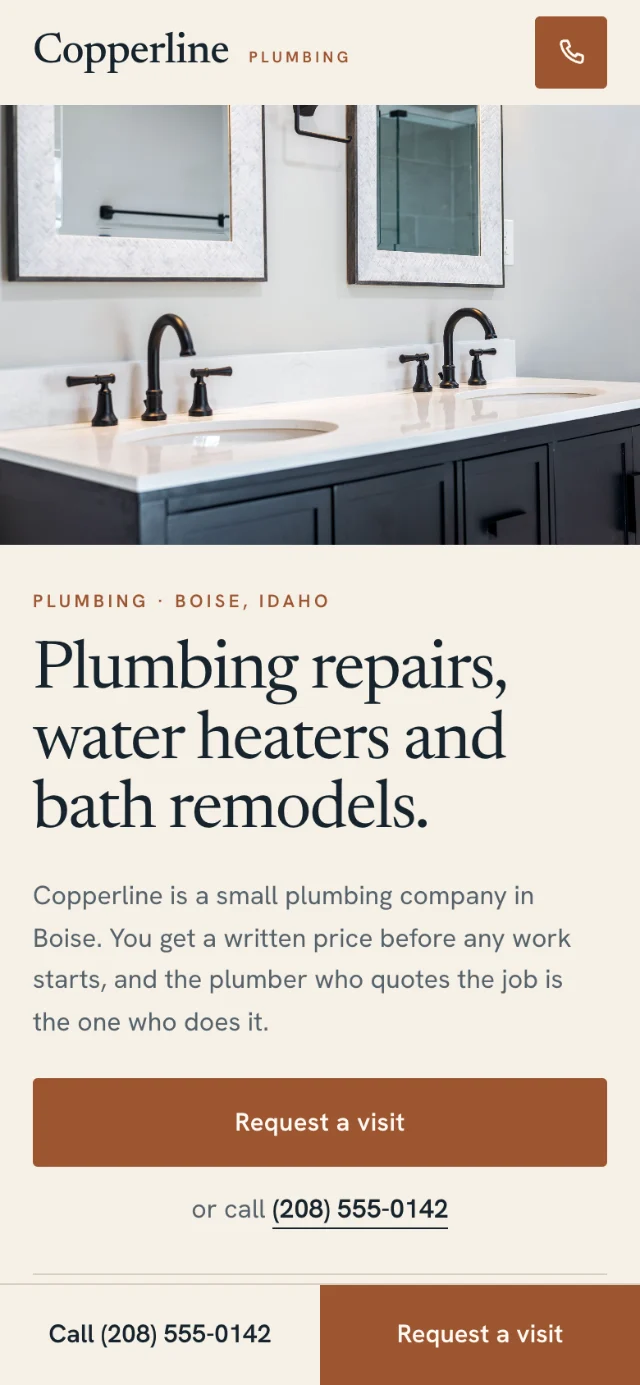
Free. No call. Usually ready in 48 hours.
The phone number and the main button sit at the top of every page.
Example concept: Copperline Plumbing is a made-up plumbing company, and the requests and numbers shown are made up too. Your site is built from your own photos, services and reviews, so it comes out stronger. See real builds
- Ad Groups
- Four jobs, four pages
- Drain, heater, leak, sewer
- What Counts
- Real calls
- Plus phone taps and form fills, not clicks
- Landing Pages
- Yours to keep
- Every account in your name
Someone with water coming through the ceiling is not going to read your website first. They tap a call button. Someone pricing a tankless swap may read a few sites before calling anyone. A plumbing ad account has to handle both, so I split it by the job: drain, water heater, leak, and sewer, each with its own ads, its own landing page, and its own list of searches to keep out. The account counts calls, not clicks. The pages the ads land on are part of a site you own, and ad management is quoted separately.
Tampa, Florida · Remote builds in any US state
Tap or read
Tap or read: the two ways a plumbing ad gets used.
A plumbing ad gets used in two very different ways, and the account has to be built for both. The first is the tap. Water is coming through the kitchen ceiling, or the toilet is backing up into the tub, and the person searching is standing in it with a phone. They see a call button in the ad and press it. They may never see your website at all. What decides that call is whether your ad is showing at that hour, whether the number rings through to a person, and whether the ad names the problem they have.
The second is the read. A water heater is fourteen years old and dripping at the base. A second sewer backup in a year has someone wondering about the line itself. A house with old galvanized pipe needs a repipe quote. Those people click the headline, land on a page, and read before they call, often after looking at more than one plumber. What decides that call is the page.
An account with one ad group called Plumbing, one set of ads, and every click sent to the homepage is built for neither. The rest of this page is how I build it for both, and why the $2,000 site is part of the campaign rather than a separate project.
Ad groups
Drain, water heater, leak, sewer: one ad group and one page each.
An ad that names the searcher's problem earns the click, and a page that names it again keeps them there. One generic plumbing ad cannot say drain cleaning to one searcher and tankless install to the next. Four ad groups can, and each one gets its own landing page and its own list of searches to keep out.
Drain
- Bids on
- "drain cleaning near me," "main line clog," "hydro jetting [city]," "kitchen sink backed up," "floor drain backing up"
- The ad says
- Drain cleaning and hydro jetting, the towns you cover, and the hours you run. Nothing about water heaters.
- Lands on
- Your drain cleaning page, with the phone number in the first screen.
- Kept out
- "drain snake rental," "best drain cleaner," "how to unclog a drain"
Water heater
- Bids on
- "no hot water," "water heater leaking," "water heater replacement [city]," "tankless water heater installation"
- The ad says
- Repair and replacement as separate ads, with the tank and tankless brands you actually install.
- Lands on
- Your water heater page, with tank and tankless in their own sections.
- Kept out
- "how to drain a water heater," "how to reset a water heater," "water heater for sale"
Leak
- Bids on
- "burst pipe," "emergency plumber near me," "water leak in wall," "slab leak detection," "leak under house"
- The ad says
- Emergency response in the hours you answer, and the towns you will drive to tonight.
- Lands on
- Your emergency page: tap-to-call first, then what to do while you are on the way.
- Kept out
- "pipe repair tape," "how to find a water leak," "leak detector"
Sewer
- Bids on
- "sewer backup," "sewer line repair," "sewer camera inspection," "trenchless sewer replacement"
- The ad says
- A camera inspection first, then the repair or replacement options.
- Lands on
- Your sewer line page, with how the inspection works and what happens after it.
- Kept out
- "sewer bill," "city sewer department," "sewer backup insurance"
Gas lines, repiping, and backflow testing get their own groups once the first four are tracking cleanly. Splitting the account this way also lets the money move. When the water heater group books jobs at a better cost than the drain group, budget shifts toward it, and you can see why in your own account.
After hours
Emergency and after-hours ads: run them on the hours you pick up.
The leak and emergency group is where a plumbing account makes or loses the most money after dark. Searches like "burst pipe" and "emergency plumber near me" are about as ready to call as search gets. But that value only exists if someone answers. A paid click at 1am that rings through to voicemail books nothing, and the caller can just try the next ad on the page.
So the schedule follows your phone, not the clock. If you answer around the clock, the emergency group runs around the clock, the ad can honestly say 24 hours, and bids can go up for the hours that bring the best calls. If you stop taking calls at 10pm, the ads and the call asset stop at 10pm too. Weekends and holidays get their own schedule, set to the hours you tell me you answer, not a default.
Weather matters here too. In towns that freeze, burst pipe searches follow a hard freeze, so the leak group gets its budget ready before one is forecast rather than after the calls have gone to someone else. The drain, water heater, and sewer groups keep their own schedules, since a planned water heater swap does not need an ad running at 2am.
Call setup
Call-only ads are being retired. What replaces them in a plumbing account.
For years the default plumbing setup was a call-only ad: a headline, a phone number, and a call button, no website needed. Google is retiring that format. Its help center says the option to create new call ads was removed in February 2026, and existing call ads stop getting impressions in February 2027. A plumbing account still leaning on them has a deadline, and it is better to move before the calls stop than the week after.
The replacement is a responsive search ad with a call asset, the thing that used to be called a call extension. On a phone, the ad still shows a call button that dials you directly, and the headline can also take the person to the matching landing page. I attach call assets at the ad group level, so the leak group's number can follow the emergency schedule while the water heater group's number keeps business hours.
Then the counting rules, set before any money is spent. Calls from the ads are reported through a Google forwarding number, and a call only counts as a conversion if it lasts long enough to be a real conversation, a length you pick, so wrong numbers and robocalls are not reported as leads. Visitors who arrive from an ad see a forwarding number on the site too, so calls from the landing page are tied back to the ad. Phone taps and form fills are recorded in GA4. The events I set up on every site are in 5 GA4 events every small business site must track.
Negatives
The negative keyword list: DIY, job seekers, parts shoppers, and work you do not do.
Plumbing gets searched by a lot of people who will never hire a plumber. Their clicks cost the same as a real customer's. A negative keyword tells Google not to show your ad when a search contains that word, and a plumbing account needs its lists loaded before launch, not three months in.
The person wants to fix it themselves tonight. Good for them, expensive for you.
"how to," "diy," "video," "youtube," "step by step," "yourself"
Plumbing is a trade people search for as a career. These searchers want work, not a plumber.
"jobs," "hiring," "salary," "apprentice," "school," "license test," "union"
They are buying the part, not the install.
"home depot," "lowes," "parts," "for sale," "rental," "wholesale," "supply"
Every click here is a call you have to turn down.
septic pumping, well pumps, pool plumbing, commercial boilers, whichever ones are not on your truck
Questions about bills, codes, and who pays, from people who are not calling anyone yet.
"code requirements," "diagram," "who is responsible," "landlord," "sewer bill," "definition"
Handled with location targeting, not keywords, so a searcher two counties over never sees the ad.
Radius or town list set to where you will actually drive, with "presence" targeting only
Two cautions. Symptom searches are not DIY: "water heater leaking from the bottom" and "no hot water in the whole house" usually come from someone close to calling, so they stay in. And "cheap" or "affordable" are not automatic negatives. Whether to block them depends on how you price, which is your call, not a default.
LSA vs search
Local Services Ads or search ads: which one for which plumbing job?
Local Services Ads
- Where it shows
- Above the regular ads, with the Google Verified badge.
- How you pay
- Per lead, not per click.
- To get in
- A Google background check and license verification.
- What you control
- Job types, service area, budget, and hours. Not the ad text or the landing page.
- Best for
- Broad searches like "plumber near me," where the person wants someone close and trusted.
Search ads
- Where it shows
- At the top of the results, under the Local Services unit when one shows.
- How you pay
- Per click, whether or not the person calls.
- To get in
- A Google Ads account in your name and a card on file.
- What you control
- Keywords, negatives, ad text, schedule, landing page, and the split by job.
- Best for
- Specific jobs you want more of: water heater replacement, sewer line repair, hydro jetting.
They are not either-or. Both draw on your Google Business Profile, and Local Services Ads lean on your reviews, so the profile work in SEO for plumbers pays on both. Where Local Services Ads are available for plumbers in your area, I set that profile up alongside the search campaign, and the call tracking shows which one books the better jobs for you.
Landing pages
The landing page is half the campaign. That part is the $2,000 site.
Every ad group needs a page to land on. The site is built around that.
An ad for water heater replacement in your town should land on a page about water heater replacement in your town: the service in the headline, the phone number as tappable text in the first screen, the towns you cover, tank and tankless explained, photos of your own installs, and a short form for people who would rather not call. Send the same click to a homepage and the person has to hunt. Some will. The ones who leave are clicks you already paid for.
That is what the build is: a custom site for a one-time $2,000, with no required monthly fee and no long-term contract, live 2 to 3 weeks after kickoff. It is server-rendered and fast on a phone, with a page per service, service-area pages for your towns, schema, and GA4, Search Console, and Microsoft Clarity in your name, so you can see where people stop reading. You own the site, the domain, and every account. Ad management is quoted separately. When the ads are paused, the same pages keep working in search. The same build for other trades is on the contractor website design page.
Get my free homepage mockupCost
How much do Google Ads cost for plumbers?
The closest published figure is $8.33 a click and $90.92 a lead. That is the 2026 average for home services in LocaliQ's benchmark report, which has no row for plumbing alone.
At that average, $1,000 of ad spend comes to about 11 leads ($1,000 divided by $90.92). Your town and the jobs you bid on move that number, which is why tracking goes in before any ad runs. This is what Google charges for clicks; the ad setup is quoted separately.
| Average | Home & Home Improvement | All industries |
|---|---|---|
| Cost per click | $8.33 | $5.42 |
| Click-through rate | 6.47% | 6.64% |
| Clicks that become a lead | 8.05% | 8.18% |
| Cost per lead | $90.92 | $66.69 |
What you get
What the site and the ad setup include, line by line.
- 01The site the ads land on: $2,000 once, no required monthly fee, live 2 to 3 weeks after kickoff
- 02A page for drain cleaning, water heaters, leaks and emergencies, and sewer lines, so every ad group has a matching page
- 03Service-area pages for the towns you drive to, so a town in the ad has a town on the page
- 04Tap-to-call in the first screen of every page, tracked as a GA4 event
- 05GA4, Search Console, and Microsoft Clarity in your name on day one, so you can watch what happens after the click
- 06A Google Ads account in your name with your card on the billing, whether I set it up or you already have one
- 07Responsive search ads with call assets per ad group, replacing any call-only ads before Google stops serving them
- 08Negative keyword lists for DIY, job seekers, parts shoppers, and work you do not do, before any money is spent
- 09Ad schedules and call asset hours that match the hours you answer, with emergency ads off when nobody picks up
01 to 05: the site, $2,000 once, no required monthly fee · 06 to 09: the ad setup, quoted separately · Every account in your name.
Build order
The build order: pages first, tracking second, ads last.
Nothing gets spent until there is a page to land on and a way to count the calls.
Step one is free, and you keep it. Five steps, in this order for a reason.
- Free homepage mockup
Send me your business name and town. I design a homepage for your plumbing company with the call button and your top jobs where a person on a phone will find them. If you already run ads, say so in a note and I will tell you what I see in the account. You keep the mockup either way.
- Pages before ads
The site gets built first, because an ad can only be as specific as the page it lands on. Drain, water heater, leak and emergency, and sewer each get a page, and your main towns get service-area pages. It is $2,000 once, server-rendered, fast on a phone, and live 2 to 3 weeks after kickoff.
- Tracking before spend
Before a dollar goes to Google, calls from the ads, calls from the site, phone taps, and form fills are all set up as conversions, with a minimum call length so wrong numbers do not count. GA4, Search Console, and Clarity are in your name from the first day.
- Launch the four ad groups
The campaign goes live with the drain, water heater, leak, and sewer groups, each pointed at its own page, with call assets on the hours you answer and the negative lists already loaded. If your business is eligible for Local Services Ads, that profile gets set up alongside it.
- Read the calls, prune the searches
While the account is new, I read the search terms report every week and add negatives for anything that should not have triggered an ad. Then it is monthly: which group booked jobs, which one only rang, and where the budget should move. Management is quoted separately, and the account stays yours whether or not I run it.
Limits + fit
What ads cannot fix, and who this is not for.
Ads buy a place at the top of the page. They cannot answer the phone, and they cannot make a slow page load faster. If calls go unanswered, if the landing page drags on a phone, or if the ad promises a service the page never mentions, more budget only makes the leak bigger. That is why the order is pages, then tracking, then ads.
The honest timeline: ads can start showing within days of launch, far sooner than organic rankings, which is why they suit emergency work. The first weeks are the account learning which searches turn into jobs while the search terms report gets pruned and the negative lists fill in, so judge the cost per booked job on the weeks after that, not on day one.
This fits a plumbing company with a defined service area, a phone someone answers, and a few jobs it wants more of than others, whether that is one truck or ten. It is not for a shop that wants an agency to own the account, one that cannot take the calls ads bring, or one that wants every plumbing search in the state. For heating and cooling there is Google Ads for HVAC, other trades are on Google Ads for contractors, and how I approach paid search overall is on the Google Ads service page.
Q&A
Plumber PPC questions, answered plainly.
How much does Google Ads for plumbers cost?
There are three separate numbers. The ad budget goes to Google, billed to your card in an account in your name, and you set it and can change it any time. Management is quoted separately once I know your towns, your services, and how much the account needs. The site the ads land on is $2,000 once, with no required monthly fee, and you own it, the domain, and every account. I do not quote a monthly budget before looking at your towns, because a plumbing click in a dense metro and one in a small town can be priced very differently.
Should I still run call-only ads for my plumbing company?
No, and soon you will not be able to. Google removed the option to create new call ads (the old call-only ads) in February 2026, and its help center says existing call ads stop getting impressions in February 2027. The replacement is a responsive search ad with a call asset, what used to be called a call extension. On a phone, it still shows a call button that dials you directly, and the headline can also take the person to a landing page. If your account still depends on call-only ads, move them now so the calls do not stop the day Google switches them off.
Should a plumber run Local Services Ads or regular Google Ads?
Usually both, for different searches. Local Services Ads sit above the regular ads, carry the Google Verified badge once you pass the Google background and license checks, and charge per lead instead of per click. They fit broad searches like plumber near me, where the person just wants someone trusted and close. What they do not give you is control: you cannot write the ad, pick a landing page, or split drain from water heater the way a search campaign can. Search ads cover the specific, higher-ticket jobs you want more of, like water heater replacement or sewer line repair, with ads and pages written for each one. Both draw on the same Google Business Profile and reviews, so that profile work pays twice.
What negative keywords should a plumber add first?
Start with four groups of searches that have nothing to do with hiring a plumber. DIY searches: how to, diy, video, youtube. Job seekers: jobs, hiring, salary, apprentice, plumbing school, license test. Parts shoppers: home depot, lowes, parts, for sale, rental. And work you do not do, which is different for every shop: septic, well pumps, pool plumbing, commercial boilers. After that, the search terms report shows you the rest, and it is worth reading weekly while the account is new. Location is handled separately, with targeting set to people in your towns rather than people who are just interested in them.
Should my plumbing ads run overnight?
Only if someone answers overnight. An emergency search at 1am is one of the best leads a plumber can get, but a paid click that rings through to voicemail books nothing, and the caller can just try the next ad. So the emergency and leak ad group runs on the hours you actually pick up, and the call asset follows the same schedule. If you do answer around the clock, the ad can say 24 hours and bid harder at night. If you stop at 10pm, the ads stop at 10pm too, and the budget goes to the hours that can turn into jobs.
Can I send my Google Ads to my homepage?
You can, and it is a common reason a plumbing campaign underperforms. Someone who searched water heater replacement in your town should land on a page that says water heater replacement in your town, with the phone number in the first screen, the towns you cover, and photos of your installs. A homepage makes them hunt. That is why the build puts a page behind every ad group: drain, water heater, leak and emergency, and sewer, plus service-area pages for your towns. The site is $2,000 once, live 2 to 3 weeks after kickoff, and it keeps working for SEO when the ads are paused.
How do I know which ads booked jobs, not just calls?
Set up the counting first. Calls from ads are recorded through a Google forwarding number, and a call only counts as a conversion when it lasts long enough to be a real conversation, a length you choose. Calls from the landing page are tracked the same way for visitors who came from an ad, phone taps and form fills are recorded in GA4, and Microsoft Clarity shows what people did on the page before they called or left. Then once a month, the call log gets checked against the jobs you actually booked. That comparison is what tells you whether the water heater group or the drain group deserves the next dollar.
I have a small budget. Where should it go first?
Into one ad group, not four thin ones. Pick the job you most want more of and have room on the schedule to take, often water heater replacement or drain cleaning, and run it tightly: your closest towns, the hours you answer, a page that matches the ad, and a full negative list. A small budget spread across every plumbing search can run out early in the day and teaches the account very little. Once that one group is booking jobs at a cost you are happy with, add the next. If you qualify for Local Services Ads, they are worth setting up early, because you pay for leads rather than clicks.
Do I own the Google Ads account?
Yes. The account is in your name, the billing is on your card, and I work inside it with access you can remove at any time. The conversion history, the negative lists, the call data, and every ad stay with you if we stop working together. The same goes for the site: the $2,000 build is yours outright, along with the domain, GA4, Search Console, and your Google Business Profile. Nothing gets switched off or held back when the work ends.
Accepting Plumbing Companies
Send me your business name and town.
Tell me your business name and town. I will send back a homepage mockup built around your call button and the jobs you want more of, and if you already run ads, what I see in the account. The site is $2,000 once and you own everything. Ad management is quoted separately. If you would rather talk first, call.
Or call (813) 531-8442.
Want calls that keep coming when the ads pause? SEO for plumbers →