Google Ads for Dentists

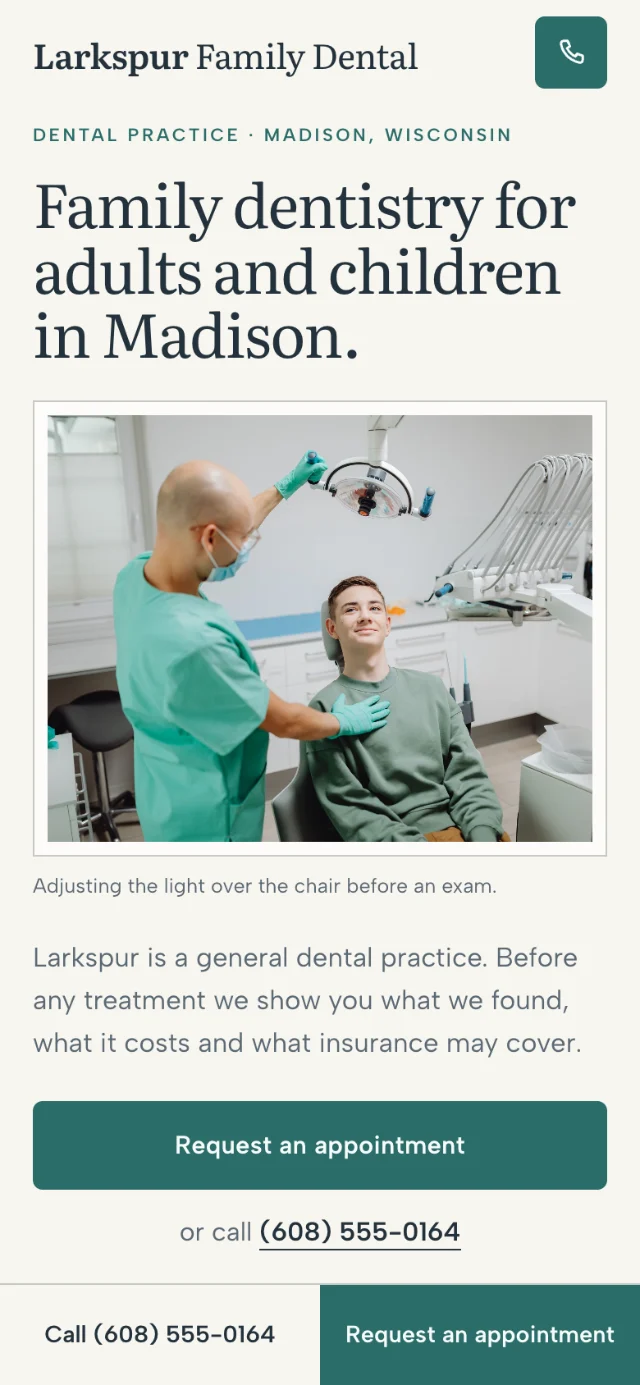
The phone number and the main button sit at the top of every page.
Example concept: Larkspur Family Dental is a made-up dental practice, and the requests and numbers shown are made up too. Your site is built from your own photos, services and reviews, so it comes out stronger. See real builds
- Pricing
- Flat monthly fee
- Never a percent of your spend
- Measurement
- Cost per patient
- Call + form conversion tracking
- Ownership
- You own the account
- Cancel anytime, keep everything
Most dental Google Ads accounts overpay for clicks and undercount patients. This one is built the opposite way: a flat monthly management fee instead of a percentage of spend, call and form tracking so you see your real cost per new patient, and a Google Ads account you own outright. Honest measurement, not a wall of vanity metrics.
Tampa, Florida · Remote builds in any US state
The problem
Why do dentists overpay for clicks and undercount their patients?
Dental keywords are some of the most expensive in Google Ads. A single click on "dental implants" or "emergency dentist near me" can cost $8 to $30. That means a loosely built account does not waste a little money, it hemorrhages it. Broad-match keywords, no negative lists, and statewide targeting send your budget to people searching for tooth-pain home remedies and dental schools two cities away. The clicks add up, the chairs stay empty, and the report still looks busy.
The second half of the problem is worse, because it is invisible. Most dental accounts only count clicks and form fills. But patients call. When someone in pain finds your ad, they tap the number and dial, they do not fill out a contact form. If those calls are not tracked, every one of them is a booked patient your reporting never sees. The account looks like it is failing when it might be working, or it looks fine while it quietly wastes half the budget. You cannot fix what you cannot measure.
The fix is not a bigger budget or a flashier dashboard. It is discipline. Tight targeting on the searches that book patients, negative keywords that block the rest, full call-and-form conversion tracking so every patient the ads produce gets counted, and a landing page built to book (the standard behind my dentist website design work). Get that right and a dental practice stops overpaying for the wrong clicks and finally sees its true cost per new patient.
Intent
The searches worth bidding on: emergency, implants, new patients.
Not all dental searches are worth your money, and the difference is intent. Someone typing "why does my tooth hurt" is reading, not booking. Someone typing "emergency dentist near me" at 9pm is ready to call right now. The whole job of a dental Google Ads account is to bid hard on the second group and block the first. Three buckets of searches carry almost all the value.
Emergency searches are the fastest to book: "emergency dentist near me," "tooth pain dentist today," "broken tooth dentist." These people will take the first available chair and rarely price-shop. Implant and cosmetic searches are the highest value: "dental implants," "all on 4," "veneers near me," "invisalign," "cosmetic dentist." A single one of these patients can be worth thousands, so they justify a much higher cost per lead. New-patient searches feed the schedule steadily: "dentist accepting new patients," "new patient special," "family dentist [town]," and "teeth whitening" brings in low-commitment patients who often become regulars.
Everything outside those buckets gets filtered out with negative keywords so it never touches your budget. A broad term like "dentist" looks cheap per click but spends on people three towns over or still researching, so it gets bid low or filtered out. This is the same intent-first discipline behind my broader Google Ads management: bid where patients are ready to book, block where they are only browsing.
Tracking
Conversion tracking that ties spend to booked patients.
This is where I am different, and it is the whole reason to run ads instead of guessing. Before a single ad goes live, the tracking goes in. If a click cannot be traced to a booked patient, it does not count.
Conversion actions get installed for two things: form submissions and phone calls. Calls run through call tracking, so the patient who taps your number and dials is counted exactly like the one who fills out a form. Everything ties into GA4. From the first day of traffic, every report ties spend directly to booked-appointment requests and calls, and breaks down your real cost per new patient by campaign and by search. You see which ads produced patients and which only produced clicks, then we move the money accordingly. That measurement discipline is the same backbone behind all my analytics and conversion tracking work. Without it, Google Ads is just a slot machine with a nicer interface.
The model
Flat-fee management vs percentage-of-spend agencies.
Most agencies charge a percentage of your ad spend, usually 10% to 20%. It sounds harmless until you see the incentive it creates. The more they convince you to spend, the more they earn, whether or not those extra dollars book a single patient. When your manager makes more money every time your budget goes up, do not be surprised when the advice is always to spend more.
A flat monthly management fee removes that conflict entirely. I charge the same number whether you spend $1,500 or $6,000, so the only way I make the arrangement work is by getting you the most booked appointments per dollar. If cutting your budget books more patients per dollar, that is exactly what I will recommend, and it costs me nothing to say so. The fee is month to month with no long-term contract, and you can cancel anytime. The same flat-fee model runs for law firms, where clicks cost more and the percentage-of-spend conflict is worse.
And you own the Google Ads account. It is created under your billing and your ownership, not buried in an agency master account. If we ever part ways, you keep the account, the conversion tracking, the history, and the audience data, and you can run it yourself or hand it to anyone the next day.
How it works
From free Google Ads audit to booked patients.
It starts with a free Google Ads audit. No sales call required.
You see exactly where the spend leaks and what a real new-patient cost looks like before you decide anything. Five steps, no surprises.
- Free Google Ads audit
You send me your practice name and town, with a note on your current account if you have one. I show you where the spend is leaking, which searches are worth bidding on, and what a real new-patient cost looks like. No sales call, no obligation, nothing to sit through.
- Account in your name
If you do not have a Google Ads account, I build one under your billing and your ownership. If you do, you keep it. You never hand your account to an agency that holds it hostage when you leave.
- Tracking before traffic
Conversion actions for form fills and phone calls go in first, tied to GA4 and call tracking. Nothing turns on until every booked patient can be traced back to the exact search and ad that produced it.
- Launch on high-intent searches
Campaigns target emergency, implant, and new-patient searches in the zip codes you serve, with negative keywords filtering out the cheap, unqualified clicks that drain a dental budget.
- Optimize on cost per patient
Every week I cut what loses money and feed what books appointments. You get a report on spend, leads, and real cost per new patient, not a wall of vanity metrics.
What is included
What the flat monthly fee includes.
- 01Campaign build around the searches that book patients, not cheap clicks
- 02Conversion tracking wired to form fills and phone calls, not just clicks
- 03Call tracking so a ringing phone counts as a real, measured lead
- 04Negative keyword lists that stop your budget funding the wrong searches
- 05Location targeting tight to the zip codes your chairs can actually serve
- 06Ad copy and extensions written for emergency, implant, and new-patient intent
- 07A landing experience built to convert the click into a booked appointment
- 08A flat monthly fee, never a percentage of your ad spend
- 09You own the Google Ads account, the data, and every conversion action
Flat monthly fee · Not a percent of spend · No long-term contract · You own the Google Ads account, the conversion tracking, and the data.
The long game
Google Ads buys patients today, SEO earns them tomorrow.
Google Ads and local SEO are not rivals, they are two ends of the same schedule. Ads put you at the top of the results today; SEO earns the spot for free over months.
Ads are the fast lane. They buy the top of the page right now, which is exactly what a new, relocating, or under-booked practice needs while slower work compounds. The catch is that the leads stop the day the budget stops. Local SEO and a tuned Google Business Profile are the slow lane: they earn the map pack and organic rankings that keep producing patients without paying per click, but they take months to mature. The smart play is to run ads for immediate flow and build local SEO underneath so the cost-per-patient keeps dropping over time. If you want that playbook, start with my guide to local SEO for medical practices. The dental version of that long game, map pack, reviews, and the searches worth ranking for, lives on the SEO for dentists page, and for practices in my own market the Tampa SEO services page shows how that local work is scoped.
Fit
Who this is for (and who it isn't).
This is for the dentist who wants new patients on the schedule soon and wants to know, to the dollar, what each one costs. If you would rather own your account and see real numbers than rent campaigns and read vanity reports, this is built for you.
It is a strong fit if you are opening, relocating, or have open chairs to fill, if you want implant, emergency, or new-patient flow, and if you value honest measurement over a busy dashboard. It is not the right fit if you want to keep paying a percentage of spend with no call tracking, if you expect a flood of cheap patients from a tiny budget overnight, or if you would rather not see your true cost per patient because it might be uncomfortable. If you want booked appointments you can trace back to the exact search that produced them, the next step is a free audit. For the practices that want both fast flow and the long game, I run ads and the tracking together, so you are not juggling vendors.
Google vs Meta
Should a dental practice run Facebook ads too?
The honest answer is that Google Ads and Facebook ads do two different jobs, and most practices should not treat them as interchangeable. Dental Google Ads catch demand that already exists. When someone searches "emergency dentist" or "dental implants," they have a problem and they want it solved now, so Google captures intent at the exact moment a patient is ready to book. That is why I almost always start a practice on Google: the dollars track straight to booked appointments.
Facebook and Meta ads work the other way. Nobody opens Facebook looking for a dentist, so it is an awareness and reminder channel, not an intent one. Where Facebook ads earn their keep for a dental practice is retargeting: showing your name again to people who visited your site but did not book, promoting a new-patient or whitening offer to your local area, and keeping a relocating or newly opened practice visible while word of mouth builds. The catch is that Facebook ads for dentists are harder to tie cleanly to a booked patient, so they need patient measurement to avoid becoming a vanity spend.
You can absolutely run both, and many practices should. The sequence I recommend is simple: get Google Ads capturing live demand and proving cost per new patient first, then layer Facebook on top for retargeting and awareness once the tracking is solid. Both run on the same flat-fee, you-own-the-account terms, with the same conversion tracking underneath so neither channel hides behind clicks.
Benchmarks
Dental Google Ads cost, by the numbers: the average click, the average lead, and real new patient cost.
Start with the published numbers. LocaliQ's 2026 Search Advertising Benchmarks report puts the average cost per click for Dentists and Dental Services at $8.00, against a cross-industry average of $5.42, and the average cost per lead at $72.97, against $66.69 across all industries. The third number matters as much as the first two: a 10.67% conversion rate, so roughly one click in nine becomes a lead. Dental clicks cost more than average, but they convert well, because someone searching for a dentist usually needs one. Those figures are averages across every dental search in the country. "Dental implants" and "emergency dentist near me" tend to run above them and a broad "dentist" click runs below, which is exactly why which searches you buy matters more than how much you spend.
At those prices the fee model decides whose interests the account serves. A percentage-of-spend agency earns more every time your budget goes up, whether or not the extra dollars book anyone. A flat monthly management fee does not move when spend moves, so the only thing left for me to optimize is the number of booked patients per dollar. If cutting the budget books more patients per dollar, that is the recommendation, and it costs me nothing to make it. That is the difference between dental PPC that is managed for you and dental PPC that is managed for the invoice.
A $73 lead is not a $73 patient. Some leads never book, some no-show, some want a procedure you do not offer, and some are three towns away. Your real new patient cost is a multiple of the cost per lead, and tracking is what tells you the multiple. Most dental leads phone the front desk rather than fill out a form, and Invoca's 2026 Lead Conversion Benchmarks report found that 42% of phone leads convert on the call itself, so an account that only counts form fills misses most of the patients it produces. Without call tracking, Google reports a cost per click. With it, you know a cost per booked patient, and a single implant or full-arch case worth thousands makes that math easy to read. That is why tracking goes in before spend.
See the full table and its source
| Average | Dentists & Dental Services | All industries |
|---|---|---|
| Cost per click | $8.00 | $5.42 |
| Click-through rate | 5.66% | 6.64% |
| Clicks that become a lead | 10.67% | 8.18% |
| Cost per lead | $72.97 | $66.69 |
Q&A
Google Ads for dentists, answered straight.
How much should a dental practice spend on Google Ads?
It depends on your market and the procedures you want to fill, but most single-location practices start somewhere between $1,500 and $4,000 a month in ad spend on top of the flat management fee. The number that actually matters is not the budget, it is the cost per booked new patient. A high-value implant or full-arch patient justifies a far higher cost per lead than a routine cleaning. I would rather start you smaller, prove the tracking shows real booked patients, and scale spend from there than talk you into a big budget on day one.
How much does a new patient cost through Google Ads?
LocaliQ's 2026 Search Advertising Benchmarks report puts the average cost per lead for Dentists and Dental Services at $72.97, on an average click cost of $8.00 and a 10.67% conversion rate. That is a lead, not a patient. Some leads never book, some no-show, and some want a procedure you do not offer, so your real new patient cost is a multiple of the cost per lead, and it moves by procedure. An implant inquiry is worth far more than a cleaning when it books, so it can justify a much higher cost per lead. You only learn your number through call and form conversion tracking tied to booked appointments, which is why it goes in before the first ad runs.
Do you charge a percentage of my ad spend?
No. Management is a flat monthly fee, quoted in writing, so the way I get paid does not change when your budget goes up or down; the section on flat-fee management above explains why that matters.
Will I own the Google Ads account?
Yes, completely. The account is created under your billing and your ownership from day one, and so is the conversion tracking, the GA4 property, and any call tracking. If we ever stop working together, you keep the account, the history, the audience data, and every conversion action. You can hand it to another manager or run it yourself the next day. Many agencies build campaigns inside their own master account so the work walks out the door when you leave. That does not happen here.
How is Google Ads different from SEO for my practice?
Google Ads buys you the top of the results today; you pay for each click, and the leads stop the day the budget stops. SEO and Google Business Profile work earns the map pack and organic rankings over months, and that traffic keeps coming without paying per click. They are complements, not competitors. Ads give a new or relocating practice immediate flow while the slower local-SEO compounding builds. If you want the long game too, start with the playbook in my guide on local SEO for medical practices.
What searches are actually worth bidding on for dentists?
The money is in high-intent, high-value searches: dental emergencies ("emergency dentist near me," "tooth pain dentist today"), implant and cosmetic searches ("dental implants," "all on 4," "veneers near me"), and new-patient intent ("dentist accepting new patients," "dentist near me"). These are people ready to book, not browsing. Generic informational searches ("why does my tooth hurt") burn budget without booking anyone, so they get filtered out with negative keywords. Bidding tight and intentional beats bidding broad and hoping.
How do you prove the ads are actually booking patients?
With conversion tracking, not promises. Before a single ad runs, I install conversion actions for form submissions and for phone calls through call tracking, tied into GA4. From then on, every report ties spend directly to booked-appointment requests and calls, and shows your real cost per new patient by campaign. You see which searches and ads produced patients and which only produced clicks. That measurement discipline is the same approach behind my analytics work, and it is the whole point of running ads instead of guessing.
Why do dentists overpay for clicks and undercount patients?
Two reasons. First, dental keywords are expensive, often $8 to $30 a click, so a loosely built campaign bleeds money on broad, unqualified searches fast. Second, most practices only track clicks and form fills, not phone calls, so the patients who call instead of filling out a form are invisible. The account looks like it is failing when it may actually be working, or it looks fine when it is quietly wasting half the budget. Tight targeting plus full call-and-form conversion tracking fixes both: you stop overpaying for the wrong clicks and you finally count every patient the ads produce.
Is there a contract, and can I cancel?
No long-term contract. The flat management fee is month to month, and you can cancel anytime. Because you own the Google Ads account, the conversion tracking, and the data, leaving is clean: you keep everything and nothing gets switched off behind your back. I would rather earn the next month by showing you booked patients in the report than lock you into a term you cannot get out of.
What is a good cost per new patient?
It varies a lot by procedure, because the value of the patient varies. An implant or full-arch case can be worth thousands, so a cost per new patient of a few hundred dollars is still a strong return, while a routine cleaning needs a much lower acquisition cost to make sense. The point of the call-and-form conversion tracking is that you stop guessing and see your real number by campaign and by search. Once you know it, you can decide which procedures are worth scaling and which are not.
Google Ads or Facebook ads for a dental practice?
Start with Google Ads. It catches patients at the moment they search for a dentist, so the spend ties straight to booked appointments and intent is high. Facebook and Meta ads are an awareness and retargeting channel, since nobody opens Facebook looking for a dentist, so they work best as a reminder layer once Google is proven. You can run both, and many practices should, but the smart sequence is Google first for live demand, then Facebook on top for retargeting and local awareness.
Should my practice use Local Services Ads or regular Google Ads?
Dentists are eligible for Local Services Ads, and for many practices the honest answer is both. Local Services Ads sit above the paid results with a Google verification badge, bill per lead instead of per click, and require a dental license, malpractice coverage, an NPI number, and a background check to qualify. They are a low-risk way to start because you only pay when a patient contacts you. Regular Google Ads give you control over keywords, ad copy, and landing pages, which is what you need to push implants, emergency visits, or a specific new-patient offer. My audit tells you which to run first and how to split the budget between them.
Do you manage dental PPC for a flat fee?
Yes, a flat monthly fee, never a percentage of your ad spend. You also own the Google Ads account, the conversion tracking and the data outright, so if we ever part ways you keep everything and can run it yourself or hand it to anyone the next day.
Accepting Dental Practices
Get your free Google Ads audit.
Send me your practice's name and town, with a note on your Google Ads account if you have one. I will show you where the spend is leaking, which searches are worth bidding on, and what a real cost per new patient looks like. Flat fee, full tracking, and an account you own. No sales call, no obligation, nothing to sit through.
Or call (813) 531-8442.