SEO for Dentists

Free. No call. Usually ready in 48 hours.
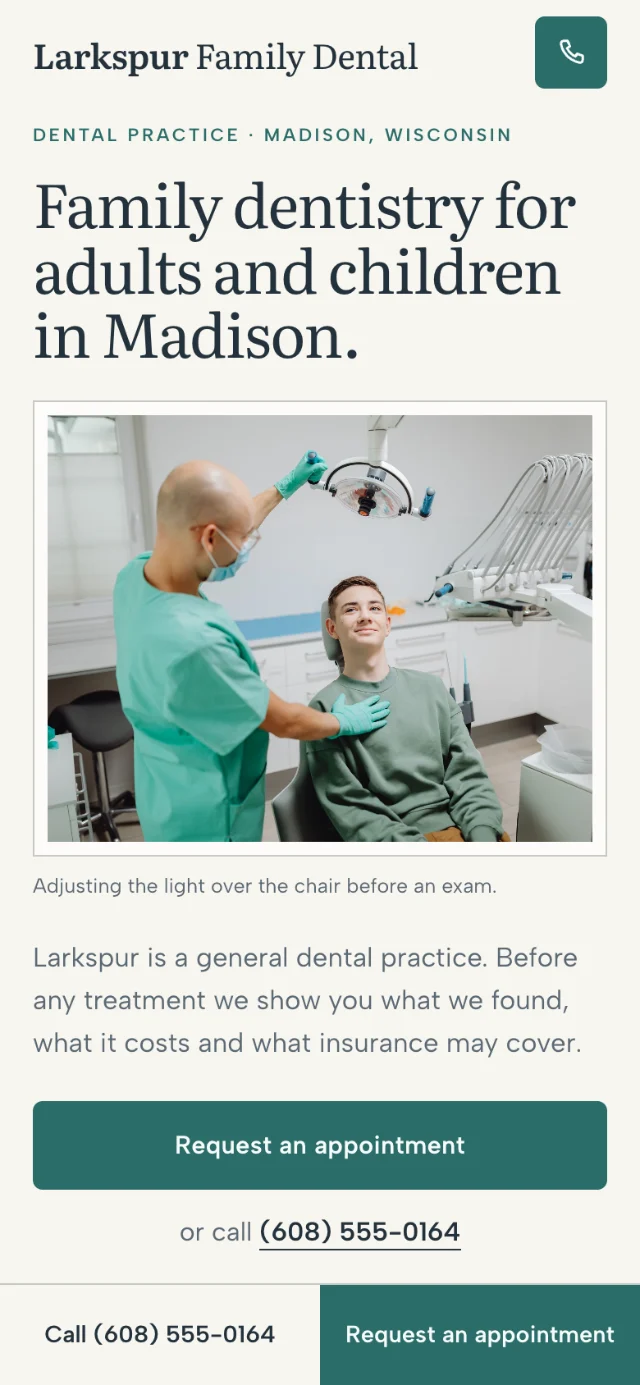
The phone number and the main button sit at the top of every page.
Example concept: Larkspur Family Dental is a made-up dental practice, and the requests and numbers shown are made up too. Your site is built from your own photos, services and reviews, so it comes out stronger. See real builds
- Who is searching
- A new patient
- Just moved, new insurance, a toothache, a child's first visit, an implant quote.
- What wins the tap
- Four checks
- Their plan accepted, rating and review count, office photos, a way to book today.
- Where the money is
- Treatment pages
- One implant or aligner case is worth thousands; cleanings and emergencies bring the volume.
Rasmussen Results is a one-person web design and SEO studio in Tampa, Florida, for single dental practices and small groups across the United States. The website belongs to the practice. The SEO is separate ongoing work, quoted in writing, billed month to month, measured in Search Console and GA4 accounts that belong to the practice. The aim: when someone nearby searches "dentist near me" or "dental implants cost", yours is the practice they see, and the page gets them booked.
Tampa, Florida · Remote builds in any US state
Two kinds of search
Dental SEO has two jobs: the volume searches and the case searches.
Most searches that bring a practice new patients are short and local: "dentist near me", "emergency dentist open now", "dentist that takes Delta Dental". The person typing wants an appointment this week, often today, and Google answers with a map and three practices. These searches fill the hygiene schedule and the new-patient exam slots; the emergencies turn into crowns and root canals. Local SEO for dentists is the work that wins them.
The second group is smaller and worth far more per search: "dental implants cost [town]", "Invisalign [town]", "veneers near me". Nobody here is in pain. They are deciding whether to spend several thousand dollars and with whom, so they read the treatment page and look for a price range and financing. This is dental website SEO, and it is where most practice sites are thinnest. A practice needs both halves, and this page takes them in that order.
Both halves need their own pages, from emergency and new-patient visits to insurance, implants and Invisalign, and the site that holds them is the $2,000 standard build. When the practice needs more, the written quote lands before the mockup, and the price is known before work starts.
Local SEO for dentists
Local SEO for dentists: what decides the map pack, and which parts you can change.
Google says local ranking comes down to relevance, distance and prominence. You cannot move the office, so local SEO for a dental practice is the work on the other two. Relevance is whether your profile and site plainly offer what was searched. Prominence is how established and well reviewed the practice looks.
Relevance starts with the category. "Dentist" is the primary for a general practice; "Pediatric dentist", "Cosmetic dentist", "Emergency dental service" and "Dental implants periodontist" exist too, and the right secondaries decide which searches you are eligible for. The business name stays your real practice name; "Best Dentist in [town]" breaks Google's rules. Google allows one profile for the practice and one per dentist who sees patients, which can leave a solo dentist with two listings competing for one spot.
Prominence is mostly reviews: the count, the pace and the words. A steady flow beats a burst, and reviews that mention the treatment ("implant", "crown", "my daughter's first visit") help Google connect you to those searches. The rest is consistency: the same name, address and phone on Healthgrades, Zocdoc and the insurance directories. Every field is covered in the Google Business Profile checklist; the practice-wide picture is in local SEO for doctors and clinics.
The page map
The pages a dental website needs, and the search each one answers.
Each treatment gets its own page, written from how your office does it and the questions a patient asks before saying yes. A pediatric or cosmetic office reorders this map.
- 01
Emergency dentistry
Searches"Emergency dentist near me", "dentist open now".
Must showSame-day policy, after-hours number, what counts as an emergency, call button first.
- 02
New patients
Searches"Dentist accepting new patients [town]".
Must showWhat the first visit includes, online forms, what to bring, how long it takes.
- 03
Insurance and financing
Searches"Dentist that accepts [plan] [town]", "dental membership plan".
Must showEvery in-network plan by name, financing, your in-house plan for the uninsured.
- 04
Dental implants
Searches"Dental implants cost [town]", "all-on-4 [town]".
Must showA price range, financing, who places and who restores, the timeline.
- 05
Invisalign and clear aligners
Searches"Invisalign [town]", "clear aligners vs braces".
Must showA range, what the consult involves, treatment length, retainers afterward.
- 06
Crowns, root canals, extractions, dentures
Searches"Same day crown [town]", "denture repair near me".
Must showOne page each: in-house or referred out, sedation options, recovery, repairs and relines.
- 07
Veneers and whitening
Searches"Veneers [town]", "teeth whitening near me".
Must showRanges, in-office versus take-home, before-and-after photos only with signed consent.
- 08
Pediatric and family
Searches"Pediatric dentist [town]", "kids dentist near me".
Must showFirst-visit age (the AAPD says by the first birthday), anxious kids, sealants.
- 09
Sedation
Searches"Sedation dentist near me", "dentist for anxious patients".
Must showWhich levels you offer (nitrous, oral, IV) and who administers them.
- 10
Bios and office pages
SearchesYour names, "[name] DDS reviews", "dentist [town]".
Must showCredentials and a real photo per dentist; address, parking, hours, reviews and map per office.
- 11
What dental work costs in [town]
Searches"Dental cleaning cost", "crown cost without insurance".
Must showRanges by procedure, what moves the price, insurance versus membership plan.
- 12
Spanish-language pages, where the area needs them
Searches"Dentista cerca de mi", "dentista en [town]".
Must showReal translations of the top pages and a Spanish-speaking contact path.
The price
What does SEO for dentists cost here?
The website is $2,000 once, with no required monthly fee from me. SEO is separate ongoing work: I quote it in writing after reviewing your site, your Google Business Profile and your market, it runs month to month with no retainer lock-in, and it is measured in Search Console and GA4 accounts in the practice's name.
The short version
Last updated:
- Price
- $2,000one time
- Monthly fee
- None required by me. Hosting usually costs $0 within Google's free allowance; a busy site might pay Google a few dollars a month. Maintenance is optional.
- Timeline
- 2 to 3 weeks from kickoff to a live site
- First step
- A free homepage mockup, so you see the design before you decide anything
See what you own and everything included
- You own
- The domainat your own registrar, renewing to you
- The codea GitHub repository in your name
- The hostinga Firebase project in your Google account, usually $0, with any charge billed by Google to you
- Google Analytics and Search Consoleproperties under your Google account
- Your Google Business Profileyou are the owner, and I am a manager you can remove
- Every form submissiondelivered to the inbox you choose
All of it in your name from day one. I am added as a collaborator for the build and removed by you at handover, and I never hold the only copy of any login.
- What's included
- Treatment pages for implants, aligners, crowns, root canals, veneers, dentures, pediatric and sedation
- Emergency, new-patient, insurance, cost explainer and office pages
- Google Business Profile set up with the right categories, services, hours and booking link
- Search Console and GA4 in the practice's name, with calls and bookings counted as conversions
- Set up on Bing too: Webmaster Tools, which reports how your pages show up in Microsoft Copilot, and Bing Places
Insurance and cost
Insurance and cost pages: the dental SEO content most practices will not publish.
Two of the highest-intent searches in dentistry are the ones most practice websites refuse to answer: which insurance you take, and what things cost. "We accept most major insurance" ranks for nothing, because nobody searches for it. "Dentist that accepts Cigna in [town]" is a real search with a patient behind it, and the page that names the plan wins it.
Cost is harder to publish; the fee schedule is yours and every case is different. But the patient with the implant question will find a number somewhere. A range does the job ("most single-tooth implants here fall between X and Y, and here is what moves it"), with financing beside it. The patient who has read that arrives at the consult most of the way to yes, which is what the office calls case acceptance. None of it needs a clinical claim; each treatment page simply carries the reviewing dentist's name, credentials and the date, which Google's quality guidelines expect on a health page.
Reviews and HIPAA
Reviews, photos and HIPAA: what a dental practice can and cannot do in its marketing.
Asking for reviews is allowed. HIPAA does not stop a practice from asking a patient to leave one, as long as the request says nothing about their care. "Sorry your crown appointment ran late" confirms the person is a patient and names a treatment, and that is a disclosure. HHS has announced HIPAA settlements with dental practices over exactly this. The safe reply is short and generic: thank them, say feedback matters, invite them to call. Never confirm, deny or explain.
Photos follow the same line. The building, the operatories and the team are yours to publish. Any photo that shows a patient, including a before-and-after smile, needs a signed authorization naming the use. And the site makes no clinical claims: no "painless", no "guaranteed", no outcome promises.
The review flow I set up is a same-day text with the direct Google link, no discount attached (Google forbids it), and a reply template that stays inside those lines.
The audit
What I check before quoting dentist SEO services, and how to run the same checks yourself.
Most of the audit behind a quote is public. Run these five on your own practice tonight.
- 01
Search the way a patient does. In a private window, on a phone, search "dentist near me" from the office and from where your patients live. Note who holds the three map spots and whether a directory outranks your own site for your own name.
- 02
Time the implants page on a phone. Paste it into PageSpeed Insights. The mobile score and the largest-contentful-paint figure tell you whether the template is costing you patients.
- 03
Check who owns the domain. Look it up at ICANN's registration lookup. If the registrant is your website vendor, the address patients type belongs to them (the switching guide explains what that means).
- 04
Ask for Search Console access. If a vendor "handles that" and you have never seen it, request owner access today. No engagement should start without it in your name.
- 05
Find your booking widget's address. If online scheduling opens on the scheduler's domain, the booking searches and conversions are recorded under someone else's name. It can usually be embedded in a page on your own site.
The sites I have shipped are live in the portfolio. If the site itself is the problem, the dentist website design page covers the $2,000 build; if the schedule needs patients this month, Google Ads for dentists runs alongside, sold as ads.
How it runs
Three steps, in the order a practice should buy them.
Mockup, build, then SEO. You can stop after any step.
The mockup is free. The site is a one-time $2,000. The SEO is a written quote, billed monthly.
- Free homepage mockup
Send me your practice name and town, and your current site or profile link if you have one. You get a real homepage design for your practice, with the call button, online booking and the insurance line inside the first phone screen. Nothing to sign.
- Build and handoff
Built on the page map above for $2,000, live two to three weeks after kickoff. The Business Profile, Search Console and GA4 end up in the practice's name, with calls, booking clicks and form submissions counted as conversions, and you get a written handoff.
- Ongoing SEO, month to month
If the practice wants the ongoing work, the quote comes in writing after the build and it runs month to month with no term. Profile changes tend to show in the map pack within weeks; new treatment pages usually take 60 to 90 days before Search Console shows clicks, then compound.
Q&A
Dental SEO questions from owner-dentists and office managers.
How does a dental practice get into the Google map pack?
Google ranks the map on relevance, distance and prominence. Distance is fixed, so the work is the other two: the right primary and secondary categories, every treatment listed as a service, and a steady flow of reviews that mention real treatments. Then the website has to match the profile: one name, address and phone everywhere, and pages for the same treatments and towns.
Should every treatment have its own page?
Every treatment you want new patients for, yes. "Dental implants cost [town]" is won by a page about implants with a price range, financing and the steps, not by a Services page listing forty procedures. Start with the cases that matter most to the practice and add the rest over time.
Do insurance pages help SEO?
Yes, and they are among the cheapest wins in dental SEO. People search for a dentist by plan name ("dentist that takes MetLife [town]"), and a page that lists your in-network plans by name is the only kind of page that can rank for those searches. Add your membership plan for patients without insurance; most competitors have no page for it.
Can I reply to Google reviews without breaking HIPAA?
Yes, if the reply never confirms the person is a patient and never mentions their care. Thank them, say feedback matters to the practice, and invite them to call the office. Do not correct the story, explain the billing or mention the appointment; that is the pattern behind the HIPAA settlements.
How is local SEO for dentists different from dental SEO?
Local SEO for dentists is the map side: the Google Business Profile, reviews and listings that get a practice shown for "dentist near me" and "dentist [town]". Dental SEO is the wider job that includes the website: treatment pages, insurance and cost pages, and the credentials behind them, which win research searches like "dental implants cost". The map side usually moves first; the treatment pages bring the high-value cases later.
How long until a dental page ranks?
Profile changes can surface in the map pack inside a few weeks. A new treatment page is usually indexed within days, then typically needs 60 to 90 days to start earning clicks in Search Console. Nobody can honestly promise a position or a date. What you get is the data: Search Console and GA4 in the practice's name from day one.
Accepting Dental Practices
Your practice's homepage, mocked up free, before you decide anything.
Send me your practice's name and town, and your current site or profile link if you have one. You get a real homepage design for your practice, with the call button, booking and insurance line in the first screen. Free, and the design stays yours.
Or call (813) 531-8442 or email chris@rasmussenresults.com.
The website build for dentists →Google Ads for dentists →Pricing →Every industry page →