Google Ads for Roofers

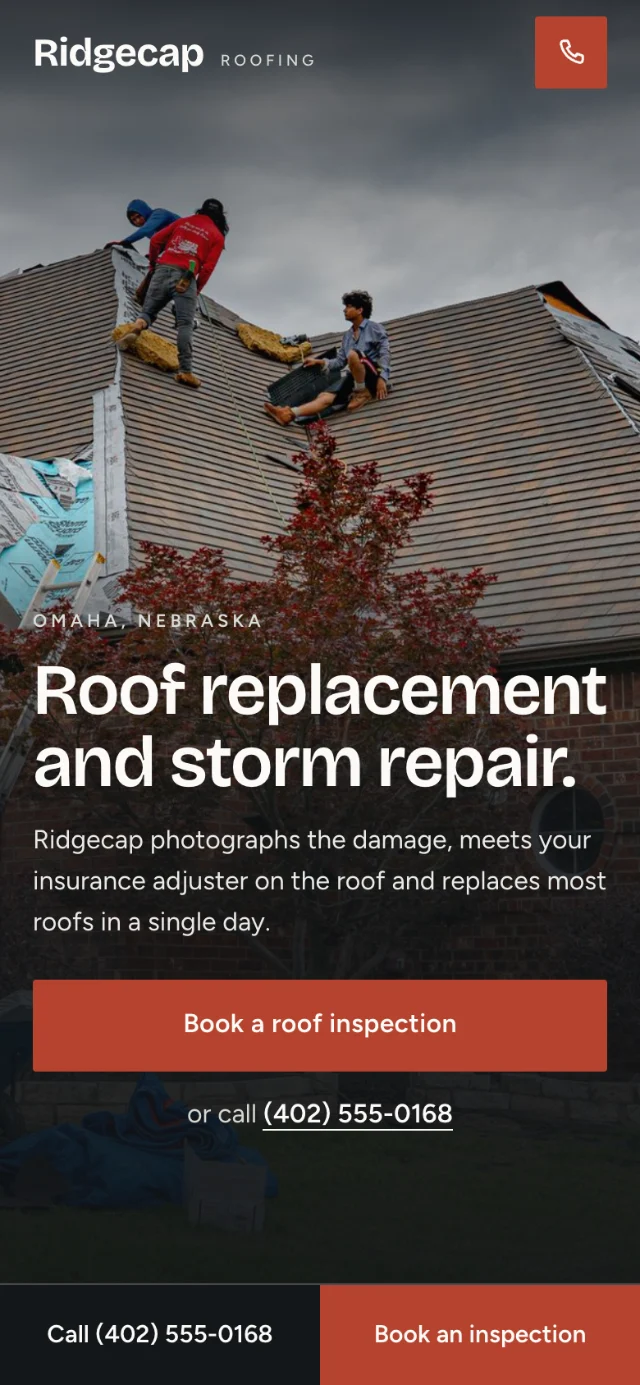
The phone number and the main button sit at the top of every page.
Example concept: Ridgecap Roofing is a made-up roofing company, and the requests and numbers shown are made up too. Your site is built from your own photos, services and reviews, so it comes out stronger. See real builds
- Fee
- Flat, quoted in writing
- Month to month, no term
- Storm weeks
- Budget up, fee unchanged
- Only the hit zip codes
- Measured by
- Signed roofs
- Not clicks or impressions
Rasmussen Results, Tampa, Florida, runs Google Ads for roofing companies anywhere in the US: a storm campaign you can switch on for the zip codes that just got hail, separate repair and replacement campaigns for the quiet months, and every call traced to the inspection and the signed contract. Management is a flat monthly fee quoted in writing, never a cut of your spend, and the ad account is yours.
Tampa, Florida · Remote builds in any US state
Straight answer
Do Google Ads work for roofers?
Yes, when four things are true. The ads bid on the roofing jobs you actually want. They only show in towns your crews will drive to. Each click lands on a page about the job that was searched. And the account counts booked inspections and signed contracts, not clicks.
They waste money when those four are missing, and that is the account most roofers have seen. One campaign called Roofing, broad keywords, every click sent to the homepage, and a monthly report full of impressions. It pays for people learning to patch their own roof, people looking for a roofing job, and people pricing shingles at the supply house.
If you have bought shared leads before, you know the other version: the same homeowner sold to four companies, and a race to call first. Pay per click for roofers is different because the call comes to you and nobody else. You are paying to be in front of the person, not for a name on a list.
Roofing demand is also lumpy. A hailstorm can fill a month of inspections in a weekend, then the phone goes quiet. An account that spends the same every day is wrong both ways.
Storm response
Google Ads for storm damage restoration: on for the hit zip codes, off when it is quiet.
The storm campaign is built ahead of time and left paused. Its ads and landing page talk about hail and wind damage, inspections, and how you handle the insurance side, so nothing gets written in a hurry.
When a storm crosses your area, we look at where it actually hit. Hail reports and your own crews on the road tell you which neighborhoods took it. Those zip codes go into the campaign's location list, and nothing else does. A storm that clipped three zip codes on the north side does not need ads across the whole metro.
Then the budget goes up for about a week, and the ad schedule matches the hours somebody answers your phone. If your office closes at six, the storm ads stop at six. A paid call that hits voicemail at nine at night is a homeowner calling the next roofer on the page.
When inspection calls slow down, it goes back to paused. Because the fee is flat, a bigger storm budget is your call alone. I earn nothing extra when you spend more.
A word on storm chasers. After a big event, crews from other states often bid on the same searches, and clicks usually get more expensive for a few weeks. You do not need to outbid them. Stay inside the hit zip codes, say plainly that you are local and licensed, and stop before you pay peak prices for stragglers.
Campaigns
Replacement, repair and insurance-claim searches each get their own campaign.
A homeowner with a leak over the kitchen and a homeowner planning a metal roof are not shopping the same way. Splitting the account by job lets each one see the right ad, land on the right page, and get its own budget.
Replacement
The biggest ticket and the longest decision. The homeowner compares two or three roofers, reads, and books an estimate. Bids can run higher here because one signed reroof covers a lot of clicks.
roof replacement, new roof cost, reroof, metal roof installer, architectural shingles
Repair and leaks
Smaller jobs, faster calls. Someone has a stain spreading on the bedroom ceiling and wants a person on the roof this week. The ad leads with the phone number.
roof leak repair, missing shingles, flashing repair, roof repair near me
Storm and insurance claim
Runs only when weather gives it a reason. The searcher has hail dents on the gutters or a tarp on the ridge and a claim number. The page explains your inspection and how you work with the adjuster.
hail damage roof, storm damage roof inspection, wind damage roof, roof insurance claim
The split is what makes PPC for a roofing company measurable. If replacement signs contracts at a cost you are happy with and repair mostly brings small patch jobs, budget shifts toward replacement, and you can see the reason in your own account.
Block list
Keeping roof repair DIY, job-seeker and supply-house clicks out.
Google will happily show a roofing ad to anyone whose search contains the word roof. Negative keywords are the list of searches you refuse to pay for. They go in before launch and grow every week from the real search terms report.
Do it yourself
Handy homeowners researching a weekend patch. They want a video, not an estimate.
how to, diy, patch kit, roof sealant, youtube, tutorial
Job seekers
People looking for roofing work, not a roofer. Hiring season brings a flood of these.
jobs, hiring, salary, apprentice, laborer, indeed, near me hiring
Supply and price shoppers
Contractors and homeowners pricing material at the supply house, plus searches for other trades.
shingles price, bundle, home depot, lowes, wholesale, roofing nails, roofing supply near me
There are quieter leaks too: searches for car roofs, RV roofs, roof racks and roofing for sheds, plus clicks from outside your service area from people who searched with a town name you do not cover. Each is small. Over a season they add up.
Two ad types
Local Services Ads and search ads: what each one does for a roofer.
Local Services Ads sit at the top of many roofing searches with a badge and a phone button. Roofers used to know that badge as Google Guaranteed. Since October 2025 it is called Google Verified, and the old money-back guarantee is gone, but the checks behind it are the same idea: your license, your insurance and a background check. Google decides who passes.
Local Services Ads
- You pay for
- A lead: a call or message that Google counts as a real inquiry. Leads that are clearly not jobs can be disputed.
- Trust mark
- The Google Verified badge, after Google checks your license, insurance and background. Approval is up to Google.
- Your control
- Low. You pick job types, service area and a weekly budget. Google writes the ad and decides who shows.
- Best for
- Plain roofer and roof repair searches from homeowners who want a vetted company and will call right away.
Search ads
- You pay for
- A click. Whether that click calls or not is the account's job, which is why tracking comes first.
- Trust mark
- None from Google. Trust comes from the ad text, your reviews and the page the click lands on.
- Your control
- High. You choose the searches, the wording, the zip codes, the hours and the landing page.
- Best for
- Specific jobs like metal roof installs or hail claims, and storm weeks when you need to turn a dial fast.
For most roofing companies the answer is both. Local Services Ads catch the homeowner who wants a vetted company and taps call. Search ads cover the specific jobs and the storm weeks. Reviews on your Google Business Profile help both, which is where SEO for roofers and paid search start to work together.
Tracking
From the call to the inspection to the signed contract.
Most roofing leads start as a phone call, so calls are tracked before any money is spent. Calls from the ad itself, calls from the landing page, and form fills are each recorded with the campaign and search that produced them. Short calls, hang-ups and supplier calls are kept out of the count.
A call is not a roof, though. The step most accounts skip is closing the loop. When an inspection is booked and later a contract is signed, that gets matched back to the original call, from your CRM if you use one, or from a simple shared sheet your office fills in. Those results go back into Google Ads.
You see which searches bring signed reroofs, and Google's bidding learns from contracts instead of rings. Replacement deals can take weeks to close, so this data builds up over a season, not overnight.
What a monthly report should show
If your current report does not have these six lines, ask why.
- Spend, by campaign
Replacement, repair and storm, each on its own line, so a storm week does not hide what the steady campaigns did.
- Calls that lasted long enough to matter
Answered calls over a set length, separated from hang-ups, wrong numbers and supplier calls. Missed calls listed too, with times, because those are booked jobs walking away.
- Inspections booked
From your calendar or CRM, matched back to the campaign and search that started them.
- Contracts signed and their value
The number that decides whether the ads earn their keep. It lags by weeks on replacements, so the report shows the trailing months too.
- Searches added to the block list
What got excluded this month and why, so you can see the waste being cut instead of taking my word for it.
- What changes next month
Two or three plain decisions: shift budget, pause a town, test a new ad, get ready for the season.
Cost
How much do Google Ads cost for roofers?
The closest published figure is $8.33 a click and $90.92 a lead, the 2026 average for home services in LocaliQ's benchmark report. The report has no row for roofing alone, and a lead there is someone getting in touch, not a signed contract.
At that average, $1,000 of ad spend comes to about 11 leads ($1,000 divided by $90.92). The number that matters to a roofer is the cost of a signed job, which is why the account follows a lead through the inspection to the contract.
| Average | Home & Home Improvement | All industries |
|---|---|---|
| Cost per click | $8.33 | $5.42 |
| Click-through rate | 6.47% | 6.64% |
| Clicks that become a lead | 8.05% | 8.18% |
| Cost per lead | $90.92 | $66.69 |
Landing pages
A page for each service and each town you want to win.
The ad gets the click. The page gets the call. Somebody who searched for hail damage inspection in a specific town should land on a page that says hail damage, names that town, shows the phone number at the top, and explains what happens at the inspection. Add your license, insurance and real reviews, because homeowners are wary after a storm.
A replacement click needs something different: the roofing systems you install, photos of finished roofs, warranty details, and a short estimate form next to the phone number.
If your current site can carry pages like these, the ads point at it. If it cannot, a roofing website with service and town pages is a separate build, $2,000 one time, owned by you, with no required monthly fee. The pricing page lists what is in it. Ad management is quoted on its own.
The year
Roofing Google Ads management across a full year.
Your season depends on where you work: spring hail in the plains, hurricane season on the Gulf, ice damage in the north. The plan starts from your calendar, not a template.
Before your busy season, the storm campaign and its pages get checked and the block list gets a cleanup. During it, budget follows the weather week to week. In slow months, replacement keeps running lower, since people still plan new roofs in winter.
Google Ads management for roofers starts here with a free audit. If you already run ads, I go through the account and the search terms and show you where money went. If you do not, I sketch the campaigns for your towns and jobs. Then I quote a flat monthly management fee in writing. It is never a percentage of your spend, and it runs month to month with no term.
The Google Ads account, the conversion tracking and all the data are set up in your name. You pay Google directly for clicks and leads on your own card. If you stop working with me, everything stays with you, history included. The Google Ads management page covers how I run accounts for every trade, and the industries page lists the others.
Q&A
Questions roofing owners ask about paid search.
Do Google Ads work for roofers?
They work when the account bids on the jobs you want, stays inside the towns you serve, sends clicks to a page that matches the search, and counts inspections and signed contracts instead of clicks. They waste money when one broad campaign pays for DIY, job-seeker and supply searches, sends everything to a homepage, and nobody knows which calls came from ads.
How do I turn ad spend up after a hailstorm?
Keep a storm campaign built and paused, with its ads, its landing page and its zip code list ready. When hail or high wind hits your area, the hit zip codes go in, the campaign turns on with a budget set for about a week, and the schedule follows the hours your office answers. When inspection calls slow down, the campaign goes back to paused. Raising your budget does not raise my fee.
How do storm chasers affect what I pay per click?
After a big storm, out-of-town crews often bid on the same searches, so clicks usually cost more for a few weeks. You cannot outspend everyone, so the answer is focus: bid on the hit zip codes, not the whole metro, lead with being local and licensed, and keep the campaign on only while calls are coming in.
What is the difference between Local Services Ads and Google search ads for a roofer?
Local Services Ads charge per lead and show the Google Verified badge once Google has checked your license, insurance and background. Google controls the ad and who sees it. Search ads charge per click and let you choose the searches, the wording, the area and the landing page. Many roofing companies run both: Local Services Ads for plain roofer searches and search ads for replacement, metal and storm work.
Is the Google Guaranteed badge still a thing for roofers?
Not under that name. In October 2025 Google folded Google Guaranteed and Google Screened into one Google Verified badge on Local Services Ads, and the old money-back guarantee went away with it. Roofers still go through license, insurance and background checks to get it, and Google decides who passes.
How do you know which ads turned into signed roofs?
Calls are tracked to the campaign and search that produced them, and form fills are tracked the same way. Then the jobs you book and sign, from your CRM or a simple shared sheet, are matched back to those calls and imported into Google Ads. That way the account learns which searches lead to contracts, and your report shows signed work by campaign.
What does Google Ads management cost for a roofing company?
Two separate bills. Google charges you directly for clicks or leads, on your card, at a budget you set. My management is a flat monthly fee, quoted in writing after I look at your market and your current account, never a percentage of what you spend, and month to month with no contract term. The account and its data are created in your name and stay yours.
Do I need new landing pages for roofing ads?
Usually yes. A click for hail damage should land on a page about hail damage and your inspection, with the phone number at the top, and a replacement click should land on a replacement page. If your site cannot do that, the pages can be part of a website build, which is a separate $2,000 one-time project you own outright.
Accepting Roofers
Get your free Google Ads audit.
Tell me your company name and town, with a note on the roofing jobs you want more of. If you run ads now, I will show you which searches you paid for last month and which ones never had a chance of booking an inspection. If not, I will sketch the campaigns for your area. Either way you get a written quote.