SEO for Roofers

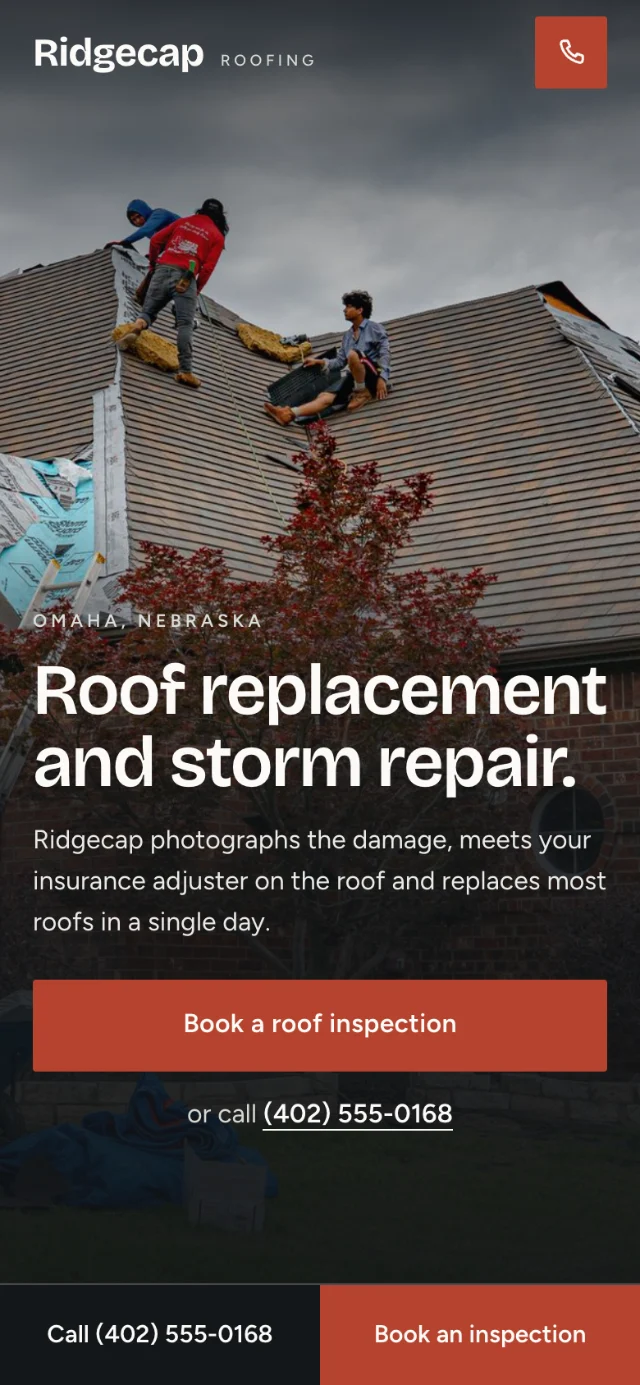
Free. No call. Usually ready in 48 hours.
The phone number and the main button sit at the top of every page.
Example concept: Ridgecap Roofing is a made-up roofing company, and the requests and numbers shown are made up too. Your site is built from your own photos, services and reviews, so it comes out stronger. See real builds
- Storm Week
- Map pack + inspection page
- "hail damage roof," "roof inspection near me"
- Planning Months
- Organic pages
- "roof replacement cost," "metal roof vs shingles"
- Measured In
- Your Search Console
- And your GA4, from day one
Rasmussen Results, in Tampa, Florida, does SEO for roofing companies across the United States: a page for each moment a homeowner searches, from a hailstorm to a planned replacement, and a Google Business Profile full of real roofs. The site launches 2 to 3 weeks after kickoff and stays yours; SEO after launch is quoted in writing, month to month.
Tampa, Florida · Remote builds in any US state
The roofing year
Storm weeks, planning months, and the calls in between.
Roofing search does not move in a steady line. After hail or a hard wind, a whole neighborhood looks up at its roofs on the same day, and the searches are short and urgent: "roof inspection near me," "hail damage roof," "roof leaking after storm," "emergency roof tarp." Those are decided in the map pack and on whatever storm or inspection page Google already knows about. A page written that week may not be indexed until the rush is over.
Between storms, the work is planned. A homeowner with an aging roof starts reading long before signing anything: what a replacement costs, metal against architectural shingle, whether the old decking has to come off. That reading happens on organic pages over several visits, and the roofer whose pages answered those questions is in a good position to make the short list.
Then there are the calls that do not wait for weather: a leak at the chimney, a home sale that needs a roof inspection, a renewal letter from an insurer asking about the roof, a flat roof that holds water after every rain. Local SEO for roofing companies means having all three kinds of page live before you need them, which is why this build starts with storm and inspection pages and works outward.
Across the 17 local trades in our study of trades without websites, 30.8% of the listings we checked have no website at all, so a roofer with real pages already stands apart from a large share of the field.
Storm, inspection, repair, replacement and roof system pages, plus a page for each town, make up the standard build at $2,000. Bigger roofing sites get their price in writing first and the mockup after, so you know the cost before work starts.
The field
We checked 1,461 roofing listings. 22.7% have no website.
We checked 1,461 public business listings for roofing contractors in 30 towns across 30 states, recording whether each one links to a website and what kind. No business is named, and the counts are a field survey, not a census.
22.7% of those roofing listings have no website, and 0.7% point to a Facebook page instead. A Facebook page has no storm page, no metal roof page, and nothing Google can rank for "roof replacement cost" in your town. The method and the tables by trade and state are in the full study.
Repair or replace
Repair and replacement are two searches, so they get two pages.
Someone with a stain spreading across the ceiling types "roof leak repair near me" on a phone and wants a roofer who can come out soon. Someone whose roof is near the end of its life types "roof replacement cost" plus their town and reads for weeks. Put both on one Services page and neither finds what they came for.
So they are separate pages. The repair page opens with tap-to-call, then lists the fixes you do (leaks, flashing, pipe boots, missing or lifted shingles, soft decking, skylight leaks) and says whether you tarp after hours. The replacement page explains what the job includes, from tear-off and decking to underlayment, drip edge, ventilation, the permit, and cleanup, and says how you handle rotted decking you find once the old roof is off.
Both pages carry a short, honest section on when a repair is enough, and they link to each other. "Repair or replace roof" and "how do I know if I need a new roof" are searches of their own, and a roofer who answers them straight gives the reader a reason to call for either job.
Insurance questions
The insurance questions homeowners search, answered within the rules.
After a storm, many roofing searches are really insurance questions: "does homeowners insurance cover hail damage," "how to file a roof insurance claim," "what does an adjuster look for on a roof." A roofer's site can answer the process part of those questions and earn the visit. It cannot promise the outcome.
So the insurance page sticks to what your company does: what your inspection checks, that you photograph what you find, that you put the repair in a written, itemized estimate, and whether the inspection costs anything. Questions about coverage, the deductible, and policy terms go to the homeowner's own insurer, and the page says so plainly.
That line is not only good practice. In Florida, section 489.147 of the state statutes bars a contractor from offering a homeowner a gift, a deductible waiver, or anything of value in exchange for a roof inspection or a claim, and from interpreting policy provisions, advising on coverage, or adjusting a claim without a public adjuster license. The same section requires a deductible and insurance fraud notice on roofing ads that encourage a claim. If you roof outside Florida, your state may have rules of its own, and in every state the wording is yours to approve before anything goes live.
Roof systems
One page per roof system you install: shingle, metal, flat, tile.
Material searches are some of the most specific in the trade, and they come from people already planning a job. Someone typing "standing seam metal roof cost" or "architectural shingles vs 3-tab" knows what they want to compare. A site that mentions metal in one line of a Services page gives Google nothing to show for that search.
The shingle page names the product lines you install, explains the warranty tiers, and mentions a manufacturer certification only if you hold one. The metal page covers standing seam against exposed fastener, rain noise, and up-front cost against lifespan. The flat roof page covers TPO, EPDM, modified bitumen, and coatings, for building owners and for the homeowner with a low-slope porch. Tile gets a page where you install tile.
A system you do not install gets no page, because it brings calls you have to decline and blurs what Google thinks the company does. The photos on each page come from your own jobs in that material, so the metal page shows your metal roofs, not a manufacturer brochure.
Inspections
Inspection pages: where a storm call, a home sale, and a second opinion begin.
Before a roof gets repaired or replaced, somebody climbs up and looks. That inspection is what the homeowner is really searching for in several different situations. A "free roof inspection" line in the footer answers none of them.
The storm inspection page is for the days after hail or wind: what you check (shingles, flashing, vents, gutters, the soft metals that show hail dents), how long it takes, and whether you send photos. The home sale page is for buyers, sellers, and agents who want a written condition report before closing. The second opinion page is for someone holding another roofer's quote who wants a fresh set of eyes.
Each page says what the inspection includes, what it costs or that it is free if that is true, and roughly how soon you can come out. If you fly a drone or send a photo report, the page shows a sample from a real job. The storm, repair, and replacement pages all link here.
Towns + photos + reviews
Service-area pages, and a Business Profile full of real roofs.
In the map pack, a homeowner compares three roofers on one screen: the name, the stars, the review count, and the photos. The primary category on your Google Business Profile should be Roofing contractor. Secondaries such as Siding contractor or Skylight contractor belong there only if you do that work, and the listed hours match when the phone is actually answered.
Photos are the part of a roofing profile a homeowner can judge without calling anyone. Job photos do the work: the old roof before tear-off, rotted decking you replaced, new flashing at a chimney, the finished roof from the street. The field-by-field version is in the Google Business Profile checklist.
On the site, each town where you have real jobs gets its own page: the neighborhoods you work in, the roof types common there, the permit office, and photos from roofs in that town. Near-identical city pages with only the name changed are what Google calls doorway pages, so they are left out.
Reviews that name the work, the material, and the town tell the next reader more than "great job." Google's review policy says not to ask only the customers you expect to be happy, so the request goes to every customer after every finished roof: a short link that opens the review form, sent by text the day the roof is done. Each review gets a reply, good or bad.
The price
What does SEO for a roofing company cost here?
The website that carries the storm, repair, replacement, roof system and town pages is $2,000, paid once, and you own it. SEO after launch is optional, quoted in writing, and runs month to month, measured in your own Search Console and GA4. A free homepage mockup comes before any of it.
The short version
Last updated:
- Price
- $2,000one time
- Monthly fee
- None required by me. Hosting usually costs $0 within Google's free allowance; a busy site might pay Google a few dollars a month. Maintenance is optional.
- Timeline
- 2 to 3 weeks from kickoff to a live site
- First step
- A free homepage mockup, so you see the design before you decide anything
See what you own and everything included
- You own
- The domainat your own registrar, renewing to you
- The codea GitHub repository in your name
- The hostinga Firebase project in your Google account, usually $0, with any charge billed by Google to you
- Google Analytics and Search Consoleproperties under your Google account
- Your Google Business Profileyou are the owner, and I am a manager you can remove
- Every form submissiondelivered to the inbox you choose
All of it in your name from day one. I am added as a collaborator for the build and removed by you at handover, and I never hold the only copy of any login.
- What's included
- Storm damage and inspection pages, live before the next storm
- Separate roof repair and roof replacement pages
- A page for each roof system you install
- A plain insurance process page you approve
- Town pages for the places you have real jobs
- Business Profile category, service areas and job photos
- A review request link for every finished roof
- RoofingContractor schema, GA4 and Search Console in your name
- Set up on Bing too: Webmaster Tools, which reports how your pages show up in Microsoft Copilot, and Bing Places
How it works
How it works: mockup first, then pages in storm order.
The mockup is free, and it is yours either way.
Tell me your company name and town. The homepage comes back before you decide anything.
- Free homepage mockup
Send me your company name and town. I design a real homepage with the storm and inspection calls where a homeowner on a phone finds them first. Nothing to sign, and the mockup is yours either way.
- Audit the starting point
Which pages Google has indexed, the primary category on your Business Profile, how many profile photos show real roofs, your review count, and any name or phone mismatch on Yelp, the BBB, Angi and Apple Maps. You get a short list, most important first.
- Pages in storm order
Storm damage and inspection pages first, because they have to be indexed before the weather arrives. Then repair and replacement, one page per roof system, the insurance page, and the town pages. Each gets schema, tap-to-call, a quote form and a text button for photos.
- Launch, then month to month
The site goes live with GA4 and Search Console in your name and phone taps counted. If you keep me on for SEO after launch, it is quoted in writing and runs month to month, and every result is something you can check in your own accounts.
Nobody can promise when a page ranks. What usually moves a roofing site is plain: the pages get indexed, the Business Profile has the right category and real job photos, reviews keep arriving, and there is a page for each service and each town you work. That is the case for building before storm season rather than during it. You watch all of it in your own Search Console from day one. More in how long SEO takes.
This fits a roofing company with a home base and a defined set of towns. It is not for a crew that follows storms from state to state, because town pages and reviews pay off where you will still be roofing next year. For the design side of the same build, see roofer website design. If you need calls this week, Google Ads for roofers can run while the pages build. Real builds you can check are on the portfolio, prices are on pricing, ten real roofing sites are compared on best roofing websites, the same SEO for other trades is on plumber SEO, HVAC SEO and electrician SEO, and other trades are on the industries page.
Q&A
Roofing SEO questions, answered plainly.
How much does SEO for a roofing company cost here?
The website with the storm, repair, replacement, roof system and town pages is $2,000 once, and you own it. Ongoing SEO after launch is optional, quoted in writing, and month to month. Google Ads management is quoted on its own if you want it. A free homepage mockup comes first.
Should I build a new page every time a storm hits a different town?
No. A "hail damage [town]" page for every storm, the same text with the town swapped, is what Google's spam policies call a doorway page. Build one strong storm damage page and add a short dated note with photos when a storm moves through. Town pages are for the towns you work in all year, and they link to it.
Can my roofing website talk about insurance claims?
Yes, as information about your part of the process: what your inspection checks, how you photograph damage, and what goes into your written estimate. It should not promise a free roof or interpret anyone's policy. In Florida, section 489.147 of the state statutes sets rules on this, so check your own state, and you approve the wording before it goes live.
Do I need separate pages for shingle, metal, and flat roofs?
If you install all three, yes. Someone comparing standing seam to architectural shingles and a property manager pricing a TPO replacement type different words and want different answers. If you do not install a system, it gets no page, because it only brings calls you have to turn down.
How long until my roofing pages rank?
Nobody can honestly promise a date. What usually moves a roofing site is getting the pages indexed, a Business Profile with the right category and real job photos, a steady flow of reviews, and a page for each service and town. You watch it in your own Search Console from the first day.
What photos should go on a roofer's Google Business Profile?
Your own jobs, taken on site: the old roof before tear-off, rotted decking you replaced, new flashing at a chimney, the finished roof from the street, and a truck with your name on it. Add them as jobs finish rather than all at once. Leave out house numbers, faces, or anything a customer has not agreed to show.
How do I show up in towns where I roof but do not have an office?
Set the profile up as a service-area business with your address hidden and your towns listed. Google allows up to twenty service areas and asks that they stay within about two hours of driving. To reach further, each town where you have real jobs gets its own page, backed by reviews from customers there.
Does this work for a commercial roofing company?
Yes, with different pages. Commercial buyers search "TPO roof replacement," "flat roof coating" and "roof maintenance plan," and they care about keeping a building open during the work. If you do both, residential and commercial get separate sections, and the quote form asks for building size and roof type.
Accepting Roofing Companies
See your roofing homepage before the next storm season.
Send me your company name and town. I design a real homepage with the storm and inspection calls up front. It is free, and you keep it either way.
Or call (813) 531-8442 or email chris@rasmussenresults.com.